What Is Natural Selection? — Definition & Importance

Interactive · 1 question

What Is Natural Selection?

Natural selection occurs when organisms that are better suited for their environments survive and reproduce, while those who are not well suited do not. It is a mechanism described by the theory of evolution. The concept was first outlined by Charles Darwin as part of his evolutionary theory in his book On the Origin of Species. (Here is some more on Darwin, if you're interested.)

Evolution is driven by this difference in survival between more fit and less fit organisms. Small genetic variations and mutations can help, hurt, or not impact an organism. If it helps, the organism is more likely to reproduce and pass on its genes. If the change is unhelpful or limiting, the organism will have a harder time reproducing or even surviving, so its genes are less likely to be passed on. Over time, this can entirely change the gene pool.

Stabilizing, Directional, and Disruptive Selection

Natural selection typically occurs in one of three ways: stabilizing, directional, or disruptive selection. We typically represent how these influence a population with a graph of the trait distribution before and after selection.

If you look at the diagram below, you'll see that before selection, the lemurs have five colors in varying amounts. There are four brown, three light gray, three dark gray, one white, and one black lemur.

Allele frequencies respond to stabilizing, disruptive, and directional natural selection.

Image source: By Keith Chan CC BY-SA 4.0, via Wikimedia Commons

Stabilizing selection occurs when selective pressures select against the extreme versions of a trait. After stabilizing selection, there are five brown, one light gray, and one dark gray lemur. The extreme versions of the fur color trait, white and black, are selected against and disappear from the gene pool.

Directional selection occurs when selective pressures select against one extreme version of a trait. After directional selection, there are four dark gray, two brown, and two black lemurs. The extreme version of the fur color trait, white, is selected against and disappears from the gene pool. It can go the opposite way too, where the black fur coloring is selected against.

Disruptive selection occurs when selective pressures select against the middle of the trait distribution. After disruptive selection in the lemur population, there are three white, one light gray, one dark gray, and three black lemurs. The middle of the fur color trait distribution, brown, is selected against and disappears from the gene pool.

What is the driving force for evolution?

Choose one answer

Illustrated · 1 min

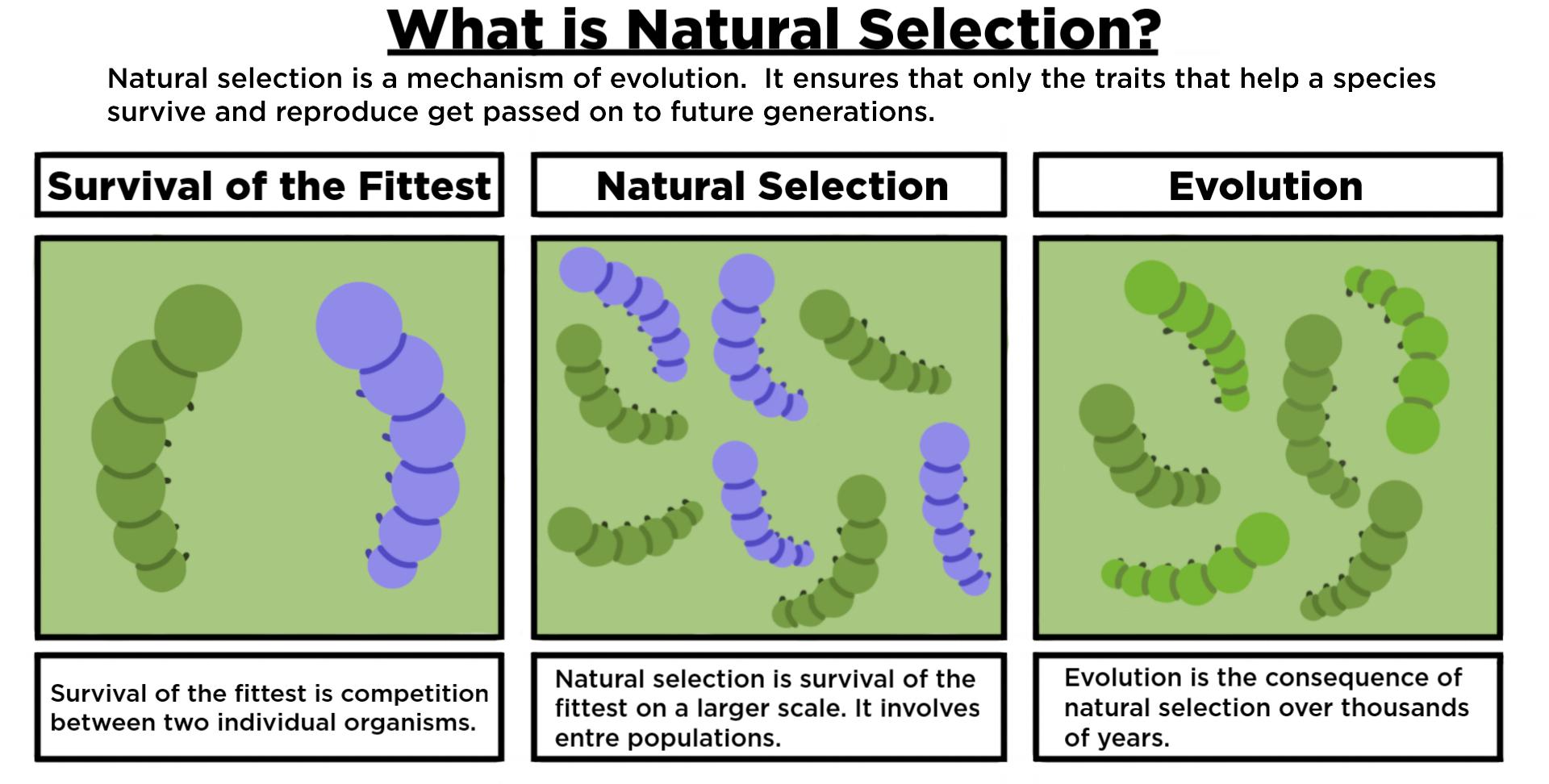
What is natural selection? Natural selection is a mechanism of evolution. It ensures that only the traits that help a species survive and reproduce get passed on to future generations. Survival of the fittest is competition between two individual organisms. Natural selection is survival of the fittest on a larger scale. It involves entire populations. Evolution is the consequence of natural selection over thousands of years.

Image source: By Gabi Slizewska

People often use the terms "survival of the fittest", "natural selection", and "evolution" interchangeably. They are all related, but they are not the same. The picture above should help clear that up.

The main differences are in:

  • Who's affected: individual organisms vs entire populations
  • How long it takes: a single generation vs thousands of years

Illustrated · 2 min

Four Main Ideas

Generally, there are four postulates, or ideas, behind the Theory of Natural Selection.

  1. Individuals do not look alike. What this means is that among individuals of the same species there is variation in what traits each possesses. This can be observed outwardly as you see people on the street with different eye colors. However, there are also internal differences that can not be as easily observed. This includes instinctual behaviors on top of physical characteristics.
  2. Some traits are heritable. We know from basic genetics that parents pass on some of their traits to their offspring. This can be seen as you having your mother's eyes or your father's personality. Not all traits are heritable; your parent's love of spinach may not have passed on to you.
  3. Resources are finite, and there is a struggle for existence. In the wild, it's a fact that there are not enough resources, such as food, water, and shelter, to support an infinite amount of animals. That means environments have carrying capacities; only a certain number of individuals can survive there. Think of a small pond with about 50 fish. The fish can coexist with one another and maintain a healthy population. However, if we were to multiply the amount of fish by ten, 500 fish would mean that there is more competition for food and therefore not all the fish will be able to survive.
  4. Some variants will survive better than others. This goes back to the first point that individuals among a single species may look different and have different traits. Therefore, individuals with advantageous traits will be able to survive better and pass the traits that led to their survival on to their offspring.
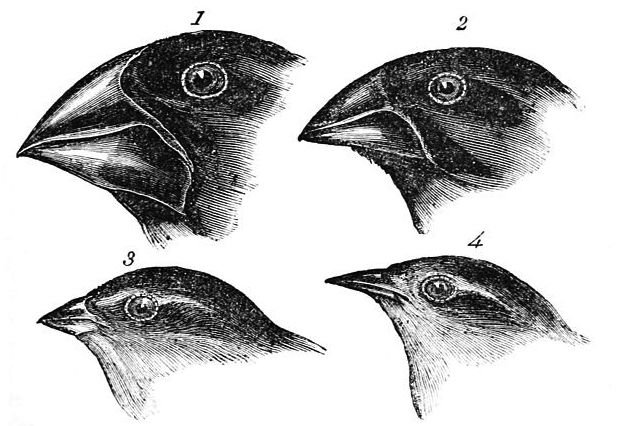
Four finch adaptations

Assuming these finches are all part of the same species, when only large and hard seeds remain, those with beaks like (1) and (2) are more likely to survive and pass on their traits than (3) and (4) are.

Image source: By John Gould (14.Sep.1804 - 3.Feb.1881) [Public domain], via Wikimedia Commons

For example, think about an island inhabited by a species of bird. These birds all possess beaks of different shapes and sizes. But suppose a disease were to wipe out all the trees that produced the small and soft seeds, leaving only seeds which are large and hard. The birds with small and thin beaks would not be able to eat the large and hard seeds as well as birds of the same species with large and thick beaks. Therefore, the birds with large beaks will tend to have a higher success in reproducing and passing on their big beak to their offspring.

Video

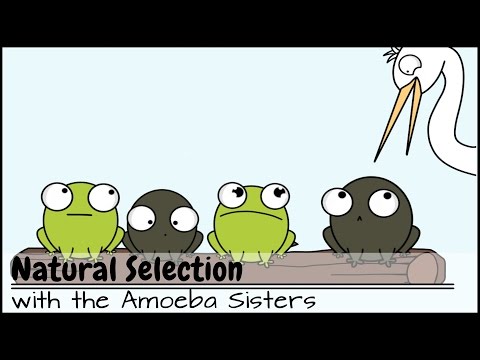
(Video) Natural Selection

by The Amoeba Sisters

In this video, Amoeba Sisters explains what natural selection is, what it does, and how it happens.

Illustrated · 1 min

Summary of Natural Selection

In the wild, organisms have to deal with many selective pressures. These pressures can be water availability, food availability, space, or predators. Selective pressures are any external factor that can cause an organism to die.

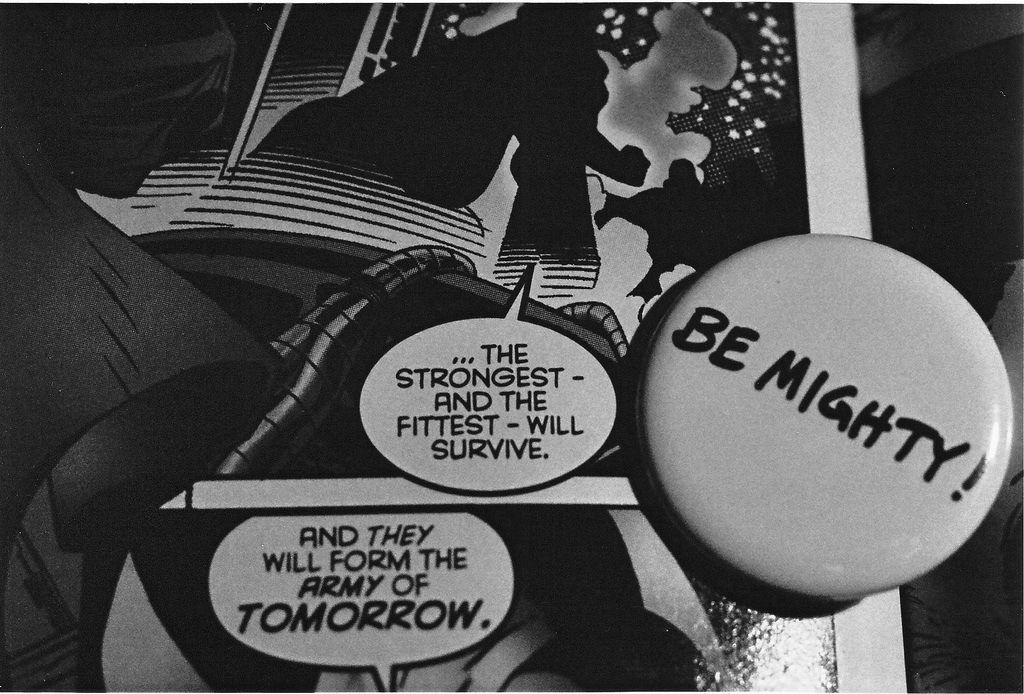
A comic showing that "the strongest and fittest will survive".

Image source: By jintae kim CC BY-ND 2.0, via flickr.com

As a group of organisms lives and breeds in an environment, they will accumulate a bunch of different mutations. Some of these kill the individual, like cancer. Others are hardly noticeable, and some are a change in habit. In the presence of selective pressures, these mutations in some way or another either help or impede the survival of an organism.

Natural selection is simply the tendency for organisms with beneficial mutations or behavioral adaptations to be more likely to survive and reproduce. This will lead to the survival of beneficial mutations and the death of negative ones, resulting in better adaptation to an environment and, with enough time, speciation.

What Is Artificial Selection?

Today, you are likely to come across the term "artificial selection". This happens when humans decide which traits of a species they think are favorable. They then alter the evolution of organisms for their own benefit. For example, when humans choose which crops to plant and which animals to breed, they are enacting artificial selection.

Type a concept, like “slope” or “photosynthesis”.

↑ ↓ to choose · Enter to openSearch explanations and problems