
Illustrated · 1 min
By Sylvia Freeman

+1 contributors
Contributors


Image source: By Sylvia Freeman

Image source: By Sylvia Freeman
Illustrated · 1 min
Image source: By Sylvia Freeman
Image source: By Sylvia Freeman
Interactive · 1 question
You might be wondering "What on Earth is pH?" Hopefully this will help it make sense.
The p in pH actually doesn't have a set definition. Some scientists argue it means potential while others say it means power. For our purposes, power makes more sense. The H definitely means hydrogen, so you can think of pH as meaning ''Power of Hydrogen".

Image source: By Manuel Almagro Rivas CC BY-SA 4.0, via Wikimedia Commons
The pH is based on how water dissociates, or comes apart, in a solution.
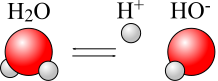
Image source: By Cdang [Public domain], via Wikimedia Commons
The water molecule separates into a hydrogen ion () and a hydroxide ion (). The hydrogen ion is acidic and the hydroxide ion is basic. So, pH is a measure of how many hydrogen ions or hydroxide ions are in a solution. The more hydrogen ions, the more acidic it is. The more hydroxide ions, the more basic it is.
The amount of acidic or basic substance in a solution is the concentration. A large concentration of ions tells us that the pH is acidic. Similarly, a large concentration of ions means that the pH is basic. To maintain homeostasis and a stable pH, the body regulates the presence and concentration of these ions in extracellular fluid.

Image source: By Deena Hauze
The figure above shows two solutions that have different pH values. Which of the statements about these solutions is false?
The pH is set on a logarithmic scale. In the simplest terms possible, a logarithmic scale is in negative base 10. This means that if we start at one on a scale of one to ten, two will be ten times smaller than one. The number three on a log scale will be 100 times smaller than one, and four will be 1,000 times smaller than one. See the pattern?
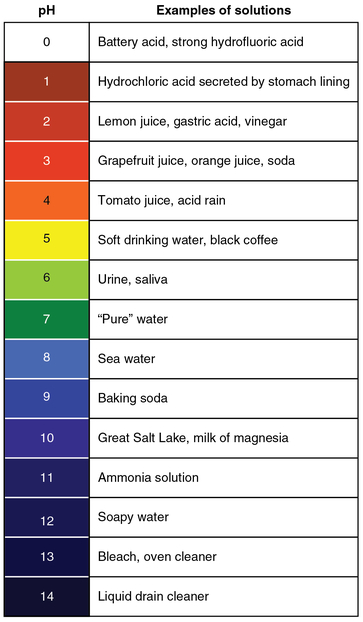
Image source: By OpenStax College CC BY 3.0, via Wikimedia Commons
In real life, however, pH is on a scale of 0 to 14, which is where it gets a bit tricky. The lower the pH, the more hydrogen ions are present and the more acidic the solution is. The higher the pH, the more hydroxide ions are present and the more basic, sometimes called alkaline, the solution is.
So, a pH of 0 is really, really acidic and only has hydrogen ions. A pH of 14 is incredibly basic and only has hydroxide ions. A pH of 7 is neutral.
: A measure of how basic or acidic a solution is
: A solution with a high number of hydroxide ions and a low number of hydrogen ions
: A solution with an equal number of hydroxide and hydrogen ions
: A solution with a low number of hydroxide ions and a high number of hydrogen ions
: A solution that resists changes in pH
Illustrated · 2 min
Think of pH as a measure of how acidic something is.
There's some chemistry and math behind this, but truthfully all you need to have a handle on now is that pH measures how acidic something is and changes in pH can have effects on the body.

Image source: By OpenStax College CC BY 3.0, via Wikimedia Commons
Substances with low pH (from 0 to 6) are acids. You're probably familiar with many acids or things that are labeled acidic. Lemon juice is acidic, as are all sour candies. Black coffee, tomato juice, and milk are acidic, too.
Lemon juice has a pH of 2, while black coffee has a pH of 5. This means that lemon juice is more acidic than black coffee. Lower pH values mean that something is more acidic.
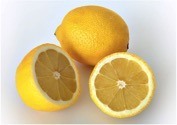
Image source: By André Karwath aka Aka CC BY-SA 2.5, via Wikimedia Commons
Substances with high pH (from 8 to 14) are bases. Bases you can find around the house include things like bleach and baking soda.
According to the chart above (in blue), bleach has a pH of 13, while baking soda has a pH of 9.5. This means that bleach is more basic than baking soda. Higher pH values mean that something is more basic.

Image source: By OpenClipart-Vectors CC0, via pixabay.com
In order to be considered neutral, a substance must have a pH of 7.0. If a substance is neutral, this means that it is neither acidic nor basic.
The most common example of a neutral substance is pure water. Blood is also pretty close to neutral with a pH of 7.4.
One way to neutralize acids and bases (get them closer to a pH of 7) is to mix them together.
pH is often measured with pH indicators like litmus paper. Indicators like this change color once they're dipped in a solution. The color tells us the approximate pH value.
Here's one example of a pH indicator key:

Image source: By Bordercolliez [CC0], via Wikimedia Commons
Changes in pH can cause major problems.
In your body, extreme changes in pH can cause enzymes (proteins) to denature, or lose their shape. This prevents them from functioning properly. Enzymes are used pretty much everywhere in your body, so changing the pH in such a way that they cannot function can cause extreme problems. pH is maintained in our bodies through homeostasis, when the body regulates ion content in extracellular fluid.
The same is true for the environment. Changing the pH of a river, for example, can kill the organisms that normally live there. Air pollution and acid rain are major culprits in ecosystem pH change.
Interactive · 2 questions
pH is a metric of how many hydrogen ions there are in a given system. More specifically, the pH of something is given by the following equation, where is the concentration of hydrogen ions.
In many cases, we are concerned with whether the value of pH is above or below seven. This is because when water naturally decomposes into and , it produces hydrogen ions. Plugging this in to our equation, And we arrive at our definitions of acids and bases.
Select the basic solutions.
Let's dial this back a bit. Since biology is primarily concerned with mixtures involving water, let's define bases a little bit differently. What we're going to say is that a base is a substance that produces ions.
Let's see this in action using ammonia. Ammonia is a basic substance and, according to our first definition of bases, it must take in a hydrogen ion. But where exactly is this hydrogen ion coming from? Well, it comes from water of course. And so we see that our two definitions of bases are really the same thing if water is involved.
If a solution has more than it does , then it is .
: A substance which will give off hydrogen ions. An acid will result in more hydrogen ions than hydroxide ions when placed in water
: A substance which will produce hydroxide ions when placed in water
: A solution with equal amounts of hydrogen ions and hydroxide ions
Video
by CrashCourse
If you want to learn about pH, watch this video. The pH scale ranges from 0 to 14. Acidic substances have pH between 0 and 7, and basic substances have pH between 7 to 14. A pH of 7 means that the substance is neutral.
pH is a measure of the concentration of ions or ions in a solution. If there is a high concentration of , it is acidic. If there is a high concentration of , it is basic (also called alkaline). To determine the pH of a solution, we can test the acidity or alkalinity by using different indicators, like litmus paper.




