What Is Photosynthesis? — Equation & Cycle

Illustrated · 1 min

What Is Photosynthesis?

To figure out what this process is, let's look at the word itself.

Photo = light 
Synthesis = making stuff
Photosynthesis = making stuff using light

Image source: By Hannah Bonville

In a moment, we'll get into what "stuff" is being made and how it's put together. But first, there are a few more basic things you need to know:

Who Uses It?

Photosynthesis is a process used by autotrophs to convert energy from sunlight, carbon dioxide, and water into oxygen and organic compounds.

Autotrophs are organisms that produce their own food using energy from the sun. They don't need to consume other organisms for food (like we do).

The best examples of autotrophs are green plants. (We'll learn why "green" is important in a minute.) Green algae and some bacteria are also autotrophs.

The image shows a potted plant, a purple flower, an algae-covered pond, and a tree.

Plants, flowers, algae, and trees are all autotrophs. Notice how they are all green.

Image source: By Mario Janakis

What Are the Steps of This Process?

Before we break the process down, let's look at the overall chemical reaction. The reactants are on the left, and the products of photosynthesis are on the right.

Photosynthesis equation

Image source: By ZooFari [Public domain], via Wikimedia Commons

This equation shows us that sunlight, water (H2OH_{2}O), and carbon dioxide (CO2CO_{2}) are turned into glucose (a sugar) and oxygen.

There are two main steps in this process. The first step is called the light-dependent reactions (or simply, light reactions). The second step is called the light-independent reactions or the Calvin cycle (formerly known as the dark reactions).

Both light-dependent and -independent reactions occur in the chloroplast, although in different parts. As a reminder, here's a close-up look at the little green organelle. Recall that it is green because it is filled with a green pigment called chlorophyll. This organelle also has a very important part in absorbing different wavelengths of light from the sun.

Diagram of chloroplast structure

Image source: By It'sJustMe (modified by expii) [Public domain], via Wikimedia Commons

Video

(Video) Spongebob Squarepants

by TheReaper5055

‘‘I know, we can act like plants."\color{Green}{``}{\text{I know, we can act like plants."}}\\

The actual process of photosynthesis is much more complicated than Spongebob lying out in the sun, but you can use this video clip to help you remember that it is conducted by plants.

Illustrated · 1 min

The Light and Dark Reactions

Photosynthesis is the process that plants and other autotrophs use to convert energy from the sun into chemical energy. They can then use this energy to make ATP through cellular respiration.

This image shows the net reaction of photosynthesis. The energy from sunlight plus six molecules of carbon dioxide (CO2) plus six molecules of water (H2O) form one molecule of glucose (C6H12O6) and six molecules of oxygen gas (O2).

The reactants are on the left, and the products are on the right.

Image source: By Mario Janakis

There are two major systems:

  • The light reactions require energy from the sun to perform. They occur across the thylakoid membrane in the chloroplast. The light reactions use the sun's energy and water molecules to produce ATP, NADPH, and oxygen. The oxygen is an important by-product because it's what we breathe. The ATP and NADPH are used in the next step to produce carbohydrates.

  • The Calvin cycle, also called the dark reactions, is the second system. It does not require any energy from the sun to occur. These reactions occur in the stroma of the chloroplast. The Calvin cycle captures carbon from the atmosphere (CO2CO_{2}) and turns it into glucose, which can then be turned into any of thousands of carbohydrates. One of the major steps in this cycle is carbon fixation. This is when inorganic carbon is converted into organic molecules like sugar.

This image shows a plant and the sun. The sunlight, water in the soil, and carbon dioxide from the air all enter the plant to be used in photosynthesis. The plant emits oxygen gas as a byproduct of photosynthesis.

Image source: By At09kg CC BY-SA 3.0, via Wikimedia Commons

Think about it: All of the carbon that makes up the wood and leaves in trees was once carbon dioxide. You might have even breathed out some of that carbon dioxide at some point.

Illustrated · 1 min

Turning Sunlight into Sugar

Autotrophs, like green plants, bacteria, and algae, use a process called photosynthesis to make food. This is the process of capturing solar energy to produce chemical energy like ATP and simple sugars.

Photosynthesis is the process of capturing solar energy in order to produce chemical energy.

Image source: By Riyasachdeva250 CC BY-SA 4.0, via Wikimedia Commons

The process can be described by this equation:

Photosynthesis needs sunlight, water, and carbon dioxide to produce chemical energy.

Image source: By CNX OpenStax CC BY 4.0, via Wikimedia Commons

Photosynthetic organisms need sunlight, water, and carbon dioxide to produce chemical energy (food) through processes called the light reaction and the Calvin cycle. They also produce as a waste product one of the key things we need to live: oxygen.

The light reaction produces ATP, while the Calvin cycle uses that ATP to create simple sugars like glucose.

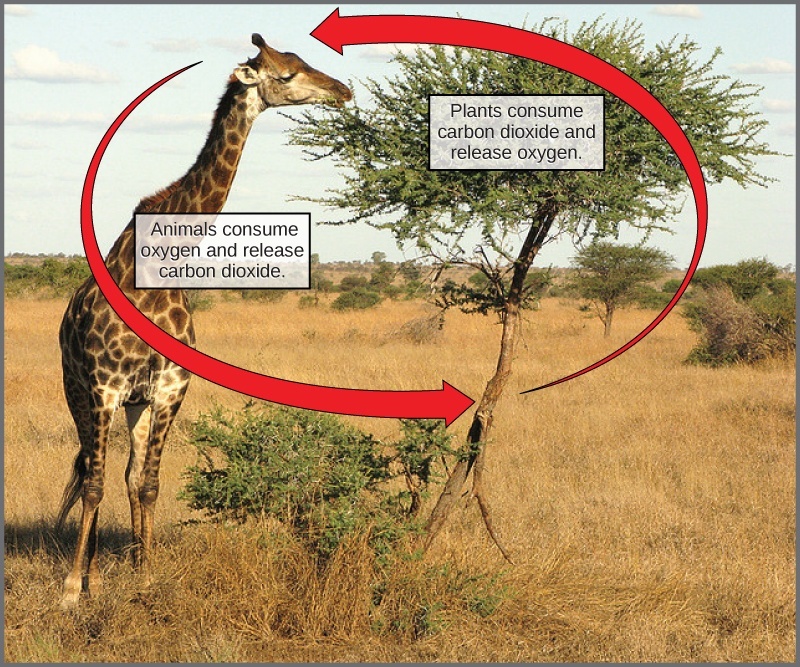
Plants consume carbon dioxide and release oxygen. Animals consume oxygen and release carbon dioxide.

Image source: By CNX OpenStax CC BY 4.0, via Wikimedia Commons

Vocabulary Review:\color{#8925AE}{\text{Vocabulary Review:}}

Photosynthesis\color{#8925AE}{\text{Photosynthesis}} : The process of capturing solar energy to produce chemical energy

ATP\color{#8925AE}{\text{ATP}} : A molecule that stores energy in its bonds. The cell is able to break these bonds to release energy

Light Reaction\color{#8925AE}{\text{Light Reaction}} : Light-dependant reactions use solar energy to convert ADP and NAD+^+ to ATP and NADPH, while also producing oxygen

Calvin Cycle\color{#8925AE}{\text{Calvin Cycle}} : How ATP and NADPH from the light reactions are used by the cell to create sugars

Type a concept, like “slope” or “photosynthesis”.

↑ ↓ to choose · Enter to openSearch explanations and problems