Illustrated · 1 min
+5 contributors





What Is Photosynthesis?
To figure out what this process is, let's look at the word itself.

Image source: By Hannah Bonville
In a moment, we'll get into what "stuff" is being made and how it's put together. But first, there are a few more basic things you need to know:
Who Uses It?
Photosynthesis is a process used by autotrophs to convert energy from sunlight, carbon dioxide, and water into oxygen and organic compounds.
Autotrophs are organisms that produce their own food using energy from the sun. They don't need to consume other organisms for food (like we do).
The best examples of autotrophs are green plants. (We'll learn why "green" is important in a minute.) Green algae and some bacteria are also autotrophs.

Plants, flowers, algae, and trees are all autotrophs. Notice how they are all green.
Image source: By Mario Janakis
What Are the Steps of This Process?
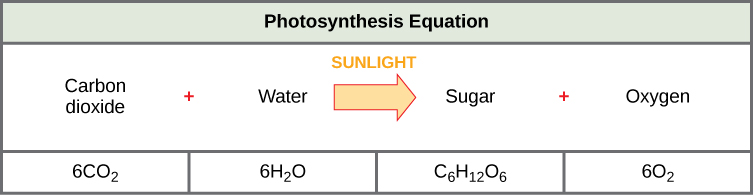
Before we break the process down, let's look at the overall chemical reaction. The reactants are on the left, and the products of photosynthesis are on the right.

Image source: By ZooFari [Public domain], via Wikimedia Commons
This equation shows us that sunlight, water (), and carbon dioxide () are turned into glucose (a sugar) and oxygen.
There are two main steps in this process. The first step is called the light-dependent reactions (or simply, light reactions). The second step is called the light-independent reactions or the Calvin cycle (formerly known as the dark reactions).
Both light-dependent and -independent reactions occur in the chloroplast, although in different parts. As a reminder, here's a close-up look at the little green organelle. Recall that it is green because it is filled with a green pigment called chlorophyll. This organelle also has a very important part in absorbing different wavelengths of light from the sun.

Image source: By It'sJustMe (modified by expii) [Public domain], via Wikimedia Commons