Video · + 1 min read

+2 contributors


(Video) Prime Factorization
by mathman1024

This video by mathman1024 covers prime factorization.
A prime is a number with only two distinct factors: and itself. In other words, it only has two numbers that can divide into it evenly which are and itself.
A composite is a number with more than two distinct factors.
Let's list the factors of the number . These are the numbers that can divide evenly into . The number has more than two distinct factors, therefore we can say it's a composite number.
Let's look at the number now. The only numbers that go into evenly are and itself. Therefore, is a prime number.
The number is a special case. It is neither prime nor composite.
Prime factorization is when you break a number down into its prime factors.
Let's find the prime factorization of the number . One way to do these is to make a factor tree. We start by putting at the top and creating two branches for two factors of the number. For the number we can choose and or and . Let's choose and .
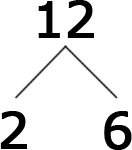
Now, we continue branching until all the numbers are primes. Since is a prime number, we're done with that branch. , on the other hand, is not a prime, so we have to factor that one.

Both branches of the are prime numbers so we are done with our prime factorization. You just take the digits at the end of each branch and they are your answer. The prime factorization of is: You do not have to write it using exponents but it is usually a good idea to do it, especially when the numbers get larger.
Try finding the prime factorization of this next number on your own. Then, watch the video to see the answer!