How Does a New Species Form?
A species is a group of closely related organisms that mate with one another and produce fertile offspring. A new species can form through speciation. In this process a parent species splits into two or more distinct sister species. These descendant species are genetically different from the parent species and one another. Due to this genetic divergence, sister species can't produce viable offspring if they interbreed.
How Does It Occur?
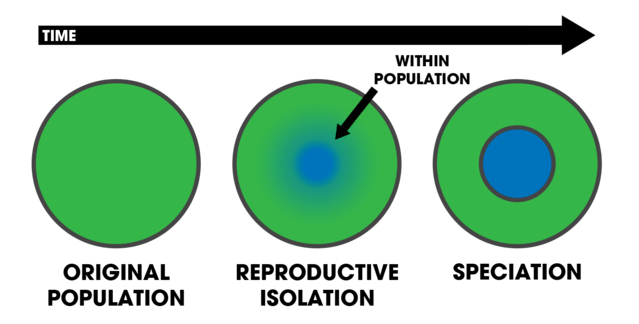
Ecological speciation begins when some factor or speciation event splits a single population and creates two or more reproductively isolated groups. Gene flow between the populations is blocked because they can no longer mate with one another. Isolated populations independently change through mechanisms of evolution like mutation, genetic drift, and natural selection. These changes result in genetically different species. The species become more different over time and develop distinct ecological niches.
A species can diverge in one of two ways:
Allopatric Speciation
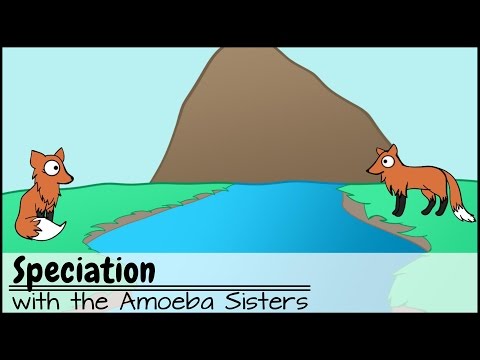
The most common cause of a species diverging is when some geographic barrier divides a population. This is allopatric speciation.
Barriers can form from drifting continents, changing sea levels, moving glaciers, or climate changes. These physical barriers can split a population, allowing separated groups to evolve independently. Populations can also split up if some members cross a pre-existing barrier.
For example, there are over 800 species of fruit flies of the genus Drosophila found on the Hawaiian Islands. The wide range of genetic diversity of Drosophila is a result of allopatric speciation. New species of fruit flies have stemmed from individuals dispersing among the islands.
Sympatric Speciation
Less commonly, a species can diverge while remaining in the same geographic location. This is called sympatric speciation.
Sympatric speciation occurs when certain individuals prefer different habitats where mating occurs.
A popular example of sympatric speciation is the North American apple maggot fly. Originally, these flies fed, mated, and deposited their eggs on hawthorn fruits. Around 150 years ago, when Europeans introduced apple trees to North America, these flies began to lay their eggs on apples. Apples are very similar to the hawthorn fruit with one distinct difference: their smell.
Flies that prefer the smell of apples tend to mate with other flies that prefer apples. The same applies to flies that prefer the hawthorn fruit. Over time, we have seen genetic divergence between these two groups.
How Is Speciation Modeled?
There are two main models of speciation that represent the rate at which it happens. They are gradualism and punctuated equilibrium.
Gradualism predicts that species are gradually changing over time. We can't see individual changes, but they add up over time to create a big change.
Punctuated equilibrium predicts that species remain in a stable equilibrium for a long time. This unchanged state is punctuated by periods of rapid evolution.