Interactive · 1 question

Fundamental Counting Principle
You and your friend are in the same class and you have a quiz coming up. Going in, you know that the quiz is going to be multiple choice questions with options for each. You, being the perfect student you are, have studied to prepare for the upcoming quiz, but your friend is not nearly as studious and decides to just guess on every answer on the quiz.
You have some free time now that you've gotten your studying out of the way, so you want to calculate the chance your friend has to correctly guess every question on the quiz. This is done by finding the total number of combinations of answers, and then taking the reciprocal to find the one combination that is entirely correct.
You can use the fundamental counting principle to easily calculate this. All you need to do is multiply the number of options in each level of the problem. In this case, there are problems on the quiz with answers each, so we need to multiply times. There are over million combinations of answers on this test! Your friend has a or chance of correctly guessing every question on the test.
Definition
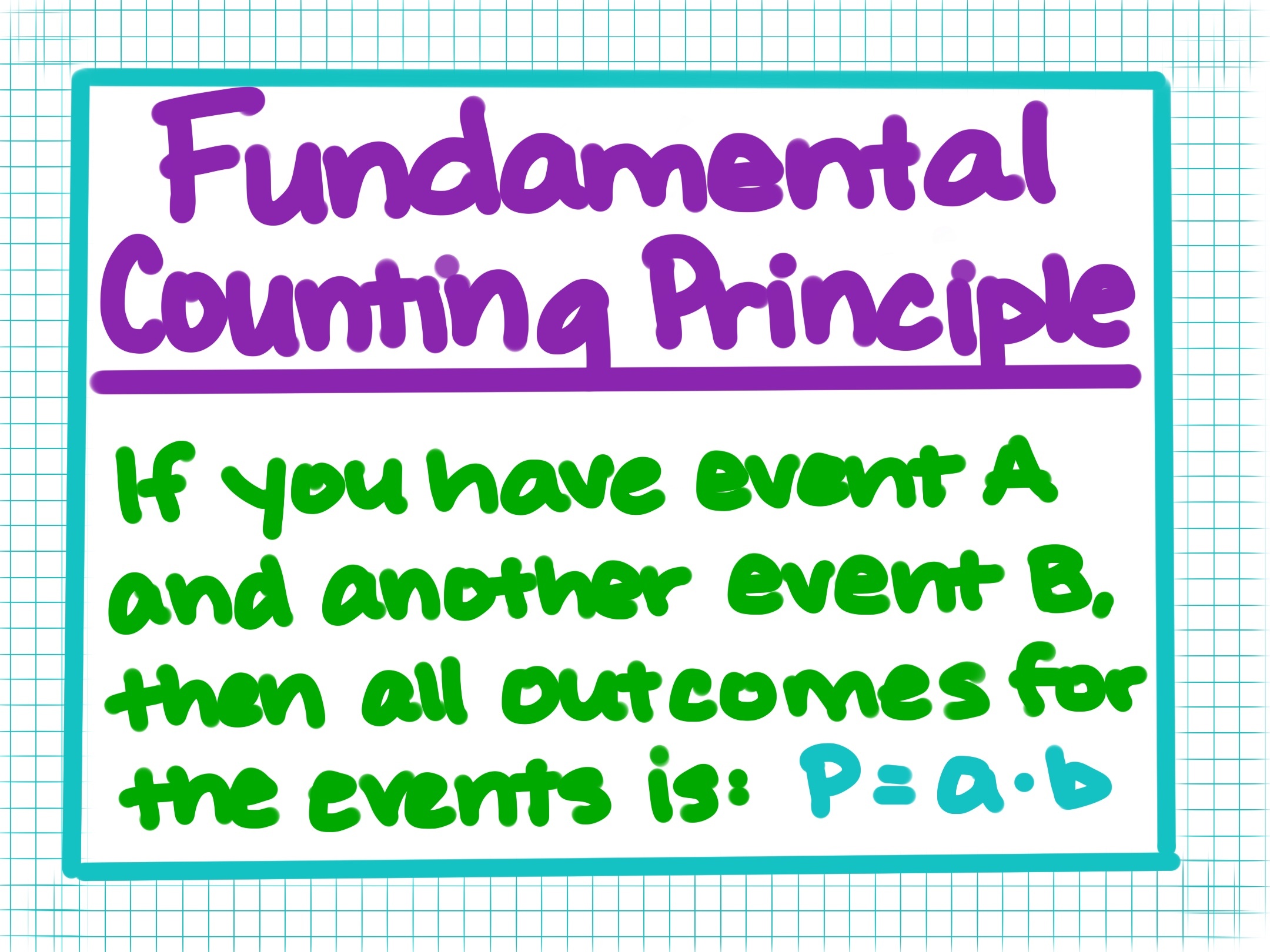
The definition of the fundamental counting theory is as follows:
"If you have an event and another event then all the different outcomes for the events is ."
This extends to any amount of events. For instance, if we had events, they could be named , , , and , then we could find the total number of outcomes with .
Examples and Practice Question
We've already used the example of a quiz, but let's use another classic example: ice cream.
Say you're looking at a menu at your favorite ice cream truck and you can choose one option from each of the following categories:
Type: hard, soft serve
Cones: regular, waffle, cup
Flavors: chocolate, vanilla, birthday cake, pistachio, strawberry
Toppings: jimmies, nuts, hot fudge, peanut butter, caramel
How many total combinations of ice cream are there? We have events: Type, cone, flavor, and toppings. Each event has a different number of options. There are types, cones, flavors, and toppings. We need to multiply these numbers together to get the total number of combinations: There are different combinations of ice cream options for you to pick from!
Try one for yourself:
You're searching for a new board game. You want to find all of the possible combinations of attributes possible before you select a game. You have found the following:
Medium: board game, card game, roll-and-write
Game type: economic/euro, war, abstract strategy, role-playing, social deduction
Number of players: only, ,
Game length: hour, hours, hours, hours
How many total combinations of attributes are there?
We have categories here: medium, game type, number of players, and game length. Each of these categories have a different number of options. There are mediums, game types, player sets, and game lengths. We need to multiply all of these together to find the different combinations: There are different combinations of attributes.