
Illustrated · 1 min
A good conductor is a material that makes an easy path for electrons to create an electricity inside the circuit. Many of us have misconception about the origin of the electrons that pass through the circuit. The electrons that pass through the circuit aren't the part of your battery or they aren't be emitted from the battery. Battery just makes a potential difference or an internal electric field that compels electrons to flow. These electrons are the part of our circuit itself. The circuit which is made by copper is an example of good conductor. Why?
The answer of this question is under the atomic level of copper. Copper acquires its stability by emitting electrons from its most outer shell. Such a way copper atom loses electrons. But these electrons don't leave the metal for binding energy. Thus, copper looks like a sea of electrons where copper atoms are sea animals. These electrons are called free electrons. Now if you apply voltage difference, these electrons will start to pass through the circuit.
So what makes a material good conductor? Simply, the answer is 'free electrons'. Why do we get these free electrons inside the materials? Because, if the outer shell of the electrons of any material has very low energy difference with the conduction band of that material, the electrons can easily fly away from the most outer shell by absorbing light energy even of very low frequency and can be the part of conduction electrons.
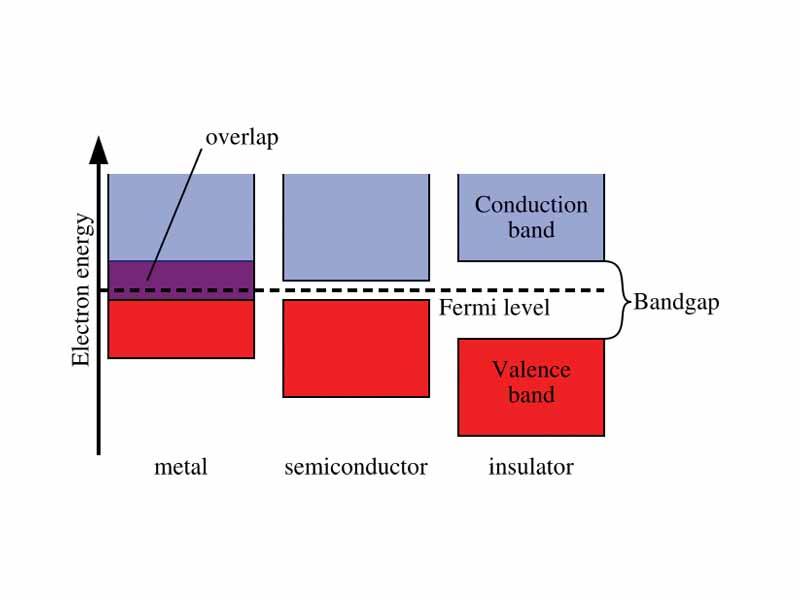
For metal the energy of electrons of conductor band and valance band overlap