Illustrated · 3 min
+5 contributors




Water and Life
In biology, water is one of the most important substances you'll learn about. Water is the most abundant resource on Earth and all life forms depend on it for survival. Just think about all the things you need water for on a daily basis. Water is constantly moving through Earth.
What Are the Properties of Water?
Because water is so important, we're going to look at some of the chemical properties that make it so crucial to life on Earth.

Image source: By Apollo 17 [Public domain], via Wikimedia Commons
Polarity, Cohesion, and Adhesion
Recall that water () is a polar molecule because oxygen atoms pull more strongly on electrons than hydrogen atoms do. This creates two poles on the water molecule: one with a positive charge and one with a negative charge.

Image source: By Hannah Bonville et al.
The importance of water's polarity can be boiled down to the phrase "opposites attract". Positive-negative attraction dictates how water behaves in some really important ways.

Image source: By k_notgeil CC0, via pixabay.com Image source: By Alvesgaspar CC BY-SA 3.0, via Wikimedia Commons

Image source: By Downtowngal CC BY-SA 3.0, via Wikimedia Commons
Universal Solvent
Water's polarity also makes it great at dissolving polar solutes. In fact, it's known as the universal solvent. This is because the negative pole around the oxygen atom can attract positively charged molecules, while the positive poles around the hydrogens can attract negatively charged molecules. In this way, water is able to break the bonds between molecules and effectively dissolve them. This ability is extremely important for cellular processes.
However, just because water is a great solvent doesn't mean that it can break down anything. It has a hard time dealing with nonpolar substances like lipids. If you've ever tried to mix oil and water, you'll know that the two substances will never completely mix, no matter how much you shake them.

Image source: By andrea candraja CC0, via pixabay.com
High Specific Heat
Water molecules are attracted to each other through hydrogen bonds. It takes a lot of energy to break these bonds. This means it takes a lot of energy to change water molecules from one phase into another.
Water does not experience large temperature fluctuations. It takes the addition of a lot of energy to heat up and the loss of a lot of energy to cool down. This is attributed to water's high specific heat.
Think of a lake. If the water went from 70°F to 40°F over the course of a few days, you'd have a lot of dead fish. The slow changes in temperature allow organisms to adjust and adapt to the water around them.
Water's high specific heat also allows us to keep our body temperature constant. If water changed temperature easily, we would always be changing from too hot to too cold depending on the temperature outside. This would be no good for the enzymes in our bodies.

Image source: By khanhlqnhctdt CC0, via pixabay.com
Density
Density is a measure of how closely molecules are packed together. Water is unusual in that it is less dense as a solid than it is as a liquid.
This means that water molecules are packed together more closely in the liquid phase than as a solid.

Image source: By Adam Derewecki CC0, via pixabay.com
When molecules are farther apart, like they are in ice, there's more room left between them for air. So, there is more air between the water molecules in ice than there is in liquid water.
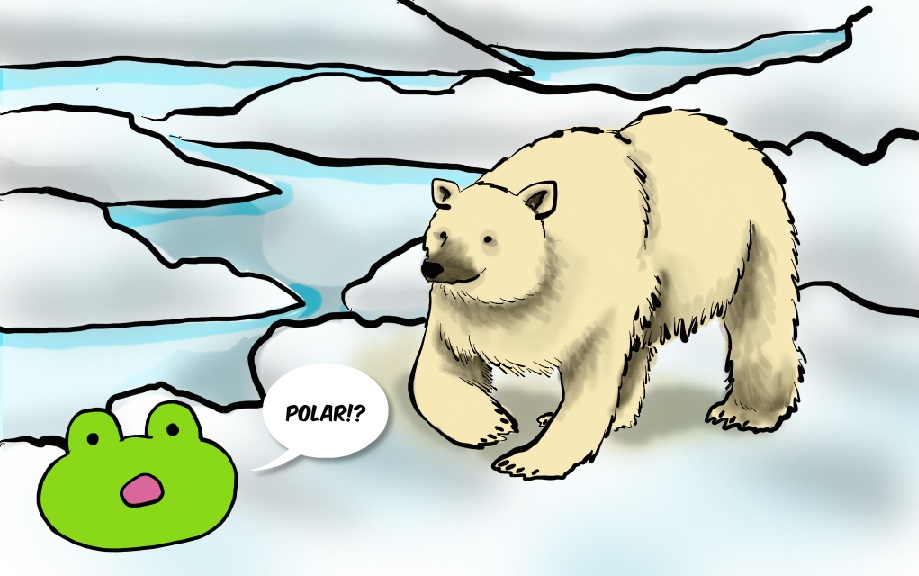
Why does all of this matter? Well, dense things sink. Because ice is less dense than liquid water, ice floats.
The ice covering a lake, for example, provides insulation for the organisms below. Also, if ice sank, the organisms in water would be crushed each winter.
Key Vocabulary:
- Polar
- Cohesion
- Adhesion
- Surface tension
- Capillary action
- Specific heat
- Density