Video · + 2 min read

(Video) Word Problems: When to Use Mean, Median, and Mode
by Anusha Rahman

This video by Anusha Rahman goes over three examples of when to use mean, median, and mode in word problems.
Summary
Example 1: Jessie’s math teacher said that their final class grade is based on the average of all exam grades. Jessie has gotten a and on her math exams. What measure of central tendency will she use to calculate the average? What is the average?
We know that when we see the word average, we're talking about the mean! So, we will be using mean to solve this problem.
So, we know that Jessie's average score on her math exams was !
Example 2: Meghan wants to get an accurate picture of household salary in her neighborhood. The salaries for people in her neighborhood are: and . What measure of central tendency will most accurate describe the data?
At first glance, we can see that there is an outlier at . At outlier is going to mess with the mean, and mode (the frequency) is not going to give us a lot of information. So, we will use the median, or the middle value.
Step 1: Put the salaries in numerical order, from least to greatest.
Step 2: Cross of the numbers evenly from each side until you're left with a middle number.
In this case, the median is .
Example 3: At her birthday party, Charlotte asks everyone to go around and say their favorite Taylor Swift song. In order, people respond with:
All Too Well, Shake it Off, Black Space, New Romantics, All Too Well, New Romantics, All Too Well, and Mr Perfectly Fine
Charlotte wants to know which song is the most popular. What measure of central tendency should she use?
Because the question is asking for the most popular song, we know we are looking for the mode! We also know that the mean and median cannot be used for nominal or qualitative data.
Our first step is to make a frequency table with the data.
From this frequency table, we can see that All Too Well has the highest frequency, so that is the mode of the data set, and it is the most popular song!
When solving word problems with central tendency, it's important to understand the pros and cons of each type. Let's break them down.
Median:
PRO: asymmetrical data (with an outlier)
CON: doesn't work with qualitative or nominal data
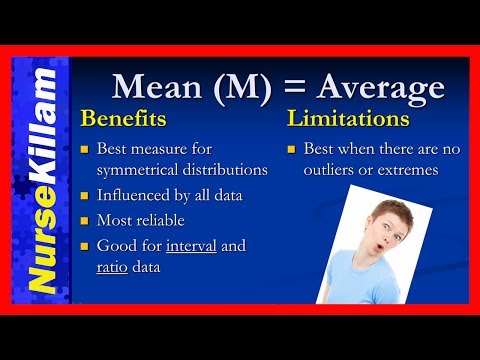
Mean:
PRO: symmetrical data (no outlier)
PRO: big data sets
CON: highly affected by outliers
Mode:
PRO: working with qualitative or nominal data
PRO: very easy to look at and read graphs/charts
CON: very limited in what it tells you