Working Backwards: Recursion, Induction, and Minimality

Interactive · 5 questions

Induction (Part 1)

Table of Contents of the induction series :

Part 1

Part 2

Part 3

Part 4

Part 5

Part 6

Part 7

So, what is induction?

You might wonder, what is induction?

This is what induction is :

∙\bullet A type of mathematical proof used to establish a given statement for all (or some) positive integers.

∙\bullet It consists of 22 steps :

11. Establishing the base case.

22. Inductive Step.

I can hear you screaming. What is base case? What is the inductive step. I'll explain these in a moment.

Analogy

Here's a simple analogy :

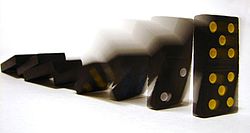
A row of dominoes. Image credits to wikipedia.

A row of dominoes. Image credits to wikipedia.

Consider a row of dominoes, when you push the first domino, what will happen?

Choose one answer

Spot the idea in disguise

In a contest problem, this idea hides inside a situation you have not seen before. Learning to spot it is the real skill. These are real problems from the AMC 8, AMC 10, AMC 12 and AIME, the national math competitions for middle and high school students, each with a worked solution on LIVE by Po-Shen Loh.

Read · 1 min

Let′sLet's talktalk aboutabout methodsmethods ofof proof!proof!

Probably the most common techniques are:

ProofProof by:by: ContradictionContradiction andand InductionInduction

Contradiction:Contradiction: Let's say that we wanted to show our annoying sibling that what they were saying, some statement X, were false. One way we can do this is by assuming that their statement X is actually true. We can use contradiction by showing that if X were true, then some impossible statement would have to be true. Obviously there lies the contradiction, and we have proven to our adamant sibling that their statement was actually false.

Induction:Induction: Induction is a pretty useful method of proof. It is generally used to prove statements which are true for all positive(or nonnegative) integers. Let's say that we wish to show that aa is true for all integers n.n.

First we start with our basisbasis case.case. A basis case is just a trivial, obvious case. So, we can show in our basis case that aa isis truetrue forfor n=1.n=1.

Then we move to our inductiveinductive step,step, also called the inductiveinductive hypothesis.hypothesis. We assume that aa isis truetrue forfor n=k.n=k.

So, if aa isis truetrue forfor n=k,n=k, thenthen itit isis alsoalso truetrue forfor n=k+1n=k+1

This is usually proved with some algebra. It shows that since aa is true for n=1,n=1, then it is also true for n=1+1.n=1+1. Therefore it is true for 3, 4, 5, 6, and so on.

We finish with our statement that:

HavingHaving donedone thethe basisbasis casecase andand thethe inductiveinductive step,step, byby thethe PrinciplePrinciple ofof MathematicalMathematical Induction,Induction, wewe havehave provenproven ourour claimclaim thatthat (writewrite youryour claimclaim herehere) toto bebe truetrue forfor allall integersintegers n.n.

Interactive · 7 questions

Induction (Part 2)

The link to the table of contents.

In the last post, we look at what induction is and gave a simple example of induction in action. In this part, we'll look at two more applications of induction.

The first problem :

Prove that for all positive integers n>3n > 3, n!>2nn! > 2^n.

What's the base case?

Choose one answer

Interactive · 1 question

Induction (Part 3)

Link to table of contents

In this part, we'll look at strong induction.

Strong induction

Forgive me that I can't find a very good photo analogy of strong induction.

A photo that doesn't matter much.

Esentially, it's almost the same as the induction we've done before. However, there's one main difference, and that is the inductive step. Instead of just assuming that the statement holds for n=kn = k, we assume it holds for all n≤kn \le k. (starting from the base case.) Note that this assumption is valid and still proves the statement.

If you remember the domino analogy, think of it as dominoes with springs that keep them from falling, and the springs get stiffer as nn increases. Now, domino nn requires not just the force of the (n−1)(n - 1)-th domino to make it fall, but all of its neighbours to the left, in order to fall.

Now, we will demonstrate the following (famous) problem :

Prove that every positive integers nn can be written as the sum of distinct Fibonacci numbers. (Fibonacci numbers are defined as F0=1,F1=1,Fn=Fn−1+Fn−2F_0 = 1, F_1 = 1, F_{n} = F_{n - 1} + F_{n - 2}, for n≥2n \ge 2.

Note : F0=F1=1F_0 = F_1 = 1 are considered the same.

Think about this for a moment before looking at the discussion below.

The base case is obvious, (1=F11 = F_1)

Now, we go to the inductive step.

The way we've be inducting previously is assuming it's true fr nn and proving it for n+1n + 1. But now, we have a problem : there's no way to relate the problem for n+1n + 1 to nn.

Instead, we'll assume it is true for all positive integers k≤nk \le n. Now, we attempt to prove the statement for n+1n + 1.

Consider the largest Fibonacci number not exceeding n+1n + 1. If it's n+1n + 1, we're done. If not, consider n+1−Fkn + 1 - F_k, where FkF_k is the Fibonacci number described. Then, n+1−Fk<n+1n + 1 - F_k < n + 1 and thus by the induction hypothesis can be written as the sum of distinct Fibonacci numbers. There's still one thing though, that is to check that FkF_k never occur again.

We'll prove that 2Fk>n+12F_k > n + 1.

Indeed, 2Fk>Fk+Fk−1=Fk+1>n+12F_k > F_k + F_{k - 1} = F_{k + 1} > n + 1, so we're done.

What have we learnt from this problem?

Choose all correct answers

Interactive · 5 questions

Induction (Part 4)

Link to table of contents

In this article, we'll look at an interesting problem that can be solved by strong induction.

A player AA plays the following game :

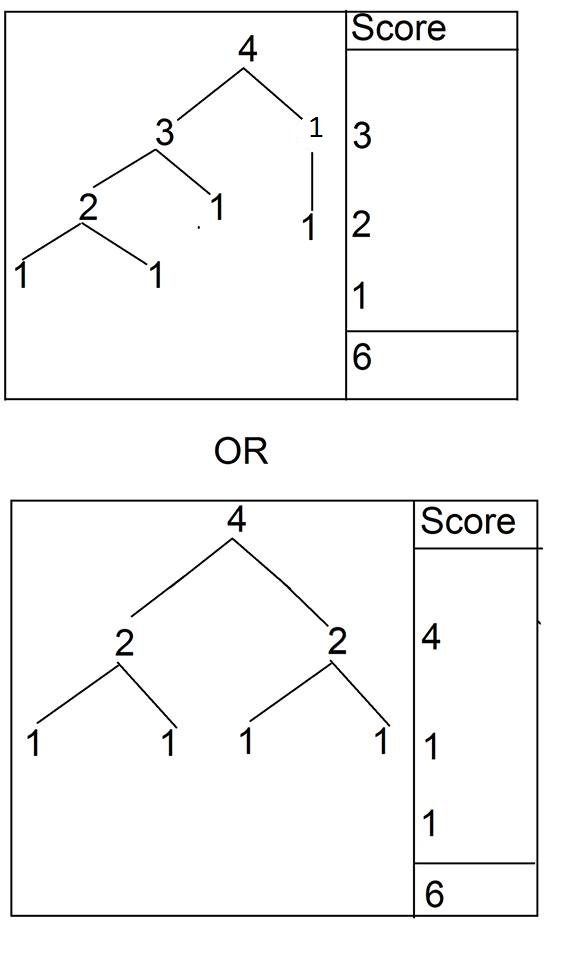
He starts with a pile of 100100 stones. Every second, he seperates a pile of stones consisting of at least 22 stones into 22 piles. If he seperate a pile of nn stones into 22 piles of stones aa and n–an – a, where aa and n–an – a are positive integers, then he gets a(n–a)a(n – a) points. He starts off with 00 points, what is the maximum number of points he can get if the game ends when there are 100100 piles, each consisting one stone.

100100 doesn't seem special, so let's just replace it with nn (where nn is a positive integer) and hope to find a pattern.

Let S(k)S(k) be the maximum possible score for n=kn = k.

What is the value of S(1)S(1)?

Interactive · 2 questions

Induction (Part 5)

Link to table of contents

Sometimes you tried to solve a problem by induction, but unfortunately failed. You're frustrated. You give up, and get a 0/7 for that problem.

Sometimes, a problem is not so straightforward. You need to use some techniques to get it working. That's why, in this part, we'll look at some of the tips and tricks to succeed in solving a problem with induction.

Techniques in using induction

Don't always Add 11

In the previous examples, we always prove the statement for n=k+1n = k + 1 using the assumption of the truth of the statement for n=kn = k (or n<=kn <= k for strong induction).

However, why does it always have to be k+1k + 1?

Consider the following question :

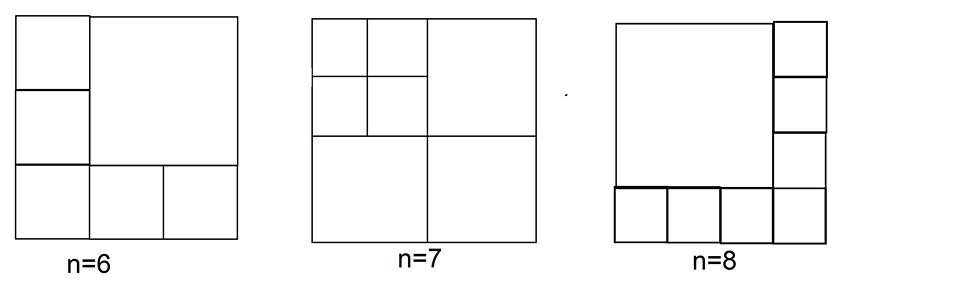
Prove that if n>5n > 5 is a positive integer, then it is possible to cut a square into nn smaller squares (not neccesary of the same size).

We'll use the following fact :

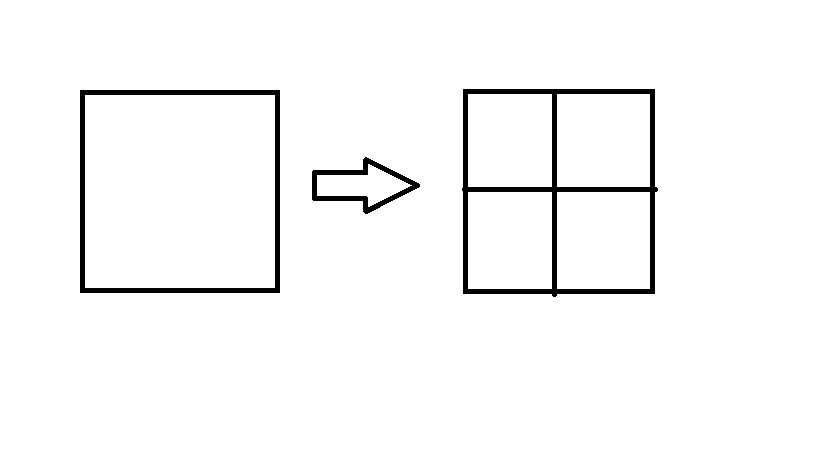
“Any square can be cut into 4 smaller squares.”

Is this true?

Choose one answer

Illustrated · 2 min

Induction (Part 7)

Link to the table of contents

In this article, we look at two tougher problems.

The plane is divided into regions by straight lines. Show that it is always possible to color the regions with 22 colors so that adjacent regions have distinct colors.

It seems odd that this problem can be solved by induction, there's not even a variable to induct on!

So, let's create a variable. The natural choice is to induct on the number of lines, so let's try that.

Let the number of lines be nn.

To make things simpler, let the 2 colors be black and white.

The statement we want to prove is "If we divide the plane with nn lines, then we can color the regions with two colors so that adjacent regions are of different colors. " (For the sake of simplicity, call this type of coloring good.)

The base case is n=1n = 1.

Then, we color the 'left' region white and the 'right' region black. This proves the base case.

Inductive Step :

Suppose it is possible to color the plane that is divided by nn lines in two colors such that it is good.

Now, we construct a coloring for a plane that is divided by n+1n + 1 lines.

See diagram below :

Before and After photos.

First, we draw the first nn lines and color it with a good coloring (it exists by the induction hypothesis.)

Then, draw in the (n+1)(n + 1)-st line. (The dotted line in the diagram)

Finally, we “invert” the coloration to the right of the line. (so white becomes black, black becomes white) (example in the diagram)

The region to the left of the line still have a good coloration, and the region to the right also have a good coloration, (it's just the inverse of their original colors.) and the region that share borders along the line, will be differently colored. (because we inverted it.)

Thus, the new coloration is good, which completes the inductive step.

This completes the induction.

We proceed to the next and final problem of this series.

Prove that for all positive integer nn, 234...n<3\sqrt{2\sqrt{3\sqrt{4\sqrt{...\sqrt{n}}}}} < 3.

Hint: induct backwards

Solution :

Clearly straightforward induction doesn't work. We introduce a technique called backward induction.

The key is to change the inequality into the following form :

k(k+1)(k+2)...n<k+1\sqrt{k\sqrt{(k + 1)\sqrt{(k + 2)\sqrt{...\sqrt{n}}}}} < k + 1, where kk is an integer >1> 1 and ≤n\le n.

Now, we want to induct on kk. Our base case is not k=2k = 2, but k=nk = n. (Now you see why it's called backward induction, we start from k=nk = n and go down to k=2k = 2.)

Verify that the base case is indeed true. We now proceed to the inductive step (I'm not including the technical details, just how to prove the inequality):

(k−1)k(k+1)(k+2)...n<(k−1)(k+1)<k2=k\sqrt{(k - 1)\sqrt{k\sqrt{(k + 1)\sqrt{(k + 2)\sqrt{...\sqrt{n}}}}}} < \sqrt{(k - 1)(k + 1)} < \sqrt{k^2} = k, by the induction hypothesis.

Thus, we're done.

This concludes the induction series.

Interactive · 1 question

Induction (Part 6)

Link to table of contents

In this part, we'll look at pitfalls of using induction.

Pitfall #1 : n = n + 1

What is wrong with the following argument :

We prove that for all positive integers nn, n=n+1n = n + 1 by induction.

Suppose the statement is true for nn, i.e. n=n+1n = n + 1. We'll prove this for n+1n + 1, i.e. n+1=n+2n + 1 = n + 2. Indeed, it follows from adding 11 to both sides of the equation. Thus, we're done.

What's wrong with the proof?

Choose one answer

Interactive · 1 question

Introduction

Recursion is a rather underestimated technique in math, especially in competitions. Perhaps it's because it sounds so vague or trivial on first hearing. So before I give a direct explanation, instead I will demonstrate its power in a problem first.

Example

A collection of 8 cubes consists of one cube with edge-length kk for each integer k, 1≤k≤8.k,\thinspace 1 \le k \le 8. A tower is to be built using all 8 cubes according to the rules:

∙\bullet Any cube may be the bottom cube in the tower.

∙\bullet The cube immediately on top of a cube with edge-length kk must have edge-length at most k+2.k+2.

How many different towers can be constructed?

2006 AIME I

Type a concept, like “slope” or “photosynthesis”.

↑ ↓ to choose · Enter to openSearch explanations and problems