Interactive · 4 questions
+2 contributors

The equation of a line has no exponents or square roots, meaning the highest power of the equation of the line is . Any equation with a power of exactly is called linear.
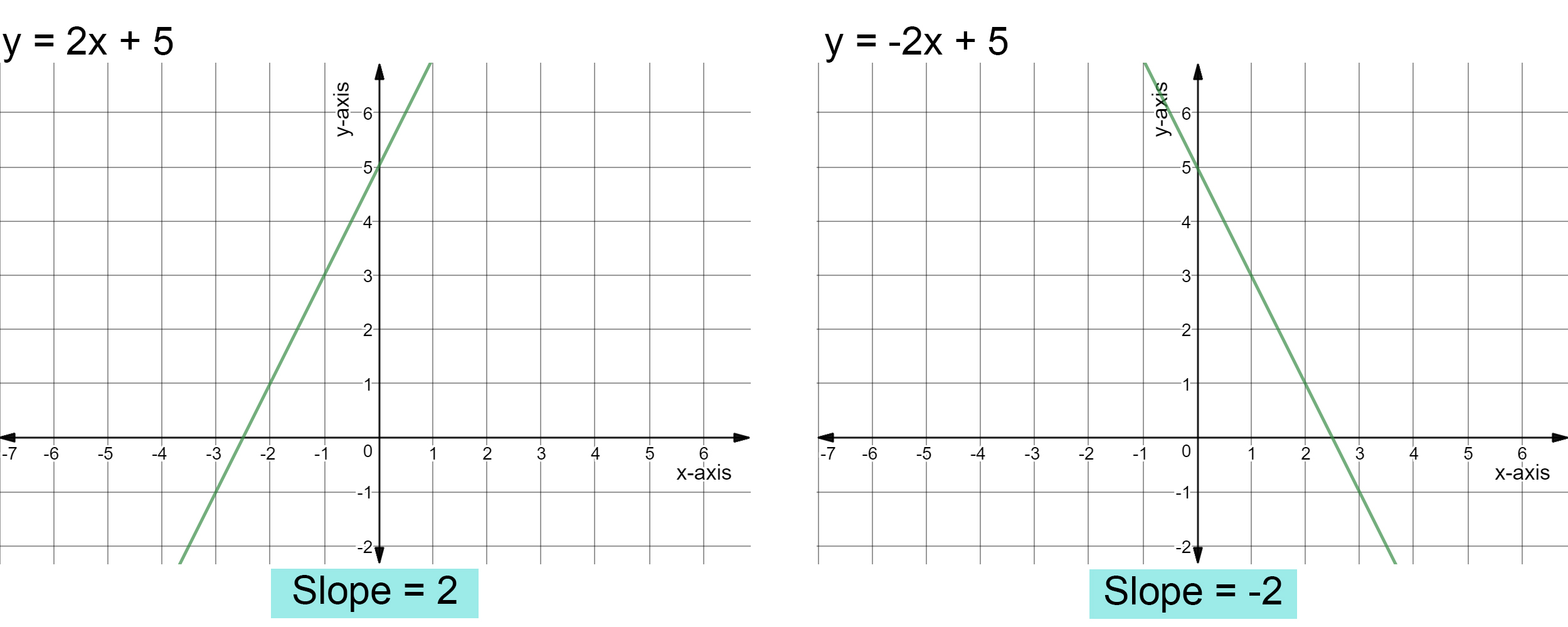
Recall that the slope of a line is the ratio between the vertical and horizontal distance between any two points. This value is always constant in a line, which means points on a line will have the same slope. The -intercept of a line is the value at the point where the line hits the -axis.
The two most common forms for writing the equation of a line are (slope-intercept form) and (point-slope form), where is the slope of the line, and is the y-intercept.
The slope of the line is sometimes called (said: rise over run). Rise is the vertical distance between two points, while run is the horizontal distance; to get the slope, the rise and run must be between the same two points on the line, although the choice of these two points is arbitrary.
Given two points and , the slope of the line passing between the two points is .
From here, we can either choose to put the equation into either form. The easier way would be to put it into point-slope form, as are the points you put into the equation.
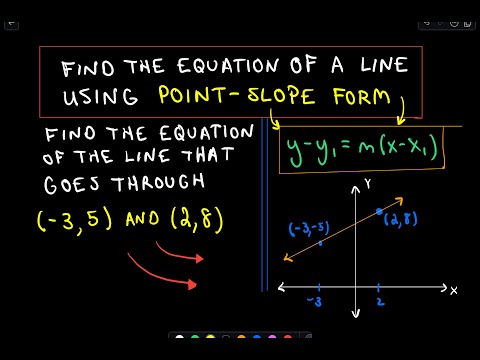
For example, the equation of the line passing through the points and would have a slope of , or . The equation of the line would then be .
However, if we wanted to put the equation into slope-intercept form, we would choose one of our coordinates, plug it into the slope-intercept form, and solve for , the -intercept of the line.
From our previous example, we would have: Solving, we find that is equal to .
Thus, the equation of our line is .
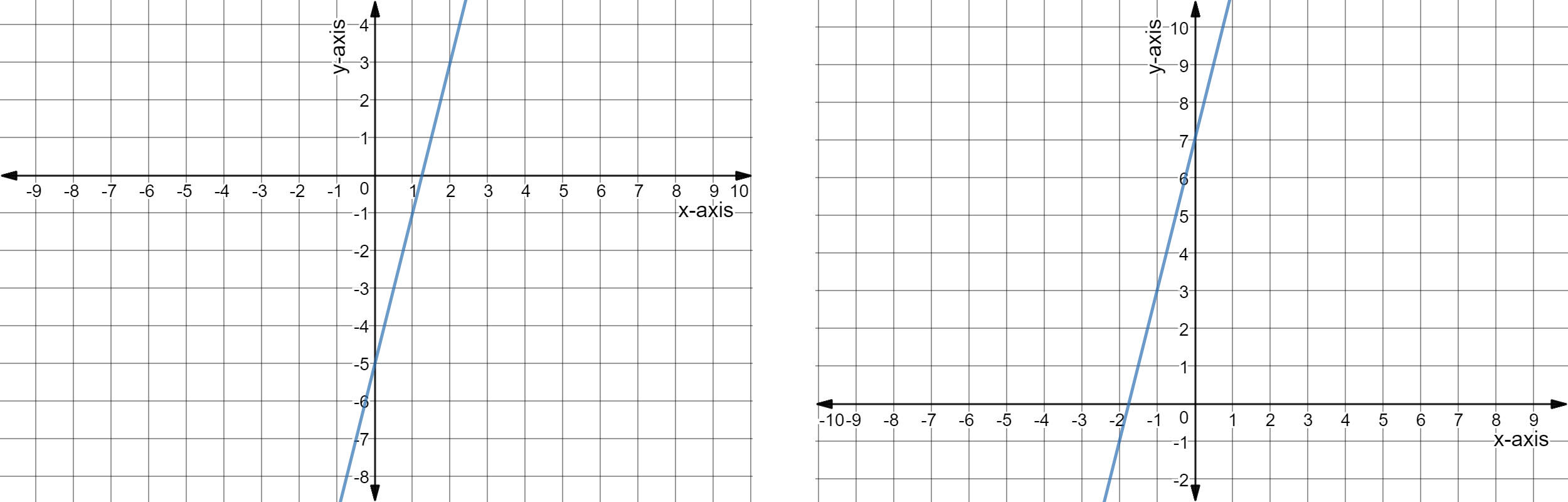
Let's try some practice. You are given the input values of and the equation .
What is the slope of the equation ?
represents the slope of the equation in point slope form . So, the slope of this equation is .
What is the -intercept of the equation ?
The simplest way to find this would be to simplify this equation into slope intercept form (). First, distribute the . Then, add to both sides. Now, we can easily see that the -intercept is .
Which of the following points are on the line ?
The values that are on this line have the slope of . You can check each point with a known point to make sure they have the correct slope. For example, we know the point is on the line. We can use that and the equation for slope to make sure the other points are on the line. Let's check the point .
We can see the point is on the line . You can also check to see if these points are on the line by plugging in the values into the equation and see if you get the correct value. For example, if we plug in , we see
We see that the output for is . That is not what the answer choice was, so it is not correct.
You can use either of these two ways to also check the points and . They are both on the line .
Given the input values of and the equation , what are the output values?
To find the output values, we must plug in the values into the equation . Doing that, we see that the -values are and .