Interactive · 2 questions
+5 contributors





When writing an inequality from a graph, there are a few things we need to do:
-
Determine the equation of the line. This gives us the general form of our inequality once we remove the equal sign.
-
Note whether the line is dotted or solid. Recall that dotted lines indicate or in an inequality and solid lines indicate or .
-
Use the graph's shading to determine which way your inequality sign will face.
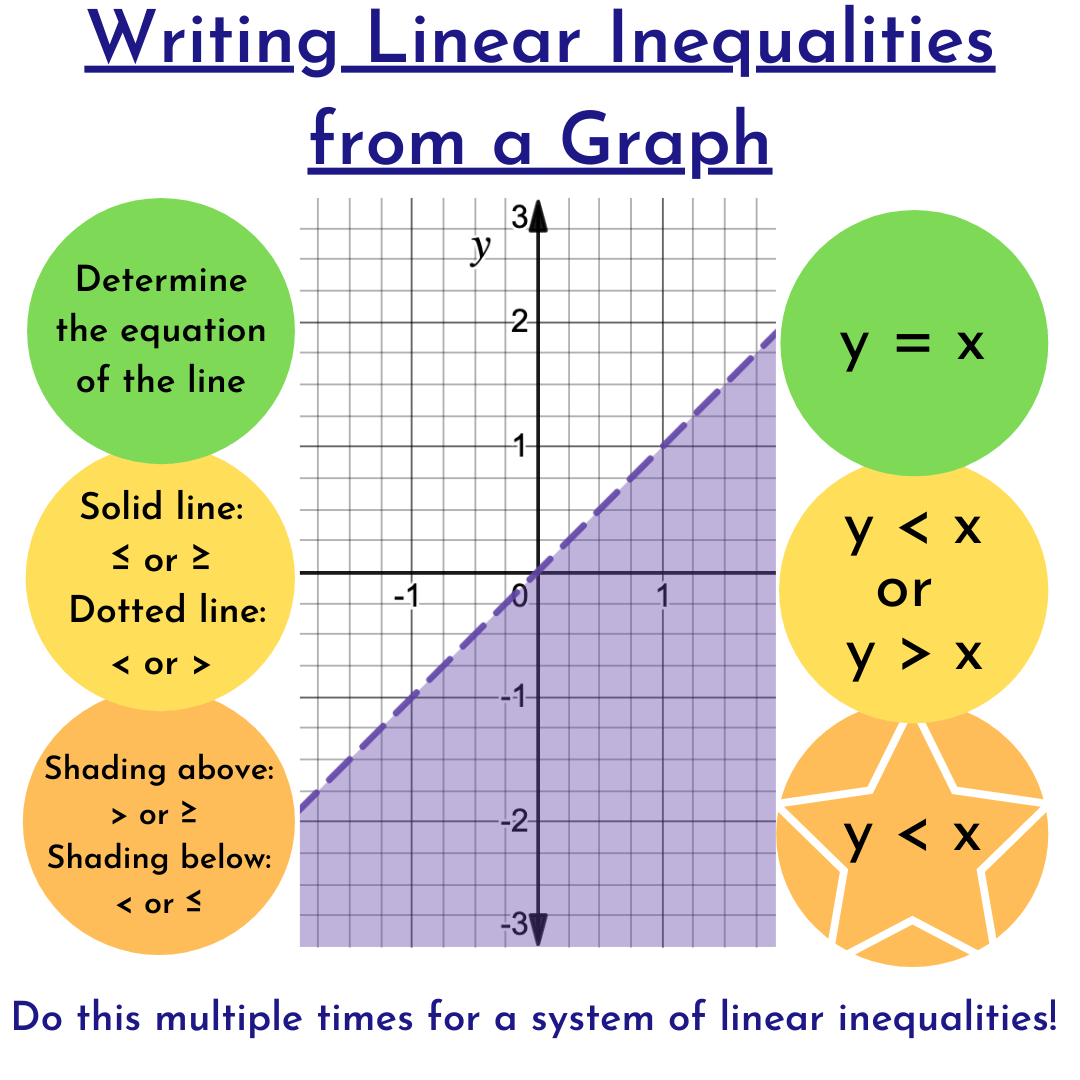
Image source: By Caroline Kulczycky
This works for single inequalities as well as systems of inequalities. If you have more than one line on the graph, you'll need to use these steps to write more than one inequality.
To go over how to graph inequalities on a coordinate plane, check out this lesson.
Let's look at an example:

Made using Desmos
STEP 1: Determine the equation of the line
We can see that the -intercept (represented as in the equation) of this line (where the line crosses the -axis) is:
The slope (represented as ) appears to be . Each time we rise by two units, our line runs to the right by unit. Since slope is , this is , which is equal to .
All of this means that the equation of our line in slope-intercept form is:
STEP 2: Note whether the line is dotted or solid
The line in our graph is dotted. This means our inequality will include either or .
STEP 3: Use shading to determine direction of inequality sign (i.e., or )
Recall that the shaded area of the graph represents the solutions to the inequality. This is the area of the graph we are interested in.
We can see that the area "above" our line (even though it's tilted) is shaded. This means that the solutions are greater than the points on the line.
As a result, we can write our inequality as:
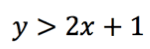
Image source: by Hannah Bonville
There's another way to verify the direction of your inequality sign. Pick any point in the shaded area of the graph. We'll choose .
Plug these values into the equation of the line:
Decide which inequality sign ( or ) makes the expression true when you replace the equals sign with it.
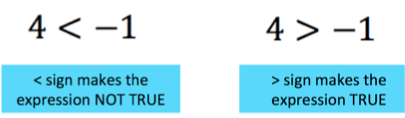
Image source: by Hannah Bonville
This tells us we need to write our inequality using the sign.