Interactive · 10 questions
Suppose we have a function we don't know how to take the derivative of, but the function is the product of two functions we do know how to take the derivative of, like this:
It would be nice to have a formula for the derivative of in terms of the derivatives of the two functions on the right. Let's call these functions and .
To do this, imagine a rectangle with sides and , and suppose represents time. Then is the area of the rectangle at time :
Now suppose a small amount of time, , passes. The values of the two functions will also change by small amounts, and , and the rectangle's dimensions will change:
We want the derivative of , so let's find , the difference between the area of the red rectangle and the area of the blue rectangle.
What strategy should we use to find this difference of areas?
We're going to find the difference by adding the areas of the three rectangles formed by the dotted red lines. (If you have a different strategy, try using yours and see if you get the same thing!)
What's the area of the long rectangle on the top?
What's the area of the tall rectangle on the right?
What's the area of the small rectangle on the top right?
Good, so what's ?
Can you figure out the derivative of from here?
Divide both sides of the equation above by ; this takes us from an equation about differences, to an equation about differences relative to a small change in .
Now we take the limit of both sides as approaches 0. (Yes, this is allowed; since the two sides are always equal, they must have the same limit!)
When approaches 0, some of the terms become derivatives. Which ones?
Good, so what does our equation become?
If you took the limit of both sides explicitly and used limit notation, you should have:
If you didn't use limit notation, but you're working under the assumption that is approaching 0, you should have:
Now for the final step:
The last term of the equation above approaches 0. Why?
If you followed the hints, you've seen most of the solution:
As approaches 0, we can rewrite the term as . Then approaches 0, so the whole term approaches 0, leaving us with:
And that's the product rule!
Another way to think about why the last term disappears as approaches 0 is to think about the areas of the rectangles. The area of the small rectangle in the upper right becomes insignificant compared to the other two rectangles.
Finally, let's solve the problem we started with.
Find the derivative of .
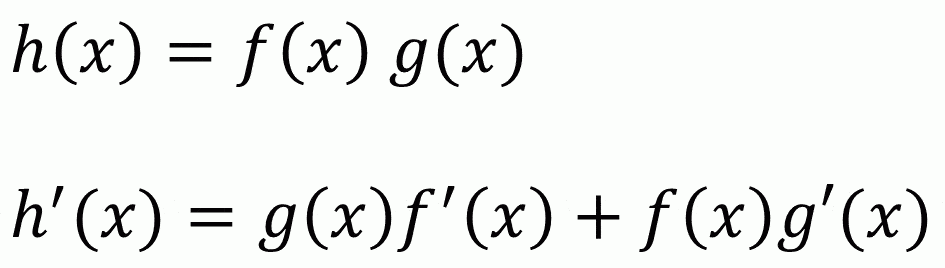
We'll finish by writing out the product rule one more time:
If , then .