লেখচিত্র: পরমমান ফাংশন

Before this, knowPiecewise Definitions of Functions

Illustrated · 2 min

Absolute Value

Think of the absolute value of a real number the distance from 00 it is on the number line. |4848| is 4848, because 4848 is that distance away from 00. Now |−48-48|'s absolute value is also 4848, because though it is negative, the distance to 00 is also 4848.

What if we are asking the absolute value of |n−1n - 1|? In this case there is another number with the nn also between the parentheses! Well, this is just like the distance from 11.

If you ever see another number or variable next to the 'main one' (in this case the main one is nn), just switch its sign, like how we did it with −1-1, and find the distance to that new number.

Absolute Value Functions

The basic absolute value function looks like this:

y=∣x∣y = |x|

Always watch for the absolute value bars around a variable in a function.

When graphed, absolute value functions look like VV's with the point at the origin, and the yy - axis splitting them in half.

The reason for this is that the absolute value of xx is always a positive number. Which means yy can never be negative. This is why the graph of absolute value functions always stay above the xx - axis, except when they are at the origin.

For our basic absolute value function, this is the reason why it looks like a symmetrical VV. Our function can be 'split' into two very simple functions:y=xy = x and y=−xy = - x. All we have to do now is slice off the halves of our new functions which are under the xx - axis, and connect the rest.

From here we get the exact description above: a symmetrical VV.

Absolute value function

Made using Desmos

A quadratic absolute value function goes by this same reasoning. The only difference is that the absolute value term on the right side of the equation is squared. This is the basic quadratic absolute value function's form:

y=∣x∣2y = |x|^2

As you can see, it's basically a quadratic function, but involving absolute value.

Graph of y=|x|^2

Made using Desmos

Looking Further

You can also apply transformations to the absolute value function, such as the function being shifted left, right, up, or down. You'll learn about this later!

Math as a puzzle

Many contest problems feel more like puzzles than homework. They are a good way to find out how much fun math can be. These are real problems from the AMC 8, AMC 10, AMC 12 and AIME, the national math competitions for middle and high school students, each with a worked solution on LIVE by Po-Shen Loh.

Video

(Video) Graphing Absolute Functions

by mathman1024

Here's a video by mathman1024 showing you how to graph absolute value functions.

Summary

In this video, you will learn how to graph non-linear absolute value functions.

Try it on your own before watching the video!

Example: Graph f(x)=∣x+2∣−3f(x) = | x+2 | -3

Here's a hint: the basic shape of an absolute value function is the "V" shape we've seen before. We want to then understand what happens to the parent function. We've seen this before with function transformations.

Illustrated · 1 min

Absolute Value Functions & Graphs

Absolute value functions
A "V" shape
Straight lines, symmetric

Made using Desmos

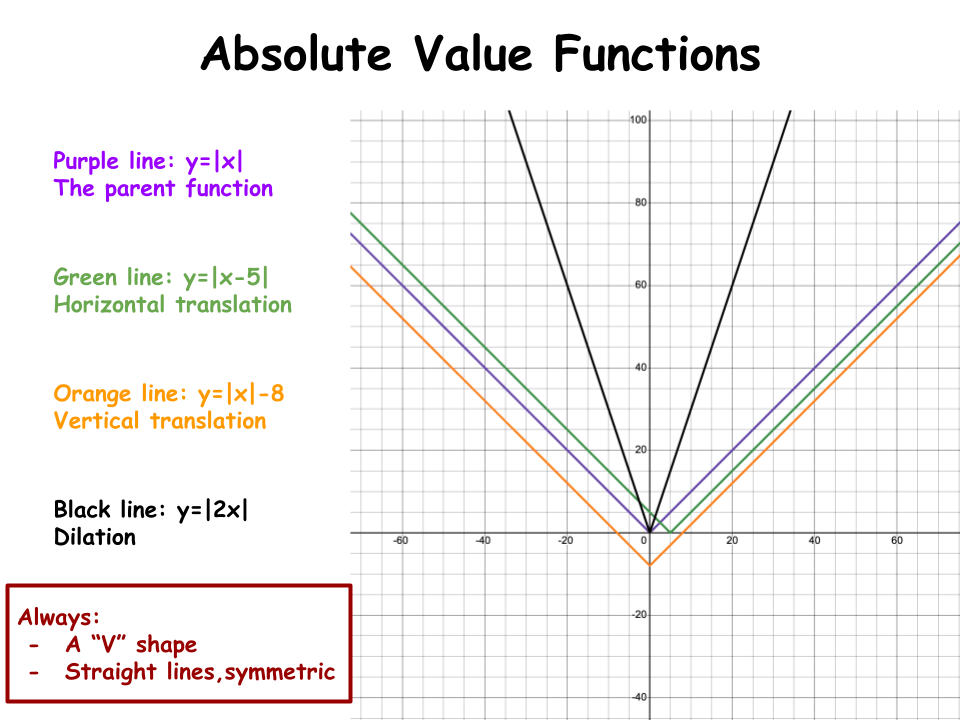
An absolute value function is a type of function where the output is always positive or zero, no matter what number you put in. The absolute value of a number is its distance from zero on a number line, without considering whether it's positive or negative. When you graph an absolute value function, the result is a "V" shaped graph. The graph has a point at the vertex, where the "V" starts, and it slopes upward on both sides.

It is possible to have function transformations, which we have demonstrated above.

  • The purple function: the parent function. Starts at the origin and opens upward.
  • The green function: a horizontal translation to the right by 55 units.
  • The orange function: a vertical translation down by 88 units.
  • The black function: a dilation by 2 units.

Looking Further

To understand why an absolute value graph splits into two rules, we can rewrite it as a piecewise function.

Type a concept, like “slope” or “photosynthesis”.

↑ ↓ to choose · Enter to openSearch explanations and problems

