Read · 4 min
We've been learning about enthalpy. We use enthalpy when we have constant pressure. At constant pressure, we defined enthalpy to equal heat. So, it does not consider pressure-volume work. Instead, it gives us a value of the energy transfers between kinetic and potential energy. If a reaction is exothermic, some potential energy is transferred to kinetic. Increased kinetic energy equals a higher temperature. In endothermic reactions, kinetic energy is transferred to potential energy. The temperature is lowered.
Now, we're going to study how we calculate enthalpy changes.
Methods for Calculating Enthalpy
There are four methods for calculating enthalpy changes. They are listed below. We'll look at each one. Each process is a little different. But, they should all produce the same results. One may be easier for one problem. But, a different one may be better for another question. But, you could just learn the method you like best and use it every time.
- Enthalpy for materials and phase changes: .
- Bond Energy
- Hess's Law
- Formation Enthalpy
Enthalpy for Heating Materials and Phase Changes
At constant pressure, enthalpy equals heat. Remember, heat is a transfer of energy created by temperature differences. So, what's the most basic form of enthalpy change? Heating something from one temperature to another.
Let's say we want to heat 50.0 grams of water. Let's start at 25.0 celsius and end at 50.0 celsius. We want to know the energy (enthalpy) required to double the temperature. Thankfully we have a simple equation, .
- is heat.
- is the mass of our substance. In this case, it's 50.0g of water.
- is the specific heat capacity at constant pressure. For liquid water, it's .
- is the temperature change.
As a side note, the normal use for this equation is heating pure substances or solutions. But, when we study calorimetry, we can use it for chemical reactions. In calorimetry, we have to define our system very specifically. And we need to know the specific heat capacity of the calorimeter.
Let's solve the problem.
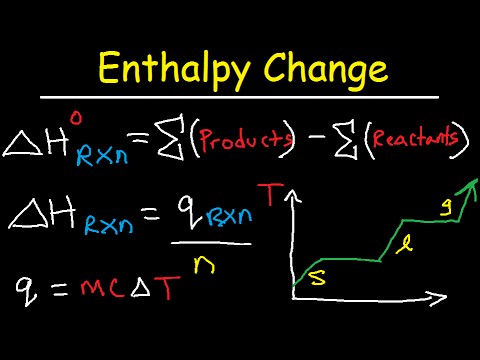
We can also solve enthalpy problems for phase changes. But, we need to think about phase change diagrams. There are two flat lines at the melting and vaporization points. But the temperature isn't changing. If we used , the energy would be zero. That doesn't seem right. Thankfully, chemists have experimentally determined the melting and vaporization enthalpies. We just have to look them up.
So let's take 50.0g of ice from to .
First, we heat the ice from to . The specific heat capacity of ice is .
.
Next, we melt the ice. The standard enthalpy of melting is .
Now we can heat the liquid water up to its melting point.
Now we have to convert our liquid water to steam. We use the standard enthalpy of vaporization. It's .
$.
Finally, we can increase the temperature of our steam from to .
.
If we add up all the steps, we find our total enthalpy.
Bond Energy
So, we've seen we can calculate the heat for materials. But what about the enthalpy of chemical reactions? There are multiple methods. But, the one I find easiest is bond energies. Chemists have determined the energy required to break many different bonds. It takes energy to break bonds. Breaking bonds is endothermic. But, it releases energy to form a bond. Remember, the lowest energy is the most stable. So, forming bonds is exothermic.
The bond energy formula is easy to remember. We can look up the values for breaking and forming bonds. But, all bond enthalpies are for gases. So, if you have a liquid, you have to add the heat of vaporization.
.
Let's look at the combustion of methane.
Broken:
- 4 C-H -
- 2 O=O -
- Total:
Formed:
- 2 C=O -
- -
- 4 O-H -
- Total:
So, the combustion of methane is exothermic. It releases energy. What's happening at the molecular scale? The products have less energy than the reactants. The bonds store potential energy. As the bonds broke, some of their potential energy was transferred to kinetic energy. The increase in kinetic energy would cause a temperature increase. The heat that we calculated is how much energy was transferred.
Hess's Law
We've learned that enthalpy is a state function. It only depends on the initial and final conditions. The path does not matter! So, we can break reactions into steps. We just need the steps to add to our overall reaction. Then we can add the enthalpy of each step to find our overall enthalpy. It's similar to reaction mechanisms. This process is called Hess's law. Thankfully, chemists have determined the enthalpy for many different reactions. So, we just have to look up the values.
Let's return to the combustion of methane.
We could write it in two steps. Each step is a thermochemical equation.
Like a reaction mechanism, we can add the two equations. We cancel any molecule that is both a product and reactant. We also add the enthalpies.
.
We can see that our enthalpy was the same as the bond energy method.
Enthalpies of Formation
Chemists have also determined a unique type of enthalpy. We call it the standard enthalpy of formation (). It's the enthalpy of making a molecule from its elements. Using the formation enthalpy is an application of Hess's law. Again, we look up the values and add everything up.
Let's return to the combustion of methane.
- Oxygen is a diatomic element. It's already in its elemental state. So, its .
Notice that our reaction forms two moles of liquid water. So, we'll need to double the .
.