
Interactive · 2 questions
So what is Cavalieri's principle?
It is known as the method of invisibles and has two cases - a 2-D case and a 3-D case, but we will only be looking at the 2-D version for now.
So... Let's take a rectangle for example.
First of all, the formula for the area of a rectangle is
For now, let the length be the base (b) and the width be the height (h)...
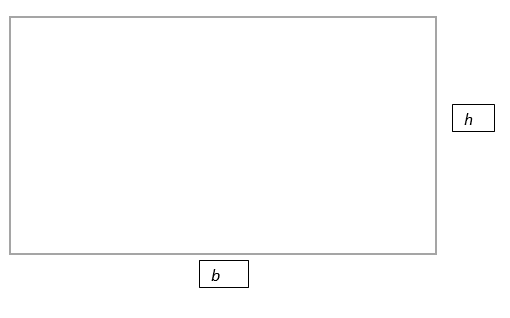
Now if you cut the rectangle into small pieces and shift the pieces:
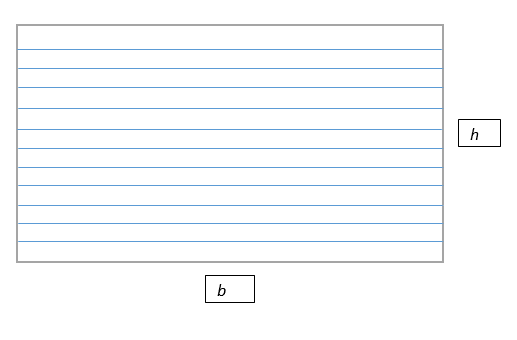
It will form a parallelogram-looking-polygon with 2 jagged sides. However, this new-looking-shape still has the same area since nothing has been changed - it has only been moved.
If you cut the rectangle into EXTREMELY small pieces and shift the pieces, you will probably get this:
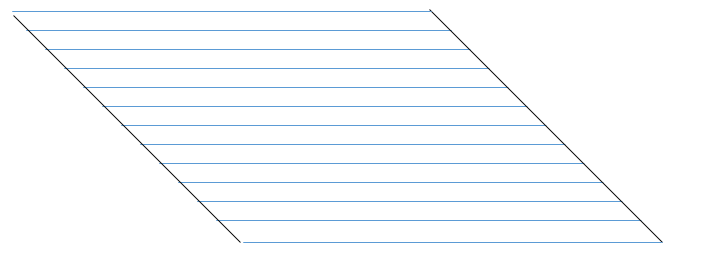
A PARALLELOGRAM!
Now, what is the formula of a parallelogram?
It is the EXACT same formula as a rectangle because technically speaking, a parallelogram is just a rectangle cut up into small pieces (that has been "layered").
This is basically the concept of Cavalieri's principle.