Interactive · 1 question

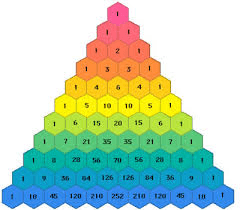
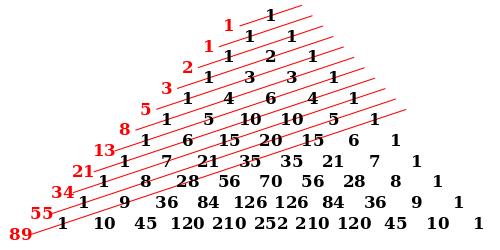
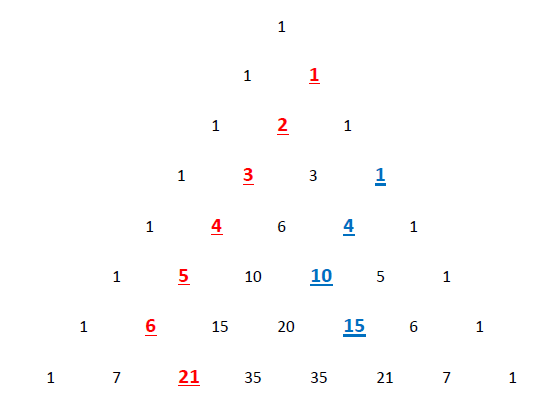
প্যাসকেলের ত্রিভুজ কিছু সংখ্যার একটি ত্রিভুজাকার তালিকা। এই ত্রিভুজটি আকারে অসীম। নীচে ত্রিভুজটির 00 থেকে 1010 সারি দেখানো হলো।

আচ্ছা, তাহলে এই ত্রিভুজের মানেটা কী? আর কেমনেই বা এই ত্রিভুজের প্রত্যেক মান নির্ণয় করা হয়?

আমরা দেখতে পাচ্ছি, ত্রিভুজটির প্রত্যেক সারির সর্ব বাম ও ডান ঘরের মান 11।

তাহলে মাঝের ঘরগুলোর মান কিভাবে নির্ণয় করে?

আরো গভীর ভাবে লক্ষ্য করলে দেখা যাবে যে মাঝের প্রত্যেক ঘরের মান ওপরের দুই ঘরের মানের যোগফল। আসলেই তাই ! প্যাসকেলের ত্রিভুজের কোনো ঘরের মান তার ঠিক ওপরের দুই ঘরের মানের সমষ্টির সমান।

প্যাসকেলের ত্রিভুজের অনেক বিস্ময়কর বৈশিষ্ট্য আছে। যেমন, প্যাসকেলের ত্রিভুজকে আমরা এভাবেও লিখতে পারি।
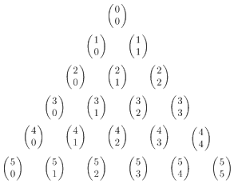
এখানে (na)\tbinom na এর মাধ্যমে nCan_{C_a} বোঝানো হয়েছে

তোমাদের জন্য একটা প্রশ্ন রইল,** আমরা কেন প্যাসকেলের ত্রিভুজকে এভাবে লিখতে পারি?** ইঙ্গিত লাগলে Continue বাটনে ক্লিক কর।

এই অভেদটি ব্যবহার কর, (ab)=(a−1b−1)+(a−1b)\binom{a}{b}=\binom{a-1}{b-1}+\binom{a-1}{b}।

আমরা সবাই তো বর্গের ও ঘন এর সূত্র জানি, তাই না? ( আসলে তো গড়গড় করে বলতেও পারি :P) (a+b)0=1(a+b)^0=1 (a+b)1=a+b(a+b)^1=a+b (a+b)2=a2+2ab+b2(a+b)^2=a^2+2ab+b^2 (a+b)3=a3+3a2b+3ab2+b3(a+b)^3=a^3+3a^2b+3ab^2+b^3 (a+b)4=a4+4a3b+6a2b2+4ab3+b4(a+b)^4=a^4+4a^3b+6a^2b^2+4ab^3+b^4 এখানে কী প্যাসকেলের ত্রিভুজ লক্ষ্য করতে পারো?

তুমি যদি শুধু সহগগুলোর দিকে খেয়াল কর, দেখতে পাবে যে সেগুলো প্যাসকেলের ত্রিভুজের এক একটি সারি তৈরি করে। আশ্চর্যের বিষয়, তাই না?

এটা কেন হয় জানতে চাইলে তুমি https://www.expii.com/t/binomial-theorem-4898?type=explanation&id=5477 দেখতে পারো।

তাহলে একটা প্রশ্ন করি, (a+b)6\left(a+b\right)^6 এর সহগ গুলো কী কী?

Choose one answer

Preparing for a math contest?

Working through past problems on one idea at a time is one of the most effective ways to prepare. These are real problems from the AMC 8, AMC 10, AMC 12 and AIME, the national math competitions for middle and high school students, each with a worked solution on LIVE by Po-Shen Loh.

Interactive · 6 questions

Pascal's Triangle

The math behind Pascal’s Triangle is very simple. It is so simple that even young students can learn and repeat the pattern.

But as you look more closely, you start to notice interesting patterns. These patterns lead to powerful ideas in counting and other areas of math.

Remember: While Pascal’s Triangle helps count combinations where order does not matter (like combinations), permutations are used when the order of the selected items matters.

Let’s start by learning how the arithmetic works.

The foundation of the triangle is 11s. The first row is a 1.1. The second row is two 11s. After that, the first and last entry in each row is a 1.1. Let's look at the first 33 rows:

First three rows of Pascal's triangle

Image source: by Trent Tormoehlen

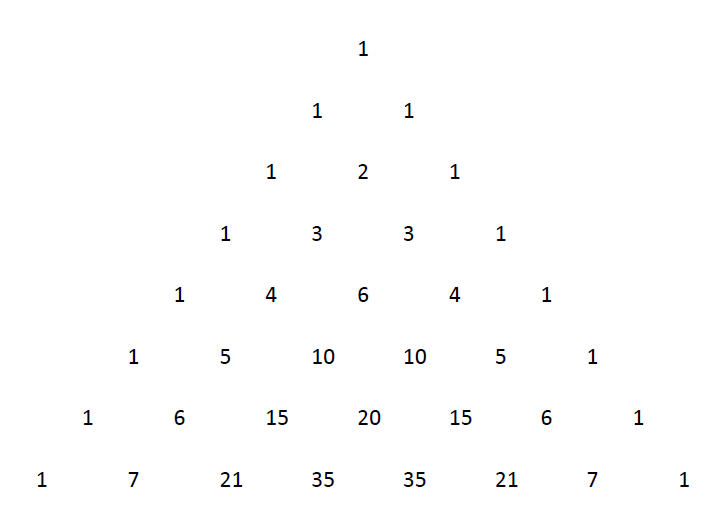
The question mark is the first entry that is not a 1.1. It is easily found by looking at the two entries it is between that are in the row above it. In this case the "?" is 1+1=21+1=2. Here is a look at the first 44 rows. Note: the general convention is for the top row to be referred to as row 0.0. Thus the first 44 rows are rows 00 through 3.3.

First four rows of Pascal's triangle

Image source: by Trent Tormoehlen

As you can see, the next row is 1,3,3,1.1, 3, 3, 1. The 33s come from 1+2=31+2=3 and 2+1=32+1=3.

What is row 44 (remember - this is actually the fifth row) of the Pascal's triangle?

Choose one answer

Interactive · 4 questions

Pascal’s Triangle is a triangle made of numbers. As the name suggests, the numbers are arranged in rows that grow longer as you move down the triangle.

Each number in the triangle follows a simple rule, which makes the pattern easy to build and remember. Even though the rule is simple, it leads to many interesting results.

Pascal’s Triangle has many special properties that show up as you explore it more. These patterns are useful in areas like number theory, combinatorics, and counting and probability. The entries in Pascal’s Triangle are binomial coefficients. Combinatorics with Pascal’s Triangle shows how these values can also be interpreted as counting different selections.

Later on, we will look at some of these properties and see how they are used in math problems.

Let's take a look at the first few rows of the triangle: 11    11    2    11    3    3    11    4    6    4    11    5   10  10   5    1⋯\begin{array}{c} 1 \\ 1\,\,\,\,1 \\ 1\,\,\,\,2\,\,\,\,1 \\ 1\,\,\,\,3\,\,\,\,3\,\,\,\,1 \\ 1\,\,\,\,4\,\,\,\,6\,\,\,\,4\,\,\,\,1 \\ 1\,\,\,\,5\,\,\,10\,\,10\,\,\,5\,\,\,\,1 \\ \cdots \end{array}

Let's think about where these numbers come from.

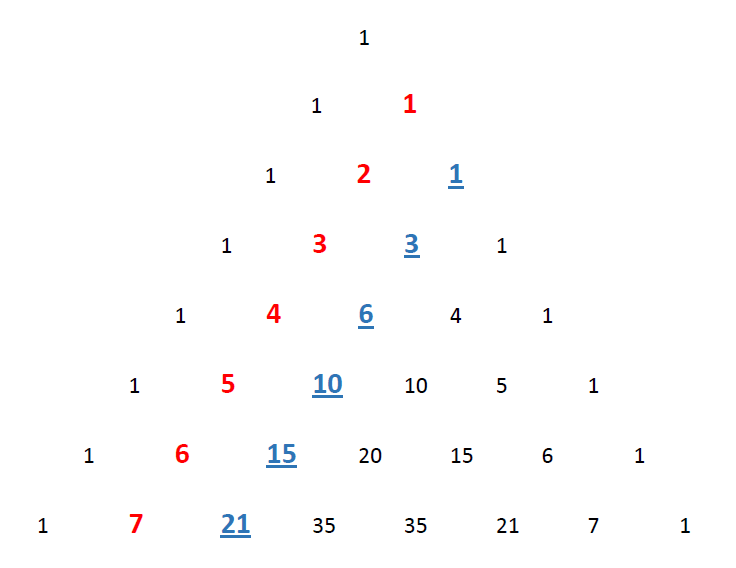
With the exception of the 11 at the top of the triangle, each number is the sum of the two numbers above it. Let's look at the above rows again, this time with some numbers colored for reference: 11    11    2    11    3    3    11    4    6    4    11    5   10  10   5    1⋯\begin{array}{c} {\color{#8925AE}{1}} \\ {\color{#8925AE}{1}}\,\,\,\,1 \\ 1\,\,\,\,{\color{blue}{2}}\,\,\,\,{\color{blue}{1}} \\ 1\,\,\,\,3\,\,\,\,{\color{blue}{3}}\,\,\,\,1 \\ 1\,\,\,\,{\color{green}{4}}\,\,\,\,{\color{green}{6}}\,\,\,\,4\,\,\,\,1 \\ 1\,\,\,\,5\,\,\,{\color{green}{10}}\,\,10\,\,\,5\,\,\,\,1 \\ \cdots \end{array}

  • 0+1=1{\color{#8925AE}{0+1 = 1}}. Note that 11s populate the far left and right sides of Pascal's triangle.
  • 2+1=3{\color{blue}{2+1 = 3}}.
  • 4+6=10{\color{green}{4+6 = 10}}.

Note that the way Pascal's triangle is constructed leads to an inherent symmetry. Any given row of the triangle is the same forwards and backwards.

What is the first number in the next row?

Choose one answer

Illustrated · 2 min

NOTE: read the other explanations to find out what a Binomial Coefficient is.

In this explanation we will be studying something called Pascal's Triangle, and how it relates to binomial coefficients. It is essentially a triangle of numbers that look like this:

Note that the numbers on the left and right edge of the triangle are always 11. In addition, each number is generated by adding the two numbers to the top-left and top-right. For example, the 22 is generated by adding the 11 and the 11 directly to its top-left and right. Similarly, the 33 is created by adding the 22 and the 11.

But what can this triangle possibly have to do with binomial coefficients?

You may have noticed in the third row that (40)=1\binom{4}{0}=1, (41)=4\binom{4}{1}=4, (42)=6\binom{4}{2}=6, (43)=4\binom{4}{3}=4, and (44)=1\binom{4}{4}=1. Following this logic, the entire triangle can be rewritten like this:

You can confirm that each of the values of the binomials equals to the corresponding value of the number on the triangle. We can see that the top number of each binomial also corresponds to the row number of pascals triangle (WARNING: the very top row with one number is considered row 00) and the bottom number of each binomial is the element number in each row (element 0 being the first number in each row).

But how can this be so? Is this all a big coincidence, or is there an underlying reason?

There are several ways to see that this is indeed not a coincidence. The argument I will use is an algebraic argument.

Note that in Pascal Triangle, we have that the sum of two adjacent numbers forms the number that is directly below and adjacent to the two numbers.

So if the first number is (nk)\binom{n}{k} and the second is (nk+1)\binom{n}{k+1}, then the number that they should sum to is (n+1k+1)\binom{n+1}{k+1}.

Recalls that the algebraic definition of a binomial is (nk)=n!k!(n−k)!\binom{n}{k}=\dfrac{n!}{k!(n-k)!}.

Thus, we want to prove that n!k!(n−k)!+n!(k+1)!(n−k−1)!=(n+1)!(k+1)!(n−k)!\dfrac{n!}{k!(n-k)!}+\dfrac{n!}{(k+1)!(n-k-1)!}=\dfrac{(n+1)!}{(k+1)!(n-k)!}

Setting a common denominator to the first two fractions, we see that n!k!(n−k)!+n!(k+1)!(n−k−1)!=(k+1)n!(k+1)!(n−k)!+(n−k)n!(k+1)!(n−k)!=(n+1)n!(k+1)!(n−k)!=(n+1)!(k+1)!(n−k)!\begin{align*}\dfrac{n!}{k!(n-k)!}+\dfrac{n!}{(k+1)!(n-k-1)!}&=\dfrac{(k+1)n!}{(k+1)!(n-k)!}+\dfrac{(n-k)n!}{(k+1)!(n-k)!}\\ &= \dfrac{(n+1)n!}{(k+1)!(n-k)!}\\ &=\dfrac{(n+1)!}{(k+1)!(n-k)!}\end{align*}

Thus, we have proved that (nk)+(nn+1)=(n+1k+1)\binom{n}{k}+\binom{n}{n+1}=\binom{n+1}{k+1}, and this proves that the relationship between Pascal's Triangle and binomial coefficients was not a coincidence.

This also brings to light a property of binomial coefficients, known as Pascal's Identity: (nk)+(nk+1)=(n+1k+1)\binom{n}{k}+\binom{n}{k+1}=\binom{n+1}{k+1}

Read · 1 min

Let's start with an example: (x+y)2=x2+2xy+y2(x+y)^2 = x^2 + 2xy + y^2 The coefficients (11, 22, and 11) happen to be the same as the second row of Pascal's Triangle, and when we try (x+y)3=x3+3x2y+3xy2+y3,(x+y)^3 = x^3 + 3x^2y + 3xy^2 + y^3, we get the third row of Pascal's Triangle (11 33 33 11) as coefficients!

And as you may know, you can find any number in Pascal's Triangle by calculating: (na)\tbinom na; where nn indicates the row and aa the place on the row.

Ex: (42)=6\tbinom 42 = 6 tells us that the second place on the fourth row of Pascal's Triangle is a six.

We just saw that the coefficients of (x+y)3(x+y)^3 were the numbers of the third row. And that you calculate these coefficients by doing: (3a)\tbinom 3a, where a is the place on the row. So (x+y)n=(n0)xn+(n1)xn−1y+(n2)xn−2y2...(nn)yn(x+y)^n = \tbinom n0 x^n + \tbinom n1 x^{n-1}y + \tbinom n2 x^{n-2}y^2 ... \tbinom nn y^n (Note that (73)=(74)\tbinom 73 = \tbinom 74.)

The proof and more about the binomial theorem can be found here.

Illustrated · 1 min

Pascal's Triangle, named after Blaise Pascal, is a triangle where two numbers added up, result in the next number:

Pascal's triangle

Image source: by Bladyda

The top row of the triangle, containing only a single 11, is indexed as row 00. The next row of the triangle, containing two 11s, is therefore row 11.

Any of the numbers can be calculated via the expression (na)\binom na where nn is the row, and aa the place on that row. For example, (43)=6.\binom 43 = 6.

This also means that (00)=1.\binom 00 = 1.

Video

(Video) Binomial Expansion Using Pascal's Triangle

by Mathispower4u

This video by Mathispower4u demonstrates how to expand using Pascal's Triangle and the binomial theorem.

What is the sum of the elements of row 44 (the fifth row) of Pascal's triangle?

Choose one answer

Interactive · 2 questions

Background

Before we discuss what exactly Pascal's triangle is, we briefly discuss what factorials and binomial coefficients are, because those are important for understanding why we care about Pascal's triangle.

A factorial of a nonnegative integer nn is the number of ways to arrange nn objects in a line, and is denoted as n!n!. We say that 0!=10! = 1 because there is one way to arrange zero objects, and that "way" is to do absolutely nothing. For positive integers this definition is more intuitive.

For instance, we can arrange the three letters A,B,A, B, and CC in 66 different ways:

ABC,ACB,BCA,BAC,CAB,CBAABC, ACB, BCA, BAC, CAB, CBA

This is precisely equal to

3!=3×2×1=6.3! = 3 \times 2 \times 1 = 6.

Now we define a binomial coefficient of two nonnegative integers nn and kk (where n≥kn \geq k) to be

(nk)=n!k!(n−k)!.{{n}\choose{k}} = \frac{n!}{k!(n - k)!}.

You may recognize this formula from our lesson of combinations. This combinations formula tells us the number of combinations, which helps with binomial expansion.

We can plug numbers into the formula just like any other formula, but it helps to understand where the formula comes from. The quantity (nk){{n}\choose{k}} represents the number of ways to select kk objects out of a group of n.n. This activity doesn't make physical sense if k>n,k > n, so we just worry about when n≥k.n \geq k. We also assume natural numbers.

What is the number of ways to select four balls out of a collection of seven?

Choose one answer

Type a concept, like “slope” or “photosynthesis”.

↑ ↓ to choose · Enter to openSearch explanations and problems