Illustrated · 1 min

Solving Compound Inequalities with an Intersection (AND)
In previous lessons, we saw how to solve individual inequalities, with grouping and graphing.
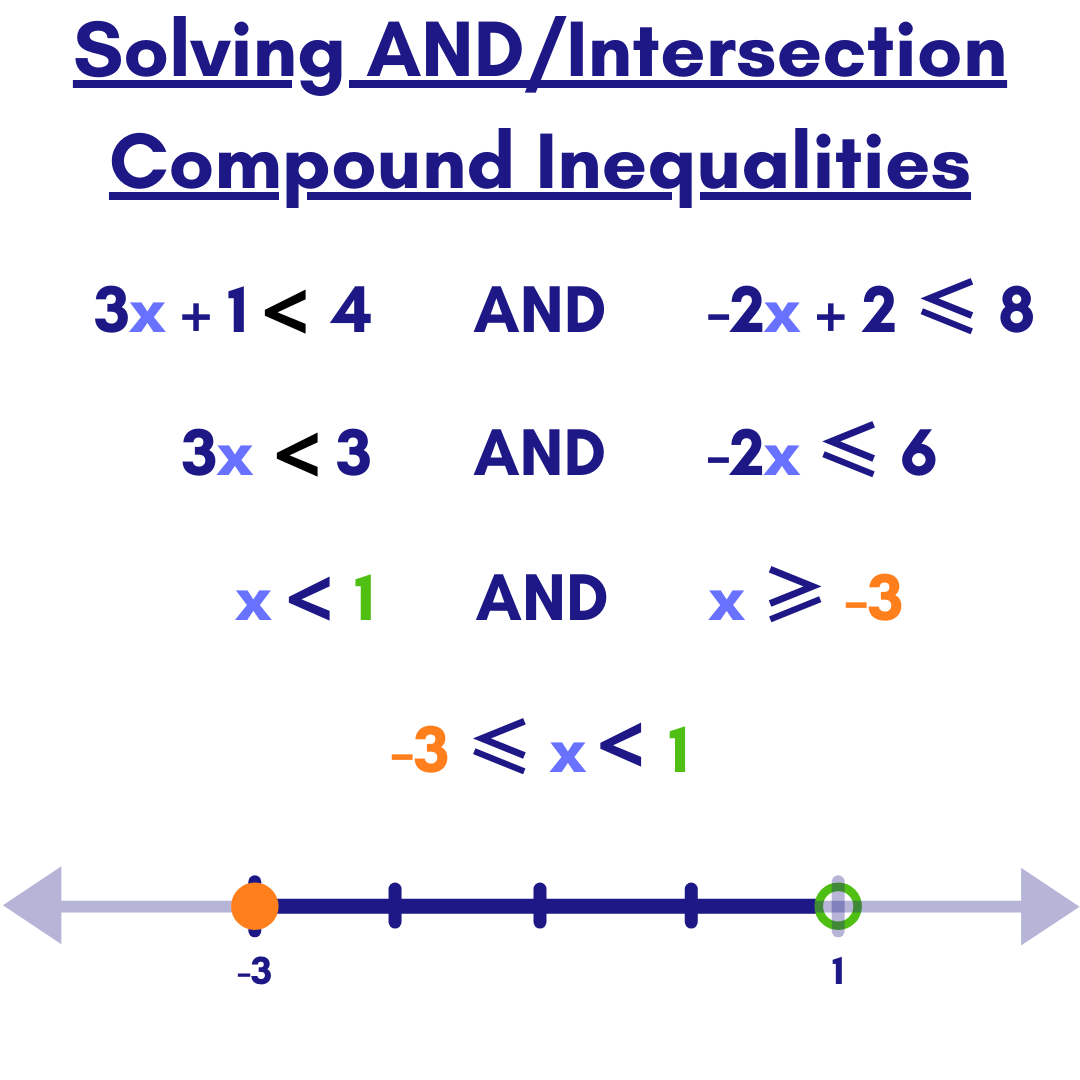
In this lesson, we're going to look at how to solve compound inequalities, which are basically two inequalities. With intersections, we're looking at the points where the two inequalities overlap. What does that mean?
Let's break it down with an example using graphing.
Say you have two inequalities:
Let's graph the first inequality, the purple inequality, on a number line.

Image source: by Anusha Rahman
On the purple graph, we can see an open circle on because the inequality is simply less than, not less than or equal to. Because we're looking at values that are less than , the purple arrow goes to the left.
Now, let's graph the second inequality, the green one.

Image source: by Anusha Rahman
This is a graph of , with an open circle and the arrow going toward the right.
Since we want to find the solution of the two inequalities, we want to find the points at which the two inequalities meet. Notice that it's similar to solving systems of equations by graphing?
Let's take a look at a graph to see how this works out.

Image source: by Anusha Rahman
The orange section is the points at which the two inequalities intersection. These are the points that are both less than and greater than . Kind of sounds similar to intersection of sets, doesn't it?
A good way to double check your work for simple problems is to think about it! List out the values that are greater than and less than , exclusive:
That seems to match what we've graphed on the number line. So it seems we're correct!