ফাংশন হিসেবে অন্তরজ

Video · + 3 min read

(Video) Understanding the Definition of Derivative

by PatrickJMT

Here's a video by patrickJMT explaining derivatives and understanding their definition.

The definition of a derivative is: f′(x)=lim⁡h→0f(x+h)−f(x)hf'(x)=\lim_{h\rightarrow0}\frac{f(x+h)-f(x)}{h}

This probably looks like a jumbled mess of nonsense but we're going to explain everything shortly. First is the notation for a derivative: f′(x)f'(x) and said "f prime of x." The rest of the definition represents the slope of a tangent line at xx.

Say we have a function f(x)f(x), our tangent line at a point is the straight line that extends out from that point.

What we're interested in is finding some way to calculate the slope of this tangent line. We use a roundabout way involving limits to find this. Remember, to find the slope we need two points on the line. We only have one point, which is where the tangent and the function touch.
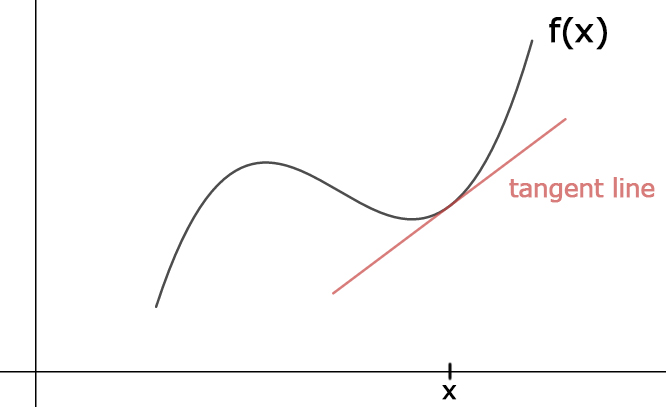
The point at xx is the only known point.

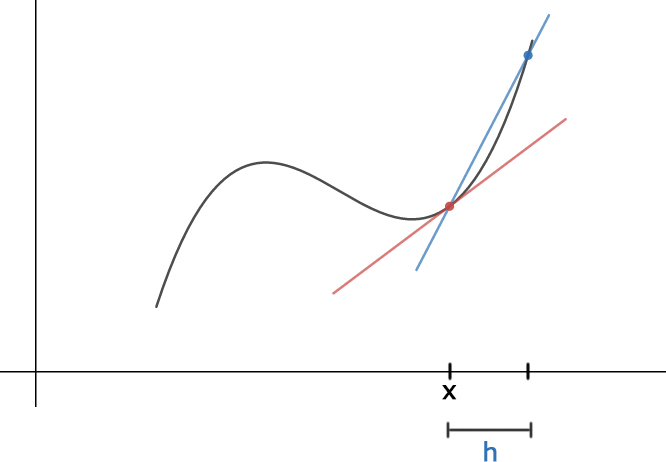
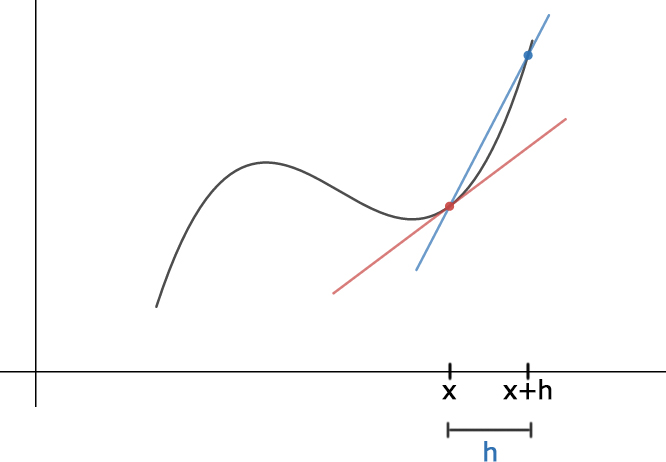
What we're going to do is find the slope of two points on the graph. So we added some addition points on our function in blue. We want to find the slope of them and our original point in red.

When you take two points on a graph and connect them, the resulting line is called a secant line.

We can find the slope of this secant line because we know two points. But who cares? We're interesting in the slope of our tangent line. The second point of the secant line is far away from our original point. What we're going to do is take a point closer to our original point.

We can find the slope of this closer secant line. But again we want the slope of the tangent line. Well let's make another secant line but with a point even closer.
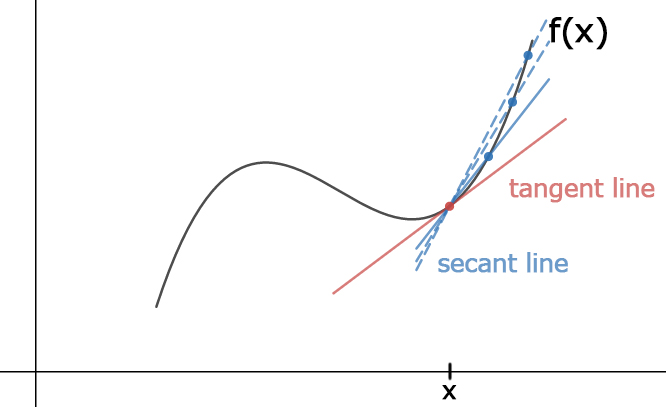
The idea is as we get closer and closer to our original point, the secant line starts to resemble the tangent line. Since we can find the secant line's slope, we can use this to figure out the tangent line's slope.

So what we're doing is find the slopes of secant lines. Let's label them arbitrarily on our graph. The first secant line we made has a slope of s1s_1, the second s2s_2 and so on.

What we do is pick points closer and closer to xx and find the slopes of those secant lines. The key idea becomes: slope oflimit of thetangent=slopes of thelinesecant lines\begin{array}{ccc} \text{slope of}&&\text{limit of the}\\ \text{tangent}&=&\text{slopes of the}\\ \text{line}&&\text{secant lines} \end{array}

From here we just need to make this key idea mathematical. So let's just go back to when we had one secant line.
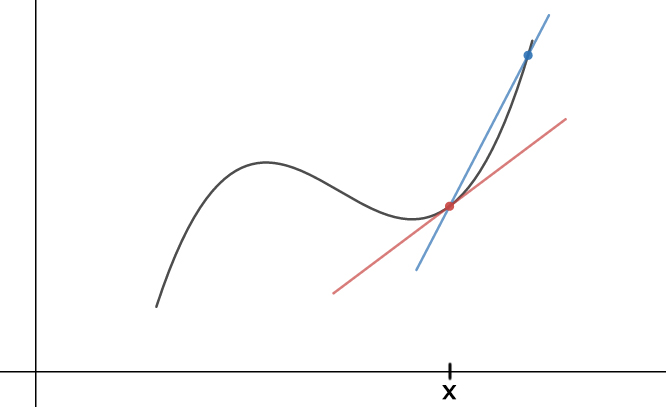
To find the slope of secant need to know the other point. Let's say that its some distance hh away from our original point.

So if we're originally sitting at the point xx and we go a distance of hh our new point will be x+hx+h.

Now we can generically label our two points as (x,f(x))(x,f(x)) and (x+h,f(x+h))(x+h,f(x+h)).

So now the slope of the secant line becomes: f(x+h)−f(x)(x+h)−x\frac{f(x+h)-f(x)}{(x+h)-x} We can simplify the denominator by adding the xx and −x-x together: f(x+h)−f(x)h\frac{f(x+h)-f(x)}{h}

Now we want to define the slope of the tangent line by using slopes of secant lines. So we define the tangent slope as f′(x)f'(x). f′(x)=      f(x+h)−f(x)hf'(x)=\ \ \ \ \ \ \frac{f(x+h)-f(x)}{h}

But we're not done yet. We wanted to take the limit of these secant slopes. We also wanted to take the points as they got closer and closer to our original xx value. As the points get closer the distance between them decreases. So our hh value, the distance between the points, gets smaller and smaller. So the limit is as hh approaches 00, which means we take points until there's no distance between them. f′(x)=lim⁡h→0f(x+h)−f(x)hf'(x)=\lim_{h\rightarrow0}\frac{f(x+h)-f(x)}{h} Look at that! We now have a formula that gives us the slope of a tangent line!

Read · 1 min

In Misha's words: "we've already defined the derivative at a point xx, and now we define a function called f′(x)f'(x) whose value at xx is that derivative."

When we speak of "the derivative of f(x)f(x)", denoted by f′(x)f'(x), dfdx\frac{df}{dx}, or ddx(f)\frac{d}{dx}(f), we are speaking of a function of xx, NOT a number.

For instance, the derivative of f(x)=x3f(x) = x^3 is f′(x)=3x2f'(x) = 3x^2. Notice that we don't need to evaluate either of them anywhere; differentiation takes a function and yields a function. Of course, this function encodes all the information about any potential evaluation of the derivative; but it is just an ordinary function.

This concept allows us to do all sorts of nice things, like taking second derivatives. Since the derivative is a function, it can be differentiated; this yields the second derivative. Notice that this ability means that getting the derivative (a function) is much more powerful than just evaluating the derivative at a point. Knowing f′(2)=3f'(2) = 3 tells you nothing about f′′(2)f''(2) (the second derivative of ff, evaluated at 2).

[Many students mistakenly claim at least once that f′(2)=3f'(2) = 3 implies f′′(2)=0f''(2) = 0, since the derivative of 3 is 0. Do you understand why this is false?]

Interactive · 5 questions

Over here, we found the derivative of f(x)=x2f(x)=x^2 at x=1.x=1. But we could easily have done the same for x=0,x=0, x=−1,x=-1, x=π,x=\pi, or x=your favorite number.x=\text{your favorite number}.

Thus, we can define a function f′(x)f'(x) that is equal to the derivative of f(x)f(x) at the point x.x.

Let f(x)=x2.f(x) = x^2. What is f′(1)f'(1)?

Choose one answer

Read · 1 min

A derivative tells us how a function changes with respect to an independent variable. In other words, f'(x) is representing the rate of change of f(x).

For example, if we look at the function of area, which is:

A = π r^2

and then find the derivative of that, A':

A' = 2 π r

This derivative shows how the area is changing with respect to the radius.

Video · + 1 min read

(Videos) Finding a Derivative Using the Definition of Derivative

by PatrickJMT

In this video by patrickJMT he shows you how to use the derivative definition to find the derivative at a point.

Recall the definition of a derivative: f′(x)=lim⁡h→0f(x+h)−f(x)hf'(x)=\lim_{h\rightarrow0}\frac{f(x+h)-f(x)}{h}

The first example he looks at is finding the derivative of f(x)=12+7xf(x)=12+7x. So we write this into our definition of a derivative. f′(x)=lim⁡h→012+7(x+h)−(12+7x)hf'(x)=\lim_{h\rightarrow0}\frac{12+7(x+h)-(12+7x)}{h} Notice if we plug in h=0h=0 we get a zero in the denominator. So to find this limit we have to do some algebra until we can plug in h=0h=0. So let's expand the top. =lim⁡h→012+7x+7h−12−7xh=lim⁡h→07hh=lim⁡h→07=7\begin{align} &=\lim_{h\rightarrow0}\frac{12+7x+7h-12-7x}{h}\\ &=\lim_{h\rightarrow0}\frac{7h}{h}\\ &=\lim_{h\rightarrow0}7\\ &=\boxed{7} \end{align} So the derivative of f(x)=12+7xf(x)=12+7x is f′(x)=7f'(x)=7.

The next example he solves is finding the derivative of G(t)=4tt+1G(t)=\dfrac{4t}{t+1}. So we need to plug this into our definition. G′(t)=lim⁡h→04(t+h)t+h+1−4tt+1hG'(t)=\lim_{h\rightarrow0}\frac{\frac{4(t+h)}{t+h+1}-\frac{4t}{t+1}}{h} So we have to get like denominators in the numerator and combine these. =lim⁡h→04(t+h)(t+1)(t+h+1)(t+1)−4t(t+h+1)(t+1)(t+h+1)h=lim⁡h→04t2+4t+4th+4h(t+h+1)(t+1)−4t2+4th+4t(t+1)(t+h+1)h=lim⁡h→04t2+4t+4th+4h−4t2−4th−4t(t+h+1)(t+1)h=lim⁡h→04h(t+h+1)(t+1)h=lim⁡h→04h(t+h+1)(t+1)⋅1h=lim⁡h→04(t+h+1)(t+1)\begin{align} &=\lim_{h\rightarrow0}\frac{\frac{4(t+h)\color{red}{(t+1)}}{(t+h+1)\color{red}{(t+1)}}-\frac{4t\color{red}{(t+h+1)}}{(t+1)\color{red}{(t+h+1)}}}{h}\\ &=\lim_{h\rightarrow0}\frac{\frac{4t^2+4t+4th+4h}{(t+h+1)(t+1)}-\frac{4t^2+4th+4t}{(t+1)(t+h+1)}}{h}\\ &=\lim_{h\rightarrow0}\frac{\frac{4t^2+4t+4th+4h-4t^2-4th-4t}{(t+h+1)(t+1)}}{h}\\ &=\lim_{h\rightarrow0}\frac{\frac{4h}{(t+h+1)(t+1)}}{h}\\ &=\lim_{h\rightarrow0}\frac{4h}{(t+h+1)(t+1)}\cdot\frac1h\\ &=\lim_{h\rightarrow0}\frac{4}{(t+h+1)(t+1)} \end{align} Now if we plug in h=0h=0: =4(t+(0)+1)(t+1)=4(t+1)(t+1)=4(t+1)2\begin{align} &=\frac{4}{(t+\color{red}{(0)}+1)(t+1)}\\ &=\frac{4}{(t+1)(t+1)}\\ &=\boxed{\frac4{(t+1)^2}} \end{align}

So the derivative of G(t)=4tt+1G(t)=\dfrac{4t}{t+1} is G′(t)=4(t+1)2G'(t)=\dfrac{4}{(t+1)^2}.

In this video he goes over another example of finding the derivative using the definition.

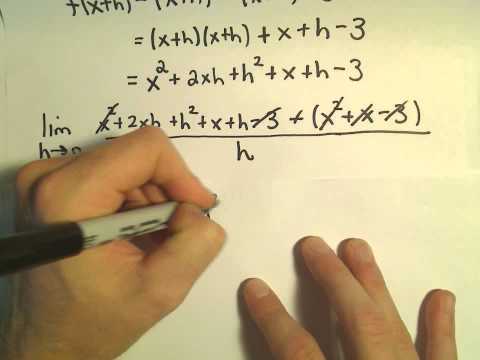
The function he takes the derivative of is: f(x)=x2+x−3f(x)=x^2+x-3. He first calculates just f(x+h)f(x+h) in order to keep things from getting messy in the numerator of the derivative definition. f(x+h)=(x+h)2+(x+h)−3=x2+2xh+h2+x+h−3\begin{align} f(x+h)&=(x+h)^2+(x+h)-3\\ &=x^2+2xh+h^2+x+h-3 \end{align} f′(x)=lim⁡h→0x2+2xh+h2+x+h−3−(x2+x−3)h=lim⁡h→0x2+2xh+h2+x+h−3−x2−x+3h=lim⁡h→02xh+h2+hh=lim⁡h→0h(2x+h+1)h=lim⁡h→02x+h+1=2x+0+1=2x+1\begin{align} f'(x)&=\lim_{h\rightarrow0}\frac{x^2+2xh+h^2+x+h-3-(x^2+x-3)}{h}\\ &=\lim_{h\rightarrow0}\frac{x^2+2xh+h^2+x+h-3-x^2-x+3}{h}\\ &=\lim_{h\rightarrow0}\frac{2xh+h^2+h}{h}\\ &=\lim_{h\rightarrow0}\frac{h(2x+h+1)}{h}\\ &=\lim_{h\rightarrow0}2x+h+1\\ &=2x+\color{red}{0}+1\\ &\boxed{=2x+1} \end{align}

Video

(Video) Calculus - Understanding the derivative as a function

by MySecretMathTutor

Type a concept, like “slope” or “photosynthesis”.

↑ ↓ to choose · Enter to openSearch explanations and problems