ত্রিকোণমিতিক ফাংশনের অন্তরজ

Before this, knowঅন্তরজের লিমিট-সংজ্ঞা ব্যবহার করে ব্যবকলন

Interactive · 10 questions

Now that we know common techniques and limits in trigonometry, the limit definition of a derivative, and how to take the derivative of products and quotients, we can do all sorts of cool things. Specifically, we can find the derivatives of trigonometric functions, which will be very useful to us later.

How could we use our limit definition of a derivative to find the derivatives of trig functions? How would we find the derivative of sin⁡x\sin x?

Choose one answer

Read · 1 min

Much like the proof of

ddx(sin⁡x)=cos⁡x\frac{d}{dx}(\sin x) = \cos x

we will prove that

ddx(cos⁡x)=−sin⁡x\frac{d}{dx}(\cos x) = -\sin x

Use the definition of the derivative:

ddx(cos⁡x)=lim⁡h→0cos⁡(x+h)−cos⁡(x)h\frac{d}{dx}(\cos x) = \lim_{h \to 0} \frac{\cos(x + h) - \cos(x)}{h}

Use the angle addition formula for cosine:

lim⁡h→0cos⁡(x)cos⁡(h)−sin⁡(x)sin⁡(h)−cos⁡(x)h\lim_{h \to 0} \frac{\cos(x)\cos(h) - \sin(x)\sin(h) - \cos(x)}{h}

Break into two limits:

lim⁡h→0cos⁡(x)cos⁡(h)−cos⁡(x)h−lim⁡h→0sin⁡(x)sin⁡(h)h\lim_{h \to 0}\frac{\cos (x)\cos(h) - \cos(x)}{h} - \lim_{h \to 0}\frac{\sin(x)\sin(h)}{h}

Rewrite:

cos⁡(x)lim⁡h→0cos⁡(h)−1h−sin⁡(x)lim⁡h→0sin⁡(h)h\cos(x)\lim_{h \to 0}\frac{\cos(h) - 1}{h} - \sin(x)\lim_{h \to 0}\frac{\sin(h)}{h}

As cited in the previous note, we know that the first limit is 00 and the second limit is 11, so the expression simplifies to −sin⁡(x)-\sin(x), as desired.

Read · 1 min

Suppose we want to find the derivative of sin⁡x\sin x.

There are two approaches- I will explain the one that most people overlook. Remember that a derivative evaluated at x=kx=k gives the slope of the tangent line to the graph at x=kx=k.

Lines with slope 0 are horizontal lines.

Let's look at the graph of sin⁡x\sin x. At x=π,3π,5π,...x= \pi, 3 \pi, 5\pi, ... it reaches the minimum/maximum values of sin⁡x\sin x.

At x=π,3π,5π,...x=\pi, 3\pi, 5\pi, ... the derivative of sin⁡x\sin x must be 0, because the tangent lines will be horizontal.

Now let f(x)=(sin⁡x)′f(x) = (\sin x)'.

Then f(x)f(x) must have zeroes at x=π,x=3π,x=5πx=\pi, x=3\pi, x=5\pi, not to mention x=−π,x=−3π,x=−5π,...x=-\pi, x=-3\pi, x=-5\pi, ...

Therefore, f(x)=acos⁡xf(x) = a \cos x for some constant aa. This is because f(x)f(x) has roots in the exact same places as cos⁡x\cos x.

How do we find aa? Let's take a look at sin⁡x\sin x when x is close to 0.

Because sin⁡x=−sin⁡(−x)\sin x = - \sin (-x), as xx approaches 0, the slope of the tangent will approach sin⁡xx\frac{\sin x}{x} which approaches 11.

Therefore, f(0)=1f(0) = 1, and we can find a=1a=1.

We have shown that the derivative of sin⁡x\sin x is 1cos⁡x1 \cos x, without using f(x+h)−f(x)h\frac{f(x+h)-f(x)}{h}

Video

(Video) Complicated Derivative Examples

by PatrickJMT

Here's a video by patrickJMT going over some derivative problems that have a mix of different rules.

The first problem he looks at has a power rule, a chain rule, and a trig rule. y=1+tan⁡x43y=\sqrt[3]{1+\tan x^4} Rewrite this in order to remove the radical symbol. y=(1+tan⁡x4)13y=(1+\tan x^4)^{\frac13} Now we can start to derive. y′=13(1+tan⁡x4)−23⋅[1+tan⁡x4]′=13(1+tan⁡x4)−23⋅[sec⁡2x4⋅(x4)′]=13(1+tan⁡x4)−23⋅[sec⁡2x4⋅(3x4)]=3x4sec⁡2x43(1+tan⁡x4)23=x4sec⁡2x4(1+tan⁡x4)23\begin{align} y'&=\frac13(1+\tan x^4)^{-\frac23}\cdot\color{red}{[1+\tan x^4]'}\\ &=\frac13(1+\tan x^4)^{-\frac23}\cdot[\sec^2x^4\cdot\color{red}{(x^4)'}]\\ &=\frac13(1+\tan x^4)^{-\frac23}\cdot[\sec^2x^4\cdot(3x^4)]\\ &=\frac{3x^4\sec^2x^4}{3(1+\tan x^4)^{\frac23}}\\ &=\boxed{\frac{x^4\sec^2x^4}{(1+\tan x^4)^{\frac23}}} \end{align}

The next problem includes the chain rule and the product rule. y=(t4−1)3(t3+1)4y′=[(t4−1)3]′(t3+1)4+(t4−1)3[(t3+1)4]′=[3(t4−1)2(t4−1)′](t3+1)4+(t4−1)3[4(t3+1)3(t3+1)′]=[3(t4−1)2(4t3)](t3+1)4+(t4−1)3[4(t3+1)3(3t2)]=12t3(t4−1)2(t3+1)4+12t2(t4−1)3(t3+1)3=12t2(t4−1)2(t3+1)3[t(t3+1)+(t4−1)]=12t2(t4−1)2(t3+1)3[t4+t+t4−1]=12t2(t4−1)2(t3+1)3(2t4+t−1)\begin{align} y&=(t^4-1)^3(t^3+1)^4\\ y'&=\color{red}{[(t^4-1)^3]'}(t^3+1)^4+(t^4-1)^3\color{red}{[(t^3+1)^4]'}\\ &=[3(t^4-1)^2\color{red}{(t^4-1)'}](t^3+1)^4+(t^4-1)^3[4(t^3+1)^3\color{red}{(t^3+1)'}]\\ &=[3(t^4-1)^2(4t^3)](t^3+1)^4+(t^4-1)^3[4(t^3+1)^3(3t^2)]\\ &=12t^3(t^4-1)^2(t^3+1)^4+12t^2(t^4-1)^3(t^3+1)^3\\ &=12t^2(t^4-1)^2(t^3+1)^3[t(t^3+1)+(t^4-1)]\\ &=12t^2(t^4-1)^2(t^3+1)^3[t^4+t+t^4-1]\\ &=\boxed{12t^2(t^4-1)^2(t^3+1)^3(2t^4+t-1)} \end{align}

The final problem consists of the product rule, chain rule, and a trig rule. y=xsin⁡1xy=x\sin\frac1x First let's rewrite fractions. y=xsin⁡x−1y′=(x)′(sin⁡x−1)+(x)[sin⁡x−1]′=(1)(sin⁡x−1)+(x)[(cos⁡x−1)(x−1)′]=(1)(sin⁡x−1)+(x)[(cos⁡x−1)(−1x−2)]=sin⁡1x−cos⁡1xx\begin{align} y&=x\sin x^{-1}\\ y'&=\color{red}{(x)'}(\sin x^{-1})+(x)\color{red}{[\sin x^{-1}]'}\\ &=(1)(\sin x^{-1})+(x)[(\cos x^{-1})\color{red}{(x^{-1})'}]\\ &=(1)(\sin x^{-1})+(x)[(\cos x^{-1})(-1x^{-2})]\\ &=\boxed{\sin\frac1x-\frac{\cos\frac1x}{x}} \end{align}

Illustrated · 2 min

(Video) Solving Every Derivative Ever

by PatrickJMT

Okay, maybe it's not EVERY derivative ever but here's a video by patrickJMT going over different derivatives for a whopping 35 minutes.

Let's have a season recap of some formulas before we go in. ddxxn=nxn−1ddxcot⁡x=−csc⁡2xddxk=0ddxsec⁡x=sec⁡xtan⁡xddxsin⁡x=cos⁡xddxex=exddxcos⁡x=−sin⁡xddxax=axln⁡addxtan⁡x=sec⁡2xddxln⁡x=1xddxcsc⁡x=−csc⁡xcot⁡xddxlog⁡ax=1xln⁡a\begin{alignat}{2} & \frac{d}{dx}x^n=nx^{n-1} \quad && \frac{d}{dx}\cot x=-\csc^2 x\\ & \frac{d}{dx}k=0 \quad && \frac{d}{dx}\sec x=\sec x \tan x\\ & \frac{d}{dx}\sin x=\cos x \quad && \frac{d}{dx}e^x=e^x\\ & \frac{d}{dx}\cos x=-\sin x \quad && \frac{d}{dx}a^x=a^x\ln a\\ &\frac{d}{dx}\tan x=\sec^2x \quad && \frac{d}{dx}\ln x=\frac1x\\ &\frac{d}{dx}\csc x=-\csc x\cot x \quad &&\frac{d}{dx}\log_ax=\frac1{x\ln a} \end{alignat}

Also let's recap the product, quotient, and chain rule. [f(x)g(x)]′=f′(x)g(x)+f(x)g′(x)[f(x)g(x)]′=f′(x)g(x)−f(x)g′(x)[g(x)]2[f( g(x) )]′=f′( g(x) )⋅g′(x)\begin{align} [f(x)g(x)]'&=f'(x)g(x)+f(x)g'(x)\\ \bigg[\frac{f(x)}{g(x)}\bigg]'&=\frac{f'(x)g(x)-f(x)g'(x)}{[g(x)]^2}\\ [f(\ g(x)\ )]'&=f'(\ g(x)\ )\cdot g'(x) \end{align}

Problem 1

y=x2+3x+4y′=2x2−1+3(1x1−1)+0=2x+3\begin{align} y&=x^2+3x+4\\ y'&=2x^{2-1}+3(1x^{1-1})+0\\ &=\boxed{2x+3} \end{align}

Problem 2

y=5t−23y′=5(−23t−23−1)=−103t−53=−103t53\begin{align} y&=5t^{-\frac23}\\ y'&=5(-\frac23t^{-\frac23-1})\\ &=-\frac{10}3t^{-\frac53}\\ &=\boxed{-\frac{10}{3t^{\frac53}}} \end{align}

Problem 3

y=3x−1x=3x−1x12=3xx12−1x12=3x12−x−12y′=3(12x−12)−(−12x−32)=32x12+12x32=3x+12x32\begin{align} y&=\frac{3x-1}{\sqrt x}\\ &=\frac{3x-1}{x^{\frac12}}\\ &=\frac{3x}{x^{\frac12}}-\frac{1}{x^{\frac12}}\\ &=3x^{\frac12}-x^{-\frac12}\\ y'&=3(\frac12x^{-\frac12})-(-\frac12x^{-\frac32})\\ &=\frac{3}{2x^{\frac12}}+\frac{1}{2x^{\frac32}}\\ &=\boxed{\frac{3x+1}{2x^{\frac32}}} \end{align}

Problem 4

y=(x+4)(x−4)=x2−4x+4x−16=x2−16y′=2x2−1−0=2x\begin{align} y&=(x+4)(x-4)\\ &=x^2-4x+4x-16\\ &=x^2-16\\ y'&=2x^{2-1}-0\\ &=\boxed{2x} \end{align}

Problem 5

y=x−1x+1=x12−1x12+1y′=(x12−1)′(x12+1)−(x12−1)(x12+1)′(x12+1)2=12x−12(x12+1)−(x12−1)(12x−12)(x12+1)2=12x−12[(x12+1)−(x12−1)](x12+1)2=(x12+1)−(x12−1)2x(x12+1)2=22x(x12+1)2=1x(x12+1)2\begin{align} y&=\frac{\sqrt x-1}{\sqrt x+1}\\ &=\frac{x^{\frac12}-1}{x^{\frac12}+1}\\ y'&=\frac{\color{red}{(x^{\frac12}-1)'}(x^{\frac12}+1)-(x^{\frac12}-1)\color{red}{(x^{\frac12}+1)'}}{(x^{\frac12}+1)^2}\\ &=\frac{\frac12x^{-\frac12}(x^{\frac12}+1)-(x^{\frac12}-1)(\frac12x^{-\frac12})}{(x^{\frac12}+1)^2}\\ &=\frac{\frac12x^{-\frac12}[(x^{\frac12}+1)-(x^{\frac12}-1)]}{(x^{\frac12}+1)^2}\\ &=\frac{(x^{\frac12}+1)-(x^{\frac12}-1)}{2\sqrt x(x^{\frac12}+1)^2}\\ &=\frac{2}{2\sqrt x(x^{\frac12}+1)^2}\\ &=\boxed{\frac{1}{\sqrt x(x^{\frac12}+1)^2}} \end{align}

Problem 6

y=2x−x⋅xx2=2x−x32x2=2xx2−x32x2=2x−1x12=2x−1−x−12y′=2(−1x−2)−(−12x32)=12x32−2x2\begin{align} y&=\frac{2x-\sqrt{x}\cdot x}{x^2}\\ &=\frac{2x-x^{\frac32}}{x^2}\\ &=\frac{2x}{x^2}-\frac{x^{\frac32}}{x^2}\\ &=\frac{2}{x}-\frac{1}{x^{\frac12}}\\ &=2x^{-1}-x^{-\frac12}\\ y'&=2(-1x^{-2})-(-\frac12x^{\frac32})\\ &=\boxed{\frac{1}{2x^{\frac32}}-\frac{2}{x^2}} \end{align}

Problem 7

y=(sin⁡x)(x12)y′=(sin⁡x)′(x12)+(sin⁡x)(x12)′=(cos⁡x)(x12)+(sin⁡x)(12x−12)=xcos⁡x+sin⁡x2x\begin{align} y&=(\sin x)(x^{\frac12})\\ y'&=\color{red}{(\sin x)'}(x^{\frac12})+(\sin x)\color{red}{(x^{\frac12})'}\\ &=(\cos x)(x^{\frac12})+(\sin x)(\frac12x^{-\frac12})\\ &=\boxed{\sqrt{x}\cos x+\frac{\sin x}{2\sqrt x}} \end{align}

Problem 8

y=(sin⁡x)(cos⁡x)y′=(sin⁡x)′(cos⁡x)+(sin⁡x)(cos⁡x)=(cos⁡x)(cos⁡x)+(sin⁡x)(−sin⁡x)=cos⁡2x−sin⁡2x=cos⁡(2x)\begin{align} y&=(\sin x)(\cos x)\\ y'&=\color{red}{(\sin x)'}(\cos x)+(\sin x)\color{red}{(\cos x)}\\ &=(\cos x)(\cos x)+(\sin x)(-\sin x)\\ &=\cos^2x-\sin^2x\\ &=\boxed{\cos(2x)} \end{align}

Problem 9

y=sin⁡(cos⁡x)y′=cos⁡(cos⁡x)⋅[cos⁡x]′=cos⁡(cos⁡x)⋅(−sin⁡x)=−sin⁡xcos⁡(cos⁡x)\begin{align} y&=\sin(\cos x)\\ y'&=\cos(\cos x)\cdot\color{red}{[\cos x]'}\\ &=\cos(\cos x)\cdot(-\sin x)\\ &=\boxed{-\sin x\cos(\cos x)} \end{align}

Problem 10

y=sec⁡[(1+x2)12]y′=sec⁡[(1+x2)12]⋅tan⁡[(1+x2)12]⋅[(1+x2)12]′=sec⁡[(1+x2)12]⋅tan⁡[(1+x2)12]⋅12(1+x2)−12⋅(1+x2)′=sec⁡[(1+x2)12]⋅tan⁡[(1+x2)12]⋅12(1+x2)−12⋅(2x)=xsec⁡[(1+x2)12]tan⁡[(1+x2)12]1+x2\begin{align} y&=\sec[(1+x^2)^{\frac12}]\\ y'&=\sec[(1+x^2)^{\frac12}]\cdot\tan[(1+x^2)^{\frac12}]\cdot\color{red}{[(1+x^2)^{\frac12}]'}\\ &=\sec[(1+x^2)^{\frac12}]\cdot\tan[(1+x^2)^{\frac12}]\cdot\frac12(1+x^2)^{-\frac12}\cdot\color{red}{(1+x^2)'}\\ &=\sec[(1+x^2)^{\frac12}]\cdot\tan[(1+x^2)^{\frac12}]\cdot\frac12(1+x^2)^{-\frac12}\cdot(2x)\\ &=\boxed{\frac{x\sec[(1+x^2)^{\frac12}]\tan[(1+x^2)^{\frac12}]}{\sqrt{1+x^2}}} \end{align}

Problem 11

y=tan⁡2[sin⁡(θ3)]y′=2tan⁡[sin⁡(θ3)]⋅[ tan⁡[sin⁡(θ3)] ]′=2tan⁡[sin⁡(θ3)]⋅sec⁡2[sin⁡(θ3)]⋅[sin⁡(θ3)]′=2tan⁡[sin⁡(θ3)]⋅sec⁡2[sin⁡(θ3)]⋅cos⁡(θ3)⋅(θ3)′=2tan⁡[sin⁡(θ3)]⋅sec⁡2[sin⁡(θ3)]⋅cos⁡(θ3)⋅3θ2=6θ2tan⁡[sin⁡(θ3)]sec⁡2[sin⁡(θ3)]cos⁡(θ3)\begin{align} y&=\tan^2[\sin(\theta^3)]\\ y'&=2\tan[\sin(\theta^3)]\cdot\color{red}{[\ \tan[\sin(\theta^3)]\ ]'}\\ &=2\tan[\sin(\theta^3)]\cdot\sec^2[\sin(\theta^3)]\cdot\color{red}{[\sin(\theta^3)]'}\\ &=2\tan[\sin(\theta^3)]\cdot\sec^2[\sin(\theta^3)]\cdot\cos(\theta^3)\cdot\color{red}{(\theta^3)'}\\ &=2\tan[\sin(\theta^3)]\cdot\sec^2[\sin(\theta^3)]\cdot\cos(\theta^3)\cdot3\theta^2\\ &=\boxed{6\theta^2\tan[\sin(\theta^3)]\sec^2[\sin(\theta^3)]\cos(\theta^3)} \end{align}

Problem 12

y=xsin⁡(3x−1)y′=(x)′[sin⁡(3x−1)]+(x)[sin⁡(3x−1)]′=(1)sin⁡(3x−1)+(x)cos⁡(3x−1)⋅(3x−1)′=sin⁡(3x−1)+(x)cos⁡(3x−1)⋅3(−1x−2)=sin⁡(3x−1)−3xcos⁡(3x−1)x2=sin⁡(3x)−3cos⁡(3x)x=xsin⁡(3x)−3cos⁡(3x)x\begin{align} y&=x\sin(3x^{-1})\\ y'&=\color{red}{(x)'}[\sin(3x^{-1})]+(x)\color{red}{[\sin(3x^{-1})]'}\\ &=(1)\sin(3x^{-1})+(x)\cos(3x^{-1})\cdot\color{red}{(3x^{-1})'}\\ &=\sin(3x^{-1})+(x)\cos(3x^{-1})\cdot3(-1x^{-2})\\\\ &=\sin(3x^{-1})-\frac{3x\cos(3x^{-1})}{x^{2}}\\ &=\sin(\frac3x)-\frac{3\cos(\frac3x)}{x}\\ &=\boxed{\frac{x\sin(\frac3x)-3\cos(\frac3x)}{x}} \end{align}

Problem 13

y=(x3+4)2(x2+1)4y′=[(x3+4)2]′(x2+1)4−(x3+4)2[(x2+1)4]′[(x2+1)4]2=2(x3+4)(x3+4)′(x2+1)4−4(x3+4)2(x2+1)3(x2+1)′(x2+1)8=6x2(x3+4)(x2+1)4−8x(x3+4)2(x2+1)3(x2+1)8=6x2(x3+4)(x2+1)4−8x(x3+4)2(x2+1)3(x2+1)8=2x(x3+4)(x2+1)3[3x(x2+1)−4(x3+4)](x2+1)8=2x(x3+4)[3x(x2+1)−4(x3+4)](x2+1)5=2x(x3+4)[(3x3+3x)−(4x3+16)](x2+1)5=2x(x3+4)(−x3+3x−16)(x2+1)5\begin{align} y&=\frac{(x^3+4)^2}{(x^2+1)^4}\\ y'&=\frac{\color{red}{[(x^3+4)^2]'}(x^2+1)^4-(x^3+4)^2\color{red}{[(x^2+1)^4]'}}{[(x^2+1)^4]^2}\\ &=\frac{2(x^3+4)\color{red}{(x^3+4)'}(x^2+1)^4-4(x^3+4)^2(x^2+1)^3\color{red}{(x^2+1)'}}{(x^2+1)^8}\\ &=\frac{6x^2(x^3+4)(x^2+1)^4-8x(x^3+4)^2(x^2+1)^3}{(x^2+1)^8}\\ &=\frac{6x^2(x^3+4)(x^2+1)^4-8x(x^3+4)^2(x^2+1)^3}{(x^2+1)^8}\\ &=\frac{2x(x^3+4)(x^2+1)^3[3x(x^2+1)-4(x^3+4)]}{(x^2+1)^8}\\ &=\frac{2x(x^3+4)[3x(x^2+1)-4(x^3+4)]}{(x^2+1)^5}\\ &=\frac{2x(x^3+4)[(3x^3+3x)-(4x^3+16)]}{(x^2+1)^5}\\ &=\boxed{\frac{2x(x^3+4)(-x^3+3x-16)}{(x^2+1)^5}} \end{align}

Problem 14

y=ln⁡(x)+x3y′=1x+3x2=3x3+1x\begin{align} y&=\ln(x)+x^3\\ y'&=\frac1x+3x^2\\ &=\boxed{\frac{3x^3+1}{x}} \end{align}

Problem 15

y=x2exy′=(x2)′ex+x2(ex)′=2xex+x2ex=xex(x+2)\begin{align} y&=x^2e^x\\ y'&=\color{red}{(x^2)'}e^x+x^2\color{red}{(e^x)'}\\ &=2xe^x+x^2e^x\\ &=\boxed{xe^x(x+2)} \end{align}

Problem 16

y=et⋅cos⁡(2t)y′=et⋅cos⁡(2t)⋅[t⋅cos⁡(2t)]′=et⋅cos⁡(2t)⋅[(t)′cos⁡(2t)+t[cos⁡(2t)]′]=et⋅cos⁡(2t)⋅[cos⁡(2t)−tsin⁡(2t)⋅(2t)′]=et⋅cos⁡(2t)⋅[cos⁡(2t)−2tsin⁡(2t)]\begin{align} y&=e^{t\cdot\cos(2t)}\\ y'&=e^{t\cdot\cos(2t)}\cdot\color{red}{[t\cdot\cos(2t)]'}\\ &=e^{t\cdot\cos(2t)}\cdot[\color{red}{(t)'}\cos(2t)+t\color{red}{[\cos(2t)]'}]\\ &=e^{t\cdot\cos(2t)}\cdot[\cos(2t)-t\sin(2t)\cdot\color{red}{(2t)'}]\\ &=\boxed{e^{t\cdot\cos(2t)}\cdot[\cos(2t)-2t\sin(2t)]} \end{align}

Problem 17

y=cos⁡(eπx)y′=−sin⁡(eπx)⋅(eπx)′=−sin⁡(eπx)⋅eπx(πx)′=−πeπxsin⁡(eπx)\begin{align} y&=\cos(e^{\pi x})\\ y'&=-\sin(e^{\pi x})\cdot\color{red}{(e^{\pi x})'}\\ &=-\sin(e^{\pi x})\cdot e^{\pi x}\color{red}{(\pi x)'}\\ &=\boxed{-\pi e^{\pi x}\sin(e^{\pi x})} \end{align}

Problem 18

y=(1+2e3x)12y′=12(1+2e3x)−12⋅(1+2e3x)′=12(1+2e3x)−12⋅2e3x⋅(3x)′=3e3x1+2e3x\begin{align} y&=(1+2e^{3x})^{\frac12}\\ y'&=\frac12(1+2e^{3x})^{-\frac12}\cdot\color{red}{(1+2e^{3x})'}\\ &=\frac12(1+2e^{3x})^{-\frac12}\cdot2e^{3x}\cdot\color{red}{(3x)'}\\ &=\boxed{\frac{3e^{3x}}{\sqrt{1+2e^{3x}}}} \end{align}

Problem 19

y=5−1x=5−x−1y′=5−x−1⋅ln⁡5⋅(−x−1)′=5−x−1⋅ln⁡5⋅(x−2)=ln⁡551xx2\begin{align} y&=5^{-\frac1x}\\ &=5^{-x^{-1}}\\ y'&=5^{-x^{-1}}\cdot\ln5\cdot\color{red}{(-x^{-1})'}\\ &=5^{-x^{-1}}\cdot\ln5\cdot(x^{-2})\\ &=\boxed{\frac{\ln5}{5^{\frac1x}x^2}} \end{align}

Problem 20

y=ln⁡(x4sin⁡2x)y′=1x4sin⁡2x⋅[x4sin⁡2x]′=1x4sin⁡2x⋅[(x4)′sin⁡2x+x4(sin⁡2x)′]=4x3sin⁡2x+2x4sin⁡x⋅(sin⁡x)′x4sin⁡2x=4x3sin⁡2x+2x4sin⁡xcos⁡xx4sin⁡2x=2x3sin⁡x(2sin⁡x+xcos⁡x)x4sin⁡2x=2(2+xcos⁡x)xsin⁡x=4x+2cot⁡x\begin{align} y&=\ln(x^4\sin^2x)\\ y'&=\frac{1}{x^4\sin^2x}\cdot\color{red}{[x^4\sin^2x]'}\\ &=\frac{1}{x^4\sin^2x}\cdot[\color{red}{(x^4)'}\sin^2x+x^4\color{red}{(\sin^2x)'}]\\ &=\frac{4x^3\sin^2x+2x^4\sin x\cdot\color{red}{(\sin x)'}}{x^4\sin^2x}\\ &=\frac{4x^3\sin^2x+2x^4\sin x\cos x}{x^4\sin^2x}\\ &=\frac{2x^3\sin x(2\sin x+x\cos x)}{x^4\sin^2x}\\ &=\frac{2(2+x\cos x)}{x\sin x}\\ &=\boxed{\frac4x+2\cot x} \end{align}

Problem 21

y=ln⁡5x−12x+3=ln⁡(5x−12x+3)12=12[ln⁡(5x−12x+3)]=12[ln⁡(5x−1)−ln⁡(2x+3)]y′=12[15x−1⋅(5x−1)′−12x+3⋅(2x+3)′]=12[55x−1−22x+3]=12[5(2x+3)−2(5x−1)(5x−1)(2x+3)]=12[10x+15−−10x+210x2+13x−3]=12[1710x2+13x−3]=1720x2+26x−6\begin{align} y&=\ln\sqrt{\frac{5x-1}{2x+3}}\\ &=\ln\bigg(\frac{5x-1}{2x+3}\bigg)^{\frac12}\\ &=\frac12\bigg[\ln\bigg(\frac{5x-1}{2x+3}\bigg)\bigg]\\ &=\frac12[\ln(5x-1)-\ln(2x+3)]\\ y'&=\frac12[\frac{1}{5x-1}\cdot\color{red}{(5x-1)'}-\frac{1}{2x+3}\cdot\color{red}{(2x+3)'}]\\ &=\frac12\bigg[\frac{5}{5x-1}-\frac{2}{2x+3}\bigg]\\ &=\frac12\bigg[\frac{5(2x+3)-2(5x-1)}{(5x-1)(2x+3)}\bigg]\\ &=\frac12\bigg[\frac{10x+15--10x+2}{10x^2+13x-3}\bigg]\\ &=\frac12\bigg[\frac{17}{10x^2+13x-3}\bigg]\\ &=\boxed{\frac{17}{20x^2+26x-6}} \end{align}

Problem 22

y=t3−3ty′=3t2−3t⋅ln⁡3=3t2−3tln⁡3\begin{align} y&=t^3-3^t\\ y'&=3t^2-3^t\cdot\ln3\\ &=\boxed{3t^2-3^t\ln3} \end{align}

Problem 23

y=ln⁡(sec⁡x+tan⁡x)y′=1sec⁡x+tan⁡x⋅[sec⁡x+tan⁡x]′=1sec⁡x+tan⁡x⋅[sec⁡x⋅tan⁡x+sec⁡2x]=sec⁡xtan⁡x+sec⁡2xsec⁡x+tan⁡x\begin{align} y&=\ln(\sec x+\tan x)\\ y'&=\frac{1}{\sec x+\tan x}\cdot\color{red}{[\sec x+\tan x]'}\\ &=\frac{1}{\sec x+\tan x}\cdot[\sec x\cdot\tan x+\sec^2x]\\ &=\boxed{\frac{\sec x\tan x+\sec^2x}{\sec x+\tan x}} \end{align}

Problem 24

y=log⁡10(2xx−1)=log⁡10(2x)−log⁡10(x−1)y′=12xln⁡10⋅(2x)′−1(x−1)ln⁡10⋅(x−1)′=22xln⁡10−1(x−1)ln⁡10=1xln⁡10−1(x−1)ln⁡10\begin{align} y&=\log_{10}\bigg(\frac{2x}{x-1}\bigg)\\ &=\log_{10}(2x)-\log_{10}(x-1)\\ y'&=\frac{1}{2x\ln10}\cdot\color{red}{(2x)'}-\frac{1}{(x-1)\ln10}\cdot\color{red}{(x-1)'}\\ &=\frac{2}{2x\ln10}-\frac{1}{(x-1)\ln10}\\ &=\boxed{\frac{1}{x\ln10}-\frac{1}{(x-1)\ln10}} \end{align}

Problem 25

y=ln⁡xx2y′=(ln⁡x)′(x2)−(ln⁡x)(x2)′[x2]2=1x(x2)−2x(ln⁡x)x4=x−2x(ln⁡x)x4=1−2ln⁡xx3\begin{align} y&=\frac{\ln x}{x^2}\\ y'&=\frac{\color{red}{(\ln x)'}(x^2)-(\ln x)\color{red}{(x^2)'}}{[x^2]^2}\\ &=\frac{\frac1x(x^2)-2x(\ln x)}{x^4}\\ &=\frac{x-2x(\ln x)}{x^4}\\\\ &=\boxed{\frac{1-2\ln x}{x^3}} \end{align}

Video · + 1 min read

(Videos) Derivatives Involving Trigonometric Functions

by PatrickJMT

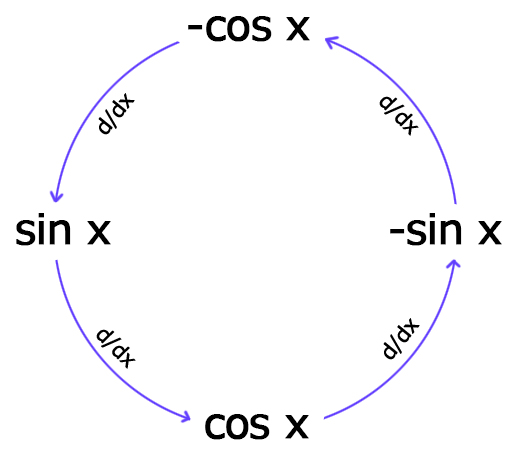
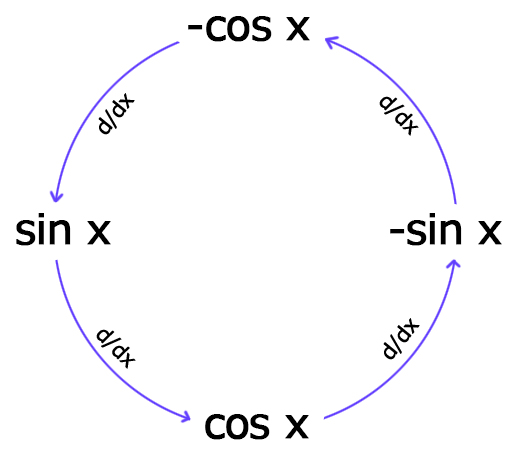
Here's a video by patrickJMT showing you how to take derivatives of sine and cosine functions. Luckily, sine and cosine are the easiest of the trig functions. ddxsin⁡x=cos⁡xddxcos⁡x=−sin⁡x\begin{align} \frac{d}{dx}\sin x&=\cos x\\ \frac{d}{dx}\cos x &= -\sin x \end{align} Sine and cosines derivatives move in a circular pattern. They alternate between sine and cosine and positive and negative. Here's a picture to explain what I mean.

The remaining trig functions are tangent, cotangent, secant, and cosecant. These aren't as nicely depicted as the two above. ddxtan⁡x=sec⁡2xddxcot⁡x=−csc⁡2xddxsec⁡x=sec⁡xtan⁡xddxcsc⁡x=−csc⁡xcot⁡x\begin{align} \frac{d}{dx}\tan x&=\sec^2x\\ \frac{d}{dx}\cot x&=-\csc^2x\\ \frac{d}{dx}\sec x&=\sec x\tan x\\ \frac{d}{dx}\csc x&=-\csc x\cot x \end{align}

So let's try these out with some examples. The first being: f(x)=5sin⁡(8πx)f(x)=5\sin(8\pi x) Remember that we still have to chain on the derivative of the inside of the sine function. Furthermore, don't get tripped up when π\pi is involved. It's just a number. f′(x)=5cos⁡(8πx)⋅(8πx)′=5cos⁡(8πx)⋅(8π)=40πcos⁡(8πx)\begin{align} f'(x)&=5\cos(8\pi x)\cdot\color{red}{(8\pi x)'}\\ &=5\cos(8\pi x)\cdot(8\pi)\\ &=\boxed{40\pi\cos(8\pi x)} \end{align}

That wasn't so bad hopefully. Let's try a harder example. g(x)=4π[cos⁡(3πx)sin⁡(3πx)]g(x)=4\pi[\cos(3\pi x)\sin(3\pi x)] Since 4π4\pi is just a constant we can leave that alone and only worry about what's inside the brackets. g′(x)=4π[[cos⁡(3πx)]′sin⁡(3πx)+cos⁡(3πx)[sin⁡(3πx)]′]=4π[−sin⁡(3πx)[3πx]′sin⁡(3πx)+cos⁡(3πx)cos⁡(3πx)[3πx]′]=4π[−sin⁡2(3πx)(3π)+cos⁡2(3πx)(3π)]=4π[3πcos⁡2(3πx)−3πsin⁡2(3πx)]=12π2[3πcos⁡2(3πx)−3πsin⁡2(3πx)]\begin{align} g'(x)&=4\pi[\color{red}{[\cos(3\pi x)]'}\sin(3\pi x)+\cos(3\pi x)\color{red}{[\sin(3\pi x)]'}]\\ &=4\pi[-\sin(3\pi x)\color{red}{[3\pi x]'}\sin(3\pi x)+\cos(3\pi x)\cos(3\pi x)\color{red}{[3\pi x]'}]\\ &=4\pi[-\sin^2(3\pi x)(3\pi)+\cos^2(3\pi x)(3\pi)]\\ &=4\pi[3\pi\cos^2(3\pi x)-3\pi\sin^2(3\pi x)]\\ &=\boxed{12\pi^2[3\pi\cos^2(3\pi x)-3\pi\sin^2(3\pi x)]} \end{align}

Here's another video with one more example. h(x)=cos⁡[sec⁡(5πx)]h(x)=\cos[\sec(5\pi x)] Here we have multiple chain rules and a secant function to work with. h′(x)=−sin⁡[sec⁡(5πx)]⋅[sec⁡(5πx)]′=−sin⁡[sec⁡(5πx)]⋅sec⁡(5πx)tan⁡(5πx)⋅[5πx]′=−sin⁡[sec⁡(5πx)]⋅sec⁡(5πx)tan⁡(5πx)⋅(5π)=−5πsin⁡[sec⁡(5πx)]sec⁡(5πx)tan⁡(5πx)\begin{align} h'(x)&=-\sin[\sec(5\pi x)]\cdot\color{red}{[\sec(5\pi x)]'}\\ &=-\sin[\sec(5\pi x)]\cdot\sec(5\pi x)\tan(5\pi x)\cdot\color{red}{[5\pi x]'}\\ &=-\sin[\sec(5\pi x)]\cdot\sec(5\pi x)\tan(5\pi x)\cdot(5\pi)\\ &=\boxed{-5\pi\sin[\sec(5\pi x)]\sec(5\pi x)\tan(5\pi x)} \end{align}

Video · + 1 min read

(Video) Deriving Trigonometric Derivative Formulas

by PatrickJMT

Here's a video by patrickJMT where he shows you how to derive the lesser remembered trig function derivatives using sine and cosine derivatives.

Recall the derivatives for sine and cosine. ddxsin⁡x=cos⁡xddxcos⁡x=−sin⁡x\begin{align} \frac{d}{dx}\sin x&=\cos x\\ \frac{d}{dx}\cos x&=-\sin x \end{align} Remember that we can always think of these as a cycle.

Tangent

So you need to take the derivative of tangent but you don't remember the formula, what do you do!? Well recall that tan⁡x\tan x is just sin⁡xcos⁡x\dfrac{\sin x}{\cos x}. So let's try deriving that instead. f(x)=tan⁡x=sin⁡xcos⁡xf′(x)=[sin⁡x]′cos⁡x−sin⁡x[cos⁡x]′[cos⁡x]2=cos⁡xcos⁡x−sin⁡x(−sin⁡x)cos⁡2x=cos⁡2x+sin⁡2xcos⁡2x\begin{align} f(x)&=\tan x\\ &=\frac{\sin x}{\cos x}\\ f'(x)&=\frac{\color{red}{[\sin x]'}\cos x-\sin x\color{red}{[\cos x]'}}{[\cos x]^2}\\ &=\frac{\cos x\cos x-\sin x(-\sin x)}{\cos^2x}\\ &=\frac{\cos^2x+\sin^2x}{\cos^2x} \end{align} Here, we can use one of our trig identities, cos⁡2x+sin⁡2x=1\cos^2 x+\sin^2x=1. f′(x)=cos⁡2x+sin⁡2xcos⁡2x=1cos⁡2x\begin{align} f'(x)&=\frac{\cos^2x+\sin^2x}{\cos^2x}\\ &=\frac{\color{red}{1}}{\cos^2x} \end{align} Finally, we can use another identity: sec⁡x=1cos⁡x\sec x=\frac{1}{\cos x}. f′(x)=1cos⁡2x=sec⁡2x\begin{align} f'(x)&=\frac{1}{\cos^2x}\\ &=\boxed{\sec^2x} \end{align}

Cotangent

We can apply the same idea to find cotangent. f(x)=cot⁡x=cos⁡xsin⁡xf′(x)=[cos⁡x]′sin⁡x−cos⁡x[sin⁡x]′[sin⁡x]2=−sin⁡xsin⁡x−cos⁡xcos⁡xsin⁡2x=−sin⁡2x−cos⁡2xsin⁡2x=−1sin⁡2x=−csc⁡2x\begin{align} f(x)&=\cot x\\ &=\frac{\cos x}{\sin x}\\ f'(x)&=\frac{\color{red}{[\cos x]'}\sin x-\cos x\color{red}{[\sin x]'}}{[\sin x]^2}\\ &=\frac{-\sin x\sin x-\cos x\cos x}{\sin^2x}\\ &=\frac{-\sin^2x-\cos^2x}{\sin^2x}\\ &=\frac{\color{red}{-1}}{\sin^2x}\\ &=\boxed{-\csc^2x} \end{align}

Secant

We know that sec⁡x=1cos⁡x\sec x=\frac{1}{\cos x}, so we can use this instead. f(x)=sec⁡x=1cos⁡xf′(x)=[1]′cos⁡x−1[cos⁡x]′[cos⁡x]2=(0)cos⁡x−(−sin⁡x)cos⁡2x=sin⁡xcos⁡2x=sin⁡xcos⁡x⋅1cos⁡x=tan⁡xsec⁡x\begin{align} f(x)&=\sec x\\ &=\frac{1}{\cos x}\\ f'(x)&=\frac{\color{red}{[1]'}\cos x-1\color{red}{[\cos x]'}}{[\cos x]^2}\\ &=\frac{(0)\cos x-(-\sin x)}{\cos^2x}\\ &=\frac{\sin x}{\cos^2x}\\ &=\frac{\sin x}{\cos x}\cdot\frac{1}{\cos x}\\ &=\boxed{\tan x\sec x} \end{align}

Cosecant

This follows the same form as secant. We use the identity csc⁡x=1sin⁡x\csc x=\frac{1}{\sin x}. f(x)=csc⁡x=1sin⁡xf′(x)=[1]′sin⁡x−1[sin⁡x]′[sin⁡x]2=(0)sin⁡x−(cos⁡x)sin⁡2x=−cos⁡xsin⁡2x=−cos⁡xsin⁡x⋅1sin⁡x=−cot⁡xcsc⁡x\begin{align} f(x)&=\csc x\\ &=\frac{1}{\sin x}\\ f'(x)&=\frac{\color{red}{[1]'}\sin x-1\color{red}{[\sin x]'}}{[\sin x]^2}\\ &=\frac{(0)\sin x-(\cos x)}{\sin^2x}\\ &=\frac{-\cos x}{\sin^2x}\\ &=\frac{-\cos x}{\sin x}\cdot\frac{1}{\sin x}\\ &=\boxed{-\cot x\csc x} \end{align}

Type a concept, like “slope” or “photosynthesis”.

↑ ↓ to choose · Enter to openSearch explanations and problems