(Video) Common Divisibility Tests
by American Public University
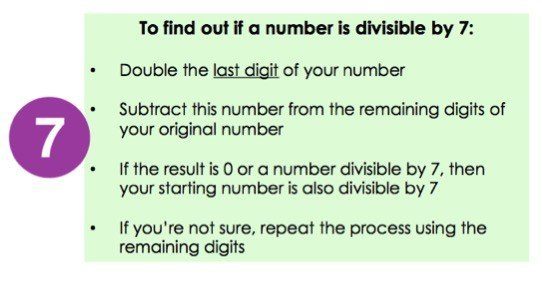
This is a video by American Public University. This one summarizes common divisibility rules you may see.
Summary
The video breaks numbers down into groups based on similar divisibility checks.
You check divisibility of 2, 5, and 10 by checking the last digit of the number. As a result, the video groups these three tests into one category. If the number is even, it is divisible by 2. If the last digit is 5 or 0, it is divisible by 5. If the last digit is 0, it is divisible by 10. Any positive number might be divisible by more than one of these. As a result I encourage you to try all three tests.
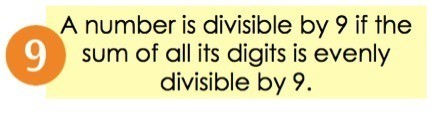
Divisibility of 3 and 9 is found by adding up all the digits in a number. If the sum of the digits is divisible by 3, the number is divisible by 3. If the sum is divisible by 9, the number is divisible by 9. Every number divisible by 9 is also divisible by 3. This is because 9 has 3 as a factor.
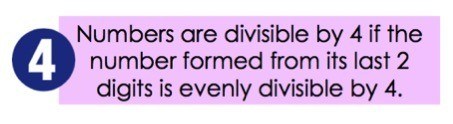
For 4 and 8, you have to check multiple digits on the end of a number. If the last two digits of a number are divisible by 4, then the original number is divisible by 4. If the number made by the last three digits of a number are divisible by 8, the number is divisible by 8. If the number doesn't have that many digits, just use all of them. Pretend there are zeros at the front to get the required number of digits. This won't change the value of the number!
Whether a number is divisible by 6 and 12 depends on other tests. If a number is divisible by both 2 and 3, it is divisible by 6 as well. This is because 6 is a product of different prime numbers. In particular,
6=21×31
If a number is divisible by both 3 and 4, it is also divisible by 12. We could also check 2 and 6 instead of 3 and 4. The key is that we check pairs of numbers that multiply to 12.
Why Do We Care?
These types of tests might seem to serve no real purpose at all. Fortunately, everything in math has a purpose, even if you don't know what it is. In this case we care about factorization of numbers. This is especially true for prime factorizations. Any number's factors are divisible by the factor. Thus we can use the tests to find factors of the number, and eventually the prime factors. In some cases we will have to use the tests more than once. Nonetheless, we have an alternative method to upside-down division.
Example: Let's find all the prime factors of 66.
Solution: We could start randomly checking for prime factors. That being said, there is a strategy to make things go faster. It is usually easiest to start by checking the smallest prime numbers. The tests for the smaller prime numbers tend to be easier. Since 2 is the smallest prime number, we'll start with 2.
The test for 2 is to check whether our number is even. Certainly 66 is even, because the units digit is a 6. So, we add 2 to our list of prime factors and divide 66 by 2:
66÷2=33
We do this division to make it easier to keep looking for other prime factors. Any prime factor of 33 will also be a prime factor of 66, not to mention the 2 we found earlier. The next smallest prime number is 3. As a result we ask if 33 is divisible by 3. Remember the test for 3. We want to check the sum of the digits of 33:
3+3=6
Of course, 6 is divisible by 3, because 6=3×2. This means 3 is a factor of 33 (and of 66). Once again, we divide away the new factor:
33÷3=11
You might remember that 11 is a prime number. This means we don't need to run another test. We conclude that the prime factors of 66 are 2,3, and 11. This completes the problem.