সমতুল্য অসমতা তৈরি

Interactive · 3 questions

Equivalent Inequalities

Equivalent inequalities are inequalities that communicate the same information.

There are a few different ways to produce equivalent inequalities.

First, an inequality is equivalent to its mirror image. Let's see what that looks like:

x>4x > 4 4<x4 < x

Notice how one inequality is essentially a backwards version of the other. The pointy part of the inequality sign is always pointing towards the 44! When this is the case, the inequalities are equivalent. However, it is important that you are VERY mindful of the direction of the inequality sign.

Example 1: These two inequalities are NOT equivalent because the pointy part of the inequality sign is pointing to 44 in the first inequality, and xx in the second inequality:

x>4x > 4 4>x4 > x

Example 2: These two inequalities are equivalent because they are mirror images....the pointy part of the inequality sign is facing the 15x15x in both cases: 15x<215x<2 2>15x2>15x

Example 3: These two inequalities are not equivalent because the orientation of the inequality signs are opposites....these two inequalities convey opposite information! −7x≥3+x-7x \ge 3 + x −7x≤3+x-7x \le 3 + x

It helps to read the inequalities aloud. For our two equivalent inequalities, the first one tells us that "xx is greater than 44" and the second says that "44 is less than xx." That is equivalent information.

If that's still confusing, there are a few more ways to determine if inequalities are equivalent.

Method One: Plug in the same value for the variable(s) in both of the following inequalities: x>4x > 4 4<x4 < x

Let's substitute 5 for x in both inequalities

5 > 4

4 < 5

Notice how both of these inequalities tell us the same information.

Method Two: Create a number line that represents each inequality. Then compare.

The inequalities x > 4 and 4< x graphed on a number line.

The number lines look the same!

Method Three: Write the solutions to each inequality in interval notation and then compare.

x > 4 in interval notation is (4, infinity).

4 < x in interval notation is (4, infinity).

The interval notation is the same!

How would you write each of these inequalities in interval notation?

x>−3x>-3 and x<3x<3

Choose one answer

Find your level

The problems run from approachable to very hard, and each is rated by how often real students solve it, so you can pick your next step. These are real problems from the AMC 8, AMC 12 and AIME, the national math competitions for middle and high school students, each with a worked solution on LIVE by Po-Shen Loh.

Video · + 1 min read

(Video) Equivalent Inequalities

by Anusha Rahman

In this lesson, Anusha Rahman covers what equivalent inequalities are and how to determine whether inequalities are equivalent.

Summary

Equivalent inequalities: inequalities that have the same range of solutions.

Let's walk through some examples to figure out whether inequalities are equivalent.

Example 1: Say we have the two inequalities, 2x>3+x2x>3+x 2x>62x>6

Let's solve the first inequality.

2x>3+x2x>3+x x>3x>3

Now, let's solve the second inequality.

2x>62x>6 x>3x>3

Both of these inequalities have the same range of solutions, x>3x>3, so these two inequalities are equivalent!

Now, try the next example on your own!

Example 2: Which of the following inequalities are equal to: 2x+4>122x+4>12?

Choose all correct answers

Interactive · 1 question

Equivalent Inequalities

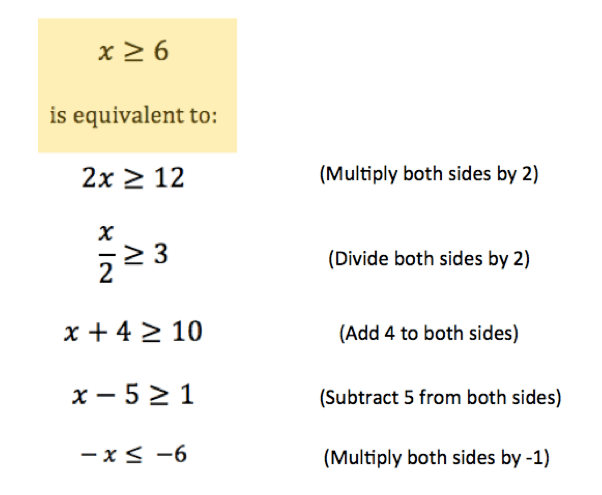
If a set of inequalities are equivalent, it means that they all have exactly the same solutions. Say you have a certain inequality and you want to produce an equivalent inequality. You can do this by taking the inequality you have and performing the same operation on each side of the inequality sign, just like you learned when solving inequalities with addition or subtraction or multiplying or dividing by a positive or negative number. Then, you will be left with an equivalent inequality!

Equivalent Inequalities are inequalities with the same solutions! For example,  x<2, 2>x, -x>-2, x+1<3, 7>3x+1, x/2<1, 6>3x, and sqrt{x}<sqrt{2} are all equivalent inequalities.

Image source: By Caroline Kulczycky

Take a look at the graphic above. All of the inequalities on there are equivalent, because they all have the same solution of x<2!x<2!

x<2x<2 is equivalent to x<2,x<2, clearly.

If you flip the numbers and the sign of 2>x,2>x, you get x<2.x<2.

If you divide both sides of −x>−2-x>-2 by −1-1 (a negative number!), you get x<2.x<2.

If you subtract 11 from both sides of x+1<3,x+1<3, you get x<2.x<2.

If you subtract 11 from both sides of 7>3x+1,7>3x+1, you get 6>3x.6>3x. If you divide both sides of 6>3x6>3x by 3,3, you get 2>x.2>x. If you flip the numbers and the sign of 2>x,2>x, you get x<2.x<2.

If you try multiplying both sides of x2<1\dfrac{x}{2} < 1 by 2,2, you get x<2.x<2.

If you divide both sides of 6>3x6>3x by 3,3, you get 2>x.2>x. If you flip the numbers and the sign of 2>x,2>x, you get x<2.x<2.

If you square both sides of x<2,\sqrt{x} < \sqrt{2}, you get x<2.x<2. (Here is a refresher on square roots!)

All of these inequalities are equivalent because they all have the same solution of x<2!x<2!

Which of the following inequalities are equivalent to 2x+1≤4?2x+1 \le 4?

Choose all correct answers

Type a concept, like “slope” or “photosynthesis”.

↑ ↓ to choose · Enter to openSearch explanations and problems