অনুক্রম: প্রকৃত সুত্র

Before this, knowঅনুক্রম: প্যাটার্ন খোঁজা

Video · + 1 min read

(Video) Explicit Formulas

by fethermath
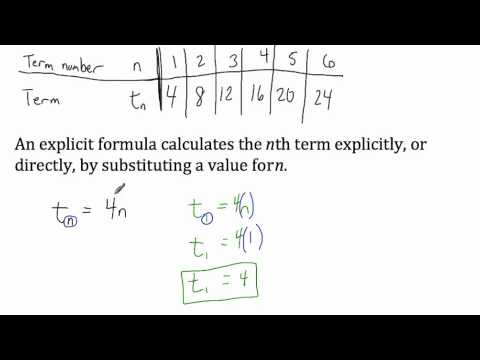
The video above by fethermath gives a more general description of explicit formula.

Summary\large{\text{Summary}}

An explicit formula helps you calculate the nthn^{\text{th}} term of a sequence explicitly, or directly, by substituting a value for nn.

Recall that nn is just the term number we want to find. It's the position of the term we want in the sequence. So if you want to find the third term in a sequence, you let n=3n=3.

Suppose we have the following sequence: Term numbern123456Termtn4812162024\begin{array}{c|c|c} \text{Term number}&n&1&2&3&4&5&6\\ \hline \text{Term}&t_n&4&8&12&16&20&24 \end{array}

So how do we express this formula? We want to be able to express any term in the sequence, tnt_n, using nn.

Start by looking at the first term. How do we get from the term number, 11, to the term value 44? We could multiply 11 by 44, or we can add 33 to 11.

Now look at the second term. How do we get from the term number, 22, to the term value 88? We could multiply 22 by 44, or we can add 66 to 22.

Notice a consistent pattern already. We can multiply the term number by 44 to get the term value. Therefore, we can write our explicit formula for the nthn^{\text{th}} term as: tn=4nt_n=4n

We can use this to find specific terms. Suppose we want to know the 8th8^{\text{th}} term. Just plug in n=8n=8. tn=4nt8=4(8)t8=32\begin{align} t_n&=4n\\ t_8&=4(8)\\ t_8&=32 \end{align}

Let's do another practice problem.

Calculate the first 33 terms of the sequence, a1,a2,a_1, a_2, and a3,a_3, using: an=3na_n=3^n

Choose one answer

Video · + 2 min read

(Video) Writing Explicit Formula of a Sequence

by Brian McLogan

Here's a quick but great video by Brian McLogan on how to figure out the explicit formula for a sequence.

Summary\large{\text{Summary}}

An explicit formula calculates the nthn^{\text{th}} term by substituting a value in for nn.

For example, suppose we have the sequence: 2,4,6,8,⋯2,4,6,8,\cdots The explicit formula for the nthn^{\text{th}} term of the sequence is: an=2na_n=2n

If you want to find the fourth term, you plug in n=4n=4. a4=2(4)=8a_4=2(4)=8

How Though?

How do you figure out the equation in the first place? Well, there's not always an easy way. Mostly, you have to test some theories until you find the one that works. This is demonstrated in the video above.

Suppose we want to find the explicit formula for the sequence: 3,7,11,15,19,⋯3,7,11,15,19,\cdots

A good strategy is to find a formula that works for the first few terms and apply it to the next few terms. For the most part (not always, though), if it works for the a few terms, it works for the sequence.

We start by asking, how can we get from the position number, n=1n=1, to the term number, 33. Well, we could multiply 11 by 33. If this is the pattern, then: a1=3(1)→an=3na_1=3(1)\quad\rightarrow\quad a_n=3n

Let's now test it on the second term, where n=2n=2. We know it should equal 77. an=3na2=3(2)a2=6\begin{align} a_n&=3n\\ a_2&=3(2)\\ a_2&=6 \end{align} This doesn't work. So we can scrap that formula.

Back to square one. How else can we get from the term position, 11, to the term 33. We can add 22 to 11. This means: a1=1+2→an=n+2a_1=1+2\quad\rightarrow\quad a_n=n+2

Again, we test it on the second term which we know is 77. an=n+2a2=2+2a2=4\begin{align} a_n&=n+2\\ a_2&=2+2\\ a_2&=4 \end{align} This also doesn't work.

Ugh, fine. What now? We can try combining multiplication and addition. If we multiply 11 by 22 and then add 11, we can get to 33. a1=2(1)+1→an=2n+1a_1=2(1)+1\quad\rightarrow\quad a_n=2n+1

You know the drill. Test it. an=2n+1a2=2(2)+1a2=5\begin{align} a_n&=2n+1\\ a_2&=2(2)+1\\ a_2&=5 \end{align} This doesn't work either.

So now what? Well, we've tried multiplying by 22 and multiplying by 33. Let's try multiplying by 44. If we multiply 11 by 44 we need to then subtract 11 to get to 33. a1=4(1)−1→an=4n−1a_1=4(1)-1\quad\rightarrow\quad a_n=4n-1

Alright, let's test it. an=4n−1a2=4(2)−1a2=7\begin{align} a_n&=4n-1\\ a_2&=4(2)-1\\ a_2&=7 \end{align} This worked! Therefore, we can infer that the explicit formula for the sequence is: an=4n−1a_n=4n-1

If you check this formula with the other terms of the sequence, you will see that it works!

You can also use this method for arithmetic sequences!

Practice Problem

Find the 19th19^{\text{th}} term in the sequence, 1,3,5,7,⋯1,3,5,7,\cdots

Choose one answer

Illustrated · 1 min

Maximum Depth Exceeded: Fun with Sequences and Python, Part 3

To read part 22 of this story, go here.

If we are asked to find an explicit formula for a sequence, it helps to start with a recurrence formula, as we can use this to find an explicit formula. An explicit formula for a sequence is one for which ana_n equals something that does not depend on any other elements in the sequence.

For example, let's work with the recurrence formula

an=an−1−1a0=7.\begin{align} a_n &= a_{n - 1} - 1 \\ a_0 &= 7. \end{align}

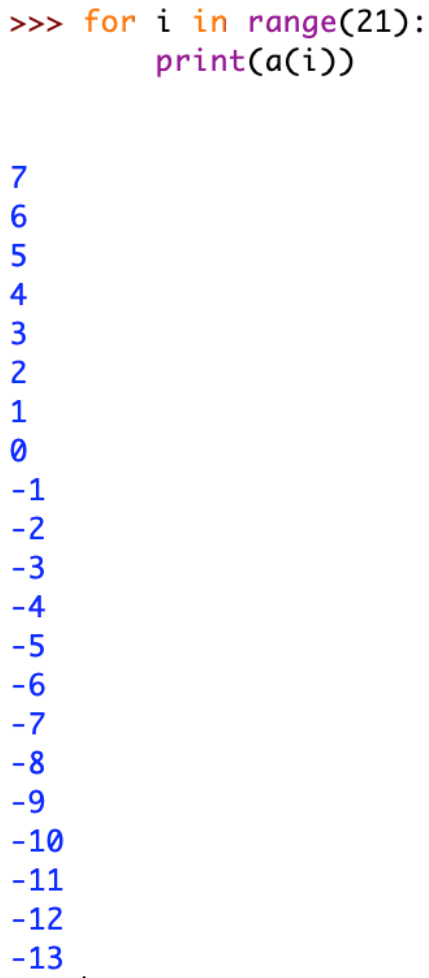
We can plug this formula into Python and get the following values in the sequence:

Sequence begins 7, 6, 5, 4, 3, 2, 1, 0, -1, -2, -3, -4, -5, -6, -7, -8, -9, -10, -11, -12, -13

Image source: By Joshua Siktar

What we've done with Python is listed out the first 2121 terms of the sequence, in order. Each term is one less than the previous term. This means that after nn terms, our value is nn less than the starting term, meaning that our sequence has an explicit form:

an=a0−n=7−na_n = a_0-n=7 - n

because we subtract 11 off every time we move to the next term, and we start the sequence from a0=7.a_0=7. This formula is called "explicit" because if we are trying to compute an,a_n, there aren't any other appearances of the sequence a0,a1,a2,...a_0, a_1, a_2,... in the formula, while our recurrence formula

an=an−1−1a_n = a_{n - 1} - 1

had an−1a_{n - 1} in it, so it's not explicit.

To go to part 44 of this story, which covers geometric sequences, go here.

Illustrated · 1 min

Explicit Formulas for Sequences

An explicit formula allows you to you directly calculate the nthn^{th} term in a sequence. It makes it easy to calculate whatever term you want. All you have to know is know the term's position! For example, say you wanted to know the 45th45^{th} term in a sequence, and you don't have the time to try to figure out all the terms before it. If you have an explicit formula, you can directly calculate the 45th45^{th} term!

Explicit formulas take the form an=f(n)a_n=f(n)

where nn represents the position number of the term. Basically, an explicit formula represents the nthn^{th} term (ana_n) as a function of its position number (f(n)f(n)).

Explicit Formulas for Sequences: You can use an explicit formula to directly calculate the nth (n is purple) term in a sequence. Just substitute a given n (n is purple) into the formula and simplify! Example: a_n=2n-1 (the n's in a_n and 2n are purple) is an explicit formula that generates the sequence of odd numbers: 1, 3, 5, ... 1st term: a_1=2(1)-1=2-1=1 (the 1's in 1st, a_1, and 2(1) are purple). 2nd term: a_2=2(2)-1=4-1=3 (the 2's in 2nd, a_2, and 2(2) are purple). 3rd term: a_3=2(3)-1=6-1=5 (the 3's in 3rd, a_3, and 2(3) are purple).

Image source: By Caroline Kulczycky

Let's do another example. Say you are given the explicit formula an=2n2+5,a_n=2n^2+5, and you want to find the 11th11^{th} term. All you have to do is plug in 1111 for n.n.

an=2n2+5a11=2(11)2+5a11=2(121)+5a11=242+5a11=247\begin{align} a_n&=2n^2+5\\ a_{11}&=2(11)^2+5\\ a_{11}&=2(121)+5\\ a_{11}&=242+5\\ a_{11}&=247 \end{align}

Type a concept, like “slope” or “photosynthesis”.

↑ ↓ to choose · Enter to openSearch explanations and problems