Illustrated · 2 min
+2 contributors

The Fibonacci Sequence is a special type of sequence over the positive integers, where the th Fibonacci number is usually denoted .
The definition of the Fibonacci sequence is and This generates the positive integer sequence (Note: we can also define .)
Perhaps the most characteristic image depicting the Fibonacci sequence is the Golden Spiral:
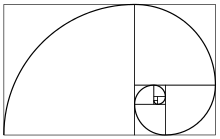
Image credit: Wikipedia
We see that this is constructed by first attaching two squares of side length together. Then, we attach a square with side length on our resulting rectangle, then attach a square of side length , and so on. The biggest rectangle that circumscribes the spiral is called the Golden Rectangle.
But why is this rectangle "golden"?
It turns out that these figures are closely related to the Golden Ratio (and thus so is the Fibonacci sequence). We can see this relation by solving for the dimensions of the Golden Rectangle:
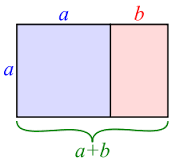
Image Credit Wikipedia
Here we can see that only the largest two rectangles have been drawn in. Since both these rectangles are similar, it follows that where the first ratio comes from the red rectangle and the second ratio comes from the entire rectangle.
Let's solve for now: Since , we must have , so the dimensions of the golden rectangle are in the ratio . This ratio is the link between the Golden Rectangle and the Golden Ratio .
In fact, this gives us information about the Fibonacci sequence itself. Note that and represent consecutive numbers in the Fibonacci sequence (due to the construction described above). Thus, we have the interesting relation
Now let's try to find a closed form representation of the Fibonacci sequence. Since it is a linear recurrence, we can use the process of solving linear recurrences to solve for . In particular, the characteristic polynomial of the linear recurrence is which has roots and (there's the Golden Ratio again!).
Thus, there are constants and that give Plugging in and solving the two-variable two-equation system, we obtain and , so we finally have our closed form:
The Fibonacci numbers, unsurprisingly, satisfy a plethora of identites, including: These can be proven using the closed form of , but some can be proven in clever ways. For example, I'll prove the second identity.
First, we note that . Now, we just need to prove that But now note that by the definition of the Fibonacci numbers which turns our sum into . Then , then and so on, and the entire sum eventually collapses to .

