$x^2+bx+c$ (যেখানে $c<0$) এই ধরনের রাশির উৎপাদকে বিশ্লেষণ

Before this, knowউৎপাদকে বিশ্লেষণ: পূর্ণবর্গের বিয়োগফল

Interactive · 2 questions

Factoring Quadratics with c<0c<0

Let's take a look at another way to factor trinomials. These will be trinomials with the form x2+bx−cx^2+bx - c. This method will be a form of factor by grouping. The leading coefficient can be any number, but CC should be a negative number.

The first step in factoring a quadratic in a form x2+bx−cx^2+bx - c is to find two numbers that multiply to cc and add to bb. bb is the middle term. Assume that we have already found numbers dd and ee, where d⋅e=cd \cdot e=c and d+e=bd+e=b. Remember that cc is negative, so one of either dd or ee will also be negative.

The polynomial can be rewritten as x2+dx+ex−cx^2 +dx +ex - c, where one of either dxdx or exex is a negative term. We can group the terms into (x2+dx)+(ex+c)(x^2+dx)+(ex+c). This expression has two terms multiplied by the same binomial. We can factor out the binomial to get the factored form of the quadratic.

Example 1:

x2+x−12x^2 + x - 12

Since −3⋅4=−12-3 ⋅ 4 = -12 and −3+4=1-3 + 4 = 1, we can rewrite our polynomial:

x2−3x+4x−12x^2 - 3x + 4x - 12

Now, we factor out greatest common factors from our polynomial's first two terms and from our polynomial's last two terms:

x(x−3)+4(x−3)x(x - 3) + 4(x - 3)

Finally, we factor the binomial x−3x - 3 out of our expression (note that we are only able to do this because our expression consists of two terms that are both being multiplied by the binomial x−3x - 3):

(x+4)(x−3)(x + 4)(x - 3)

The product of the two binomials, the pair of factors, should equal the original expression, x2+x−12x^2 + x - 12. You can use tables or FOIL to multiple binomials.

Example 2:

x2−5x−14x^2 - 5x - 14 =x2−7x+2x−14= x^2 - 7x + 2x - 14 =x(x−7)+2(x−7)= x(x - 7) + 2(x - 7) =(x+2)(x−7)= (x + 2)(x - 7)

Test Yourself!

Factor x2+4x−21x^2 + 4x - 21

Choose one answer

Illustrated · 1 min

It is important to consider what c<0c<0 means. When a number is less than 00 that means it is a negative number. So generally, we are looking at the case when cc is a negative number. This means, when we factor ax2+bx−c=(?x+?)(?x−?)ax^2+bx-c=( ?x {\color{#8925AE}{+}} ? )( ?x {\color{#8925AE}{-}} ? ). There are two possible factorizations when cc is negative.

  • When ax2+bx−c=( ? x+ bigger number )( ? x− smaller number )ax^2{\color{#29A603}{+}}bx-c=( \text{ ? }x {\color{#8925AE}{+}}\text{ bigger number } )( \text{ ? }x {\color{#8925AE}{-}} \text{ smaller number } ).

  • When ax2−bx−c=( ? x− bigger number )( ? x+ smaller number )ax^2{\color{#29A603}{-}}bx-c=( \text{ ? }x {\color{#8925AE}{-}}\text{ bigger number } )( \text{ ? }x {\color{#8925AE}{+}} \text{ smaller number } ).

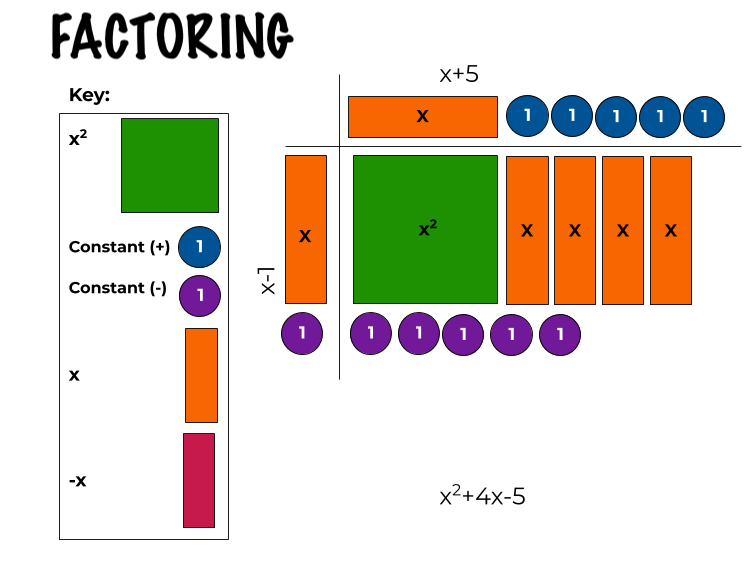
Let's look at a modeling example of the factoring of x2+4x−5x^2+4x-5.

Model of factoring x^2+4x-5

Image source: by Zora Gilbert

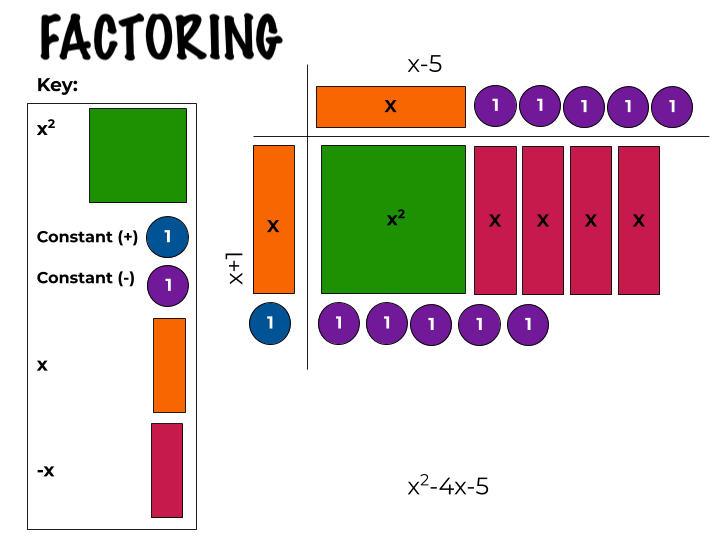
Now, let's look at a very similar one. x2−4x−5x^2-4x-5. Notice the differences are in the positive and negative values of the factors and xx in the trinomial.

Model of factoring x^2-4x-5

Image source: by Zora Gilbert

Video · + 1 min read

(Video) Factoring Quadratics with Negative c

by Anusha Rahman

In this video, Anusha Rahman covers how to factor quadratic expressions in standard form when c<0c<0.

Summary

There are two essential components:

  • The quadratic expression must be in standard form [ax2+bx+cax^2+bx+c]
  • c<0c<0 (i.e., when cc is negative)

We will be using factoring by grouping to solving these types of quadratics.

In standard form, a quadratic expression looks like this: ax2+bx+cax^2+bx+c. When c<0c<0, the quadratic expression will look more like this: ax2+bx−cax^2+bx-c.

Let's look at some examples.

Example 1: Factor x2−3x−10x^2-3x-10

When we factor by grouping, we want to find the factors of −10-10 that add to −3-3. After we write out the factors, we determine that the factors we are looking for are: −5-5 and +2+2.

So, we can write:

x2−3x−10x^2-3x-10 =x2−5x+2x−10=x^2 -5x +2x -10 =x(x−5)+2(x−5)=x(x-5) +2(x-5) =(x−5)(x+2)=(x-5)(x+2)

We always want to double check by multiplying binomials.

Example 2: Factor x2+3x−18x^2+3x-18

We're going to do something very similar to what we saw in Example 1. We're going to look for factors of −18-18 that sums to +3+3. After we write out all of the factors, we know that the factors we are looking for are: −3-3 and +6+6.

So, we can write:

x2+3x−18x^2+3x-18 =x2−3x+6x−18=x^2-3x+6x-18 =x(x−3)+6(x−3)=x(x-3)+6(x-3) =(x−3)(x+6)=(x-3)(x+6)

As always, we want to double check by multiplying the two binomials.

Type a concept, like “slope” or “photosynthesis”.

↑ ↓ to choose · Enter to openSearch explanations and problems