
Interactive · 1 question

+3 contributors


Magnitude of Complex Numbers
The magnitude of a complex number is its distance from the origin in the complex plane. The concept may seem a little bit foreign right now as you build up your knowledge of complex numbers, but the process is very similar to finding the distance between two points on a coordinate plane or a number line.
Recall the distance formula for points on the Cartesian plane: As always, be careful with the square root!
If you're finding the distance from the origin in the Cartesian plane, this formula gets simplified: As and would both be .
When we move onto the complex plane, we use the same process. We're still only looking at the positive square root since distance is always positive. Let's look at the complex plane to refresh our minds.

Made with Desmos
The -axis is replaced with the real axis, and the -axis is replaced with the imaginary axis. We can use this information to alter our distance formula from the origin to be used with the complex plane.
Let's say we have a complex number in rectangular form: We sometimes denote the magnitude (or distance from the origin) of as (Careful: this is the same signage we use to find the absolute value).
Similar to the distance formula, the formula for the magnitude of a complex number is as follows:
Where is our real component and is our imaginary component. Let's look at an example of this.

Made with Desmos
This is a graph of the point on the complex plane. It is units to the right, and units above the origin, similar to the point in the Cartesian plane. To break this down even further, this complex number has a real component of and an imaginary component of . Let's plug this into our magnitude formula:
Here's a problem for practice:
What is the magnitude of ?
First, let's see this point on a graph.
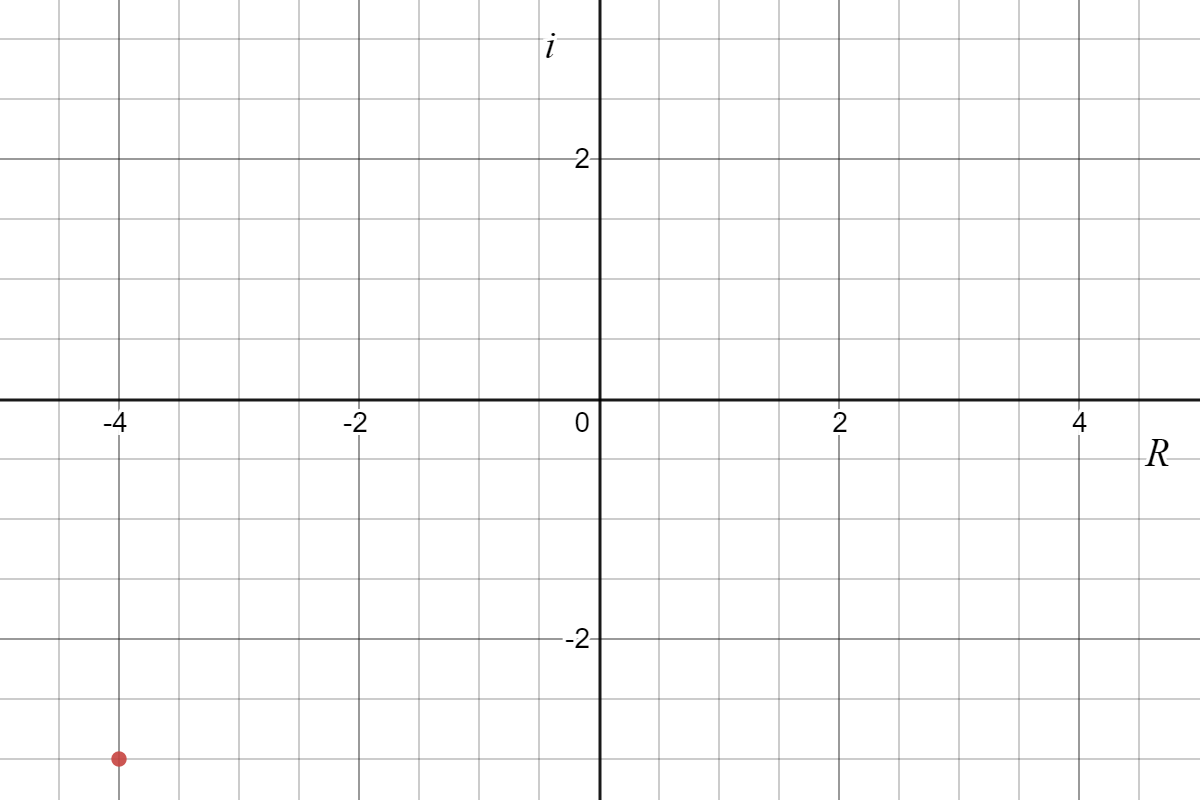
Made with Desmos
We can see that it is units to the left and units below the origin. Let's plug our numbers into the magnitude formula.
The big takeaway here is remembering the formula.


