Illustrated · 2 min

Now that we've covered the Intermediate Value Theorem, Descartes' Rule of Signs, and the Fundamental Theorem of Algebra, we can move to the last lesson.
End Behavior
The end behavior of a polynomial is how the ends of the functions behave. We want to see what happens to the graph of the function as approaches . In general, the function will either approach or .
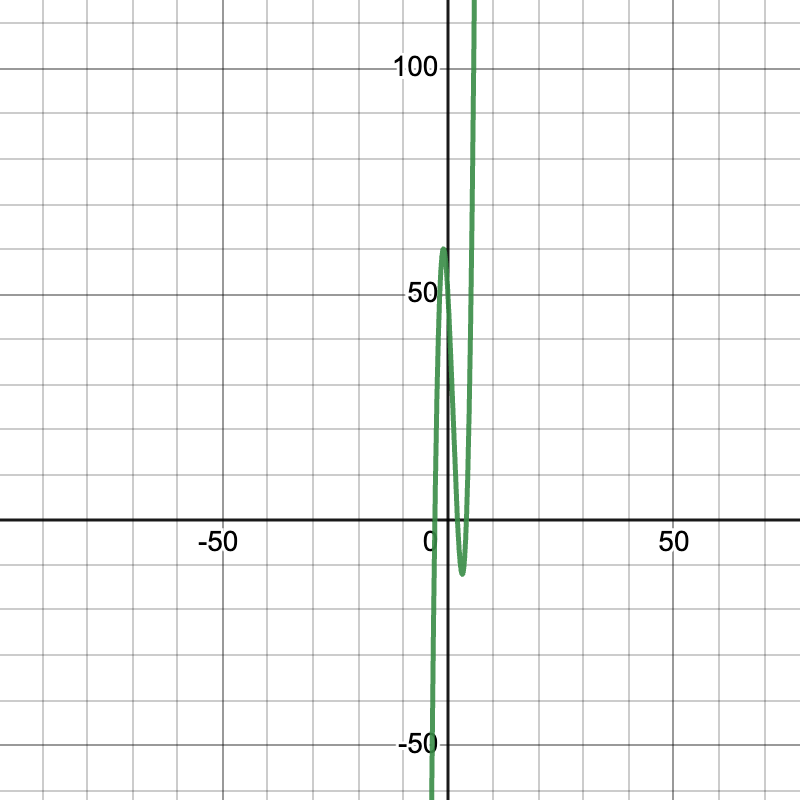
We can look at a graph and consider a polynomial's end behavior. Let's look at the graph of the parent function .

Made using Desmos
From just looking at the graph, we can tell that as decreases, also decreases. We can write this mathematically as: . Similarly, as increases, also increases. Mathematically, this looks like: . These statements describe our end behavior.
When you learn calculus, you'll learn about limits and how you can use limits to determine end behavior. For now, we'll use graphing!
Graphing Polynomials Using Roots and End Behavior
Now that we've learned about end behavior, let's think about how we can use that to help us graph polynomials. If we are given a polynomial's roots and end behavior, we can create a sketch of what the graph looks like. The roots will tell us at which points the polynomial crosses the -axis. The end behavior will then fill in the rest of the information about the general shape of the polynomial.
Remember that this technique will give you a general idea of what a graphed polynomial looks like. This is by no means an exact method, but if you need to quickly understand the shape of a graph, then this method will help you!
Let's walk through an example.
Example
Say you're given the following information:
-
Roots: ,
-
-
We know that our polynomial crosses the axis at two points because we have two roots. Our first thought may be that this polynomial is a quadratic, but that may not necessarily be the case. This polynomial could be a cubic function where one of the points of inflection is sitting on the -axis. For that reason, we will look at the end behavior before making a decision about the power of the polynomial.
The end behavior tells us that both ends of the function go upward, toward infinity. If this were a cubic function, one of the tails of the function would be going toward negative infinity, while the other would go toward positive infinity. For that reason, we can determine that this is a quadratic function.
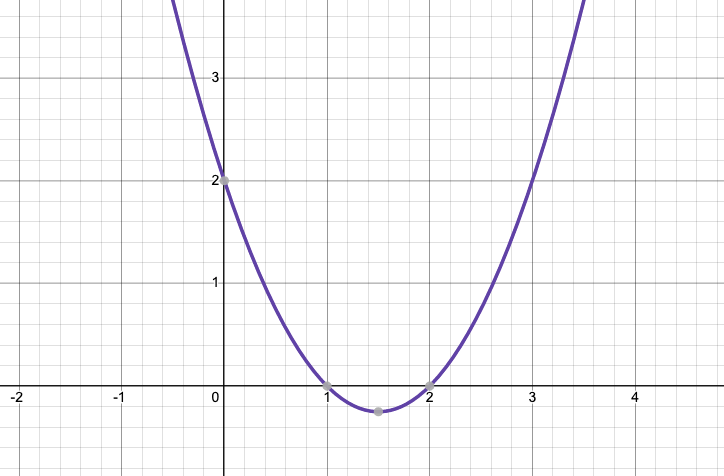
So, we know that this polynomial is a quadratic with roots at and , so now we can sketch the quadratic! We do not know the vertex of this quadratic, so we are missing some of the key characteristics, but we have a rough idea.
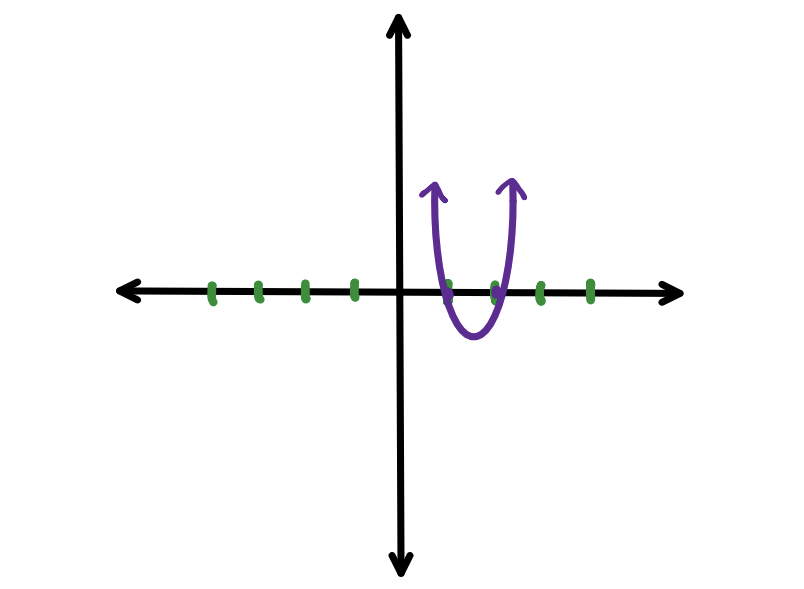
Image source: by Anusha Rahman
I can tell you that the polynomial is: , and its graph looks like:
Made using Desmos