Read · 1 min

Gravity এর বাংলা অর্থ হল মহাকর্ষ। মহাবিশ্বে সকল বস্তুর মধ্যে যে আকর্ষণ বল ক্রিয়া করে তাকে মহাকর্ষ বল বলে। 1687 সালে Sir Issac Newton যখন তার *Phisophiae Naturalis Principia Mathematica *বইটি প্রকাশ করেন,তখন মানবজাতি মহাকর্ষ সম্পর্কে একটি পূর্ণাঙ্গ ধারণা লাভ করে। চল মহাকর্ষ নিয়ে জানা যাক।

ক্লাস ৮ এ উঠলেই NCTB Curriculum এ মহাকর্ষ অন্তর্ভুক্ত হয়ে যায়।তা ই Physics এর সাথে Official পরিচয় হওয়ার আগেই আমাদের মাথায় আরও কিছু বস্তুর মত মহাকর্ষ ও ঢুকিয়ে দেওয়া হয়। তবে,এক্ষেত্রে সবচেয়ে মজার বিষয় হল,আমাদের ক্লাস এ যে ঘটনা দিয়ে মহাকর্ষ বুঝানো হয় তা কিন্তু ঠিক না! আসলে আংশিক ঠিক। সাধারত বলা হয় যে, Newton গাছের নিচে বসে ছিল এবং তার মাথায় আপেল পড়ার ফলে তার মাথা খুলে যায় এবং সে মহাকর্ষীয় সূত্র আবিষ্কার করে। আপেল এর জায়গায় কেন কাঠাল বা তরমুজ পড়ল না এটা নিয়ে পোলাপাইন এর আক্ষেপের শেষ নেই। আসলে ঘটনা হল,Newton ভাবুক মেজাজ এ বাগানে বসে ছিলেন এবং গাছ হতে একটি আপেল পড়তে দেখে তার মনে এই সূত্রের idea জন্ম নেয়। এখন পোলাপাইন মনে করতে পারে আমি কেমনে আমা্দের শ্রদ্ধেইয় স্যারদের কে ভুল বলতে পারি। এক্ষেত্রে reference হিসেবে A Brief History of Time-Bantam Edition এর ৫ নং পৃষ্ঠা দেখতে পার।

**মহাকর্ষ **বল বলতে সেই বলকে বুঝায় যা মহাবিশ্বের যে কোন দুইটি বস্তুর মধ্যে ক্রিয়া করে ।
Video · + 3 min read

Gravity

Let's watch some physics in action:

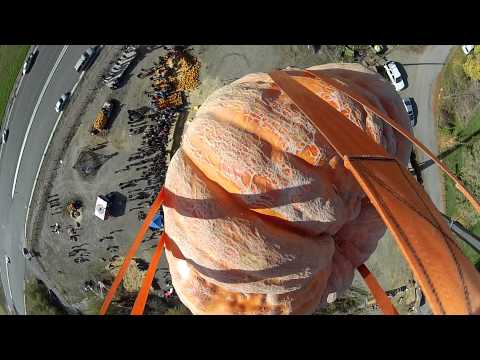
When the giant pumpkin hits the ground, it definitely feels the force of the ground stopping it.

But are there any forces acting on it as it falls, before it makes contact with the edge of the pool?

Choose one answer

Video · + 2 min read

Have you ever done sky-diving? Or dropped something from your hands? why do you/the object keep falling towards the ground? Is it a supernatural entity..... or a force of nature? Lets find out.

** The Discovery of Gravity**

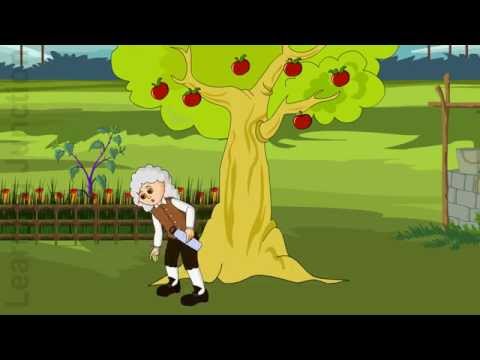
As you see in the above video, while he was sitting under an apple tree, Sir Isaac Newton discovered that a force of nature acted on all objects which pulled them towards the earth as a result of which the apple dropped on his head. With this rose a question in his mind, "Why does everything fall towards the Earth when nothing is touching them?" After further research, he rose to a conclusion that the force being exerted by Earth pulled everything towards it, and he called that force Gravity. This was one of the biggest discoveries in the field of Physics.

**Earth's Gravity **

Let us take the example of Earth and a ping pong ball.

Gravity depends on two factors mass and distance. -

  1. Mass - Earth has a mass much larger than that of the ping pong ball, thus the Earth exerts a large gravitational pull on the ball. But the mass of the ping pong ball is really less, so its gravitational pull is almost negligible.

  2. Distance - If the distance between the Earth and the ball is less, the Earth's pull would be more, and if the distance is more, the pull is considerably less.

There are four planets- Planet A, Planet B, Planet C, Planet D. They have the same mass. Distance between Planet A & B is 500 km, while the distance between Planet C & D is 900 km. Which pair would have more gravitational pull?

Choose one answer

Video · + 1 min read

Have you ever put on your thinking caps and thought about why your football whenever is kicked in the air high up doesn't stays there but comes just on the ground. This is because of something called as: Gravity.

But WHAT is Gravity? (Hint: It is not matter, a type of force)

What is 'Gravity' ?

In simple words, 'Gravity' is the force exerted by the planets which pull other objects (sometimes even planets!) towards them.

Who discovered 'gravity' ?

Choose one answer

Read · 1 min

First of all, what is gravity? Hint: I'm not talking about the George Clooney film.

Gravity, or rather gravitational force, is one of the four fundamental forces of the universe, which basically causes everything that has mass to attract everything else. Generally, the greater an object's mass, the greater gravitational attraction it has for other objects.

For example, a great way to experience gravity (other than just, you know, living on Earth) is to pick up a ball in your hand and letting it go. Naturally, it falls down, as you would expect it to. Why does it fall down (or, in other words, towards the Earth) and not in any other directions, even though all objects have gravitational attraction for each other? This is simply because the Earth's large mass greatly overshadows the masses of anything ON Earth, thus exerting the most force on the ball and causing it to "fall" towards it.

Now, the actual gravitational force exerted on objects is sometimes called a familiar phrase, called "weight." Weight, unlike mass, is a force, using Newtons (kilograms∗meters/second2kilograms*meters/second^2) as a standard unit of measure instead of just kilograms. The formula for it is

W=mgW=mg

where "WW" is weight (in Newtons), mm is mass (in kilograms), and gg is a constant (9.81 m/s2m/s^2 on Earth).

Video · + 2 min read

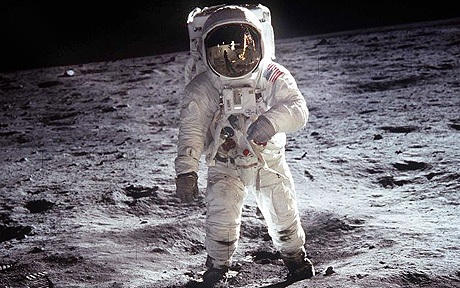
Buzz Aldrin: July 21st, 1969

The force of gravity on the moon is considerably less than the force of gravity on the earth. This is because the moon has a smaller size and mass when compared to the earth. Watch the video below of Neil Armstrong in 1969 during the first moon landing. He appears to be bouncing around rather than simply walking. That is the result of a smaller force of gravity pulling the astronauts down towards the surface of the moon. In fact, his feet aren't falling to the surface of the moon as fast as they fall towards the surface of the earth. The force that the moon applies on the astronauts on the moon is less than the force applied by the earth. The force is gravity, what we know of as weight. Thus, on the moon, things seems less heavy and fall more slowly.

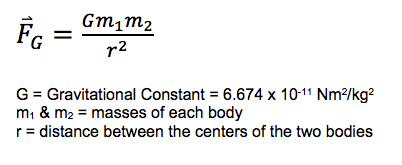
Newton's equation to determine the force gravity is:

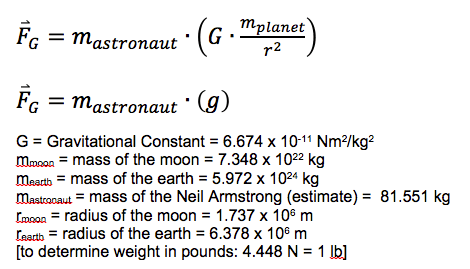
If we consider the moon:

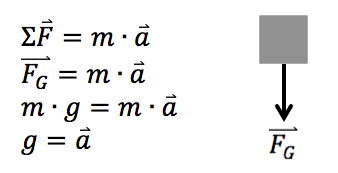
The constant g shown in the equation above is also referred to as the acceleration due to gravity [measured in m/s2m/s^2]. That is the rate at which an object will fall in the absence of air resistance. In other words, when an object has no other force acting on it other than the force of gravity. Look at this using Newton's 2nd law of motion:

Determine the force of gravity, or weight of Neil Armstrong on both the moon and the earth using Newton's equation for gravity. Convert your answer from Newtons to Pounds.

Also determine the value of the acceleration due to gravity, gg on both the earth and the moon.

[round your answers to the nearest tenth]

FORCE (Weight) on MOON = ___ N

Type a concept, like “slope” or “photosynthesis”.

↑ ↓ to choose · Enter to openSearch explanations and problems