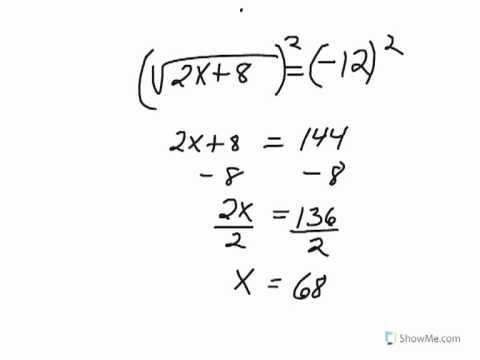
মূূলযুক্ত সমীকরণের সমাধান:

Before this, knowবর্গমূল সংক্রান্ত অসমতা

Interactive · 1 question

Identifying Extraneous Solutions to Radical Equations

Some radicals have extraneous soulutions. These are solutions that aren't valid when plugged into the original equation.

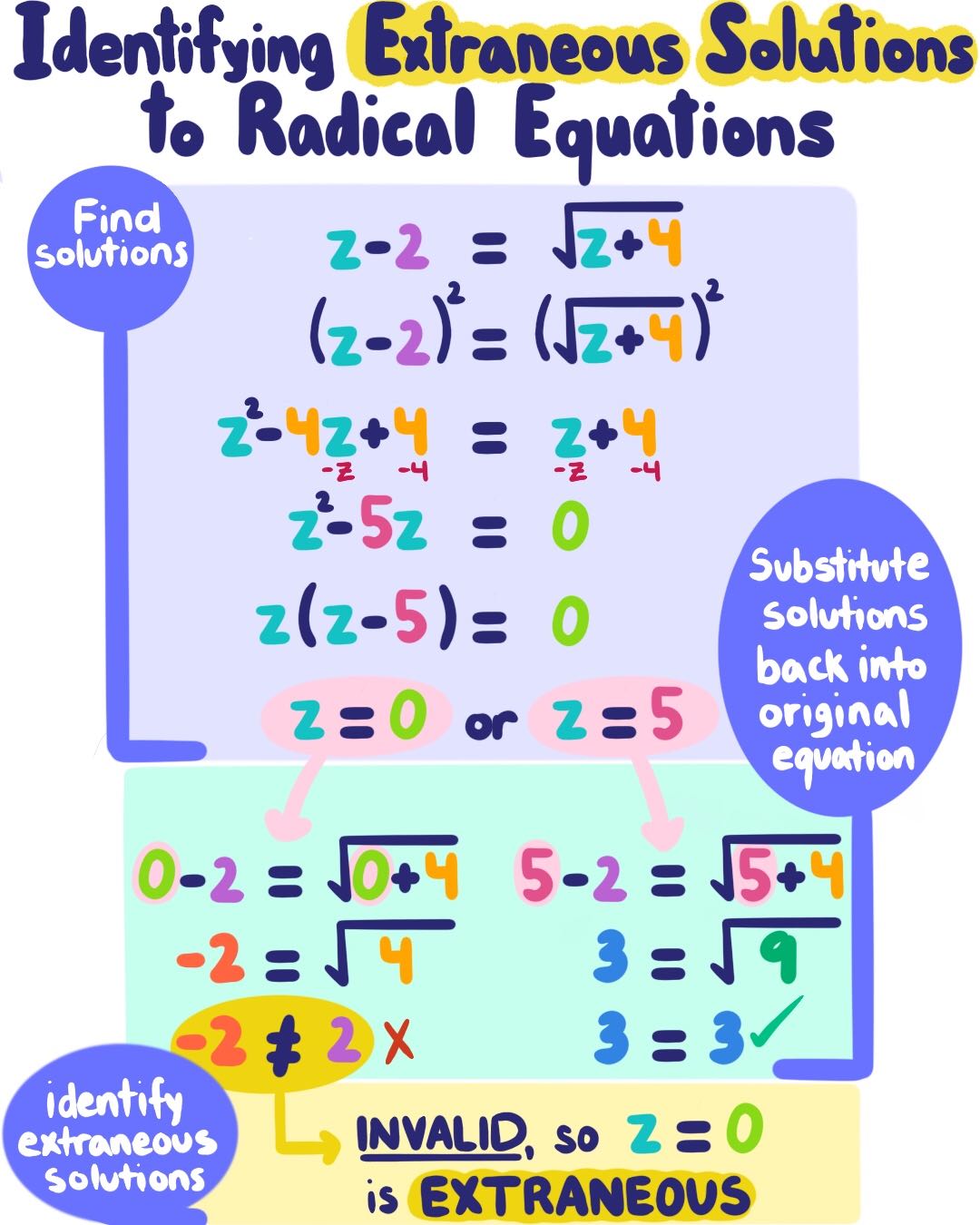
Here's an example of how you check for extraneous solutions:
Identifying Extraneous Solutions to Radical Equations
1) Find solutions
2) Substitute solutions back into original equation
3) Identify extraneous solutions

Image source: by Caroline Kulczycky

Extraneous solutions don't work when you substitute them back into your original equation!

Let's do another example.

Is there an extraneous solution to the following equation? x−1=x−7\sqrt{x-1} = x-7

If so, what is it?

Choose one answer

Illustrated · 1 min

Some radicals have extraneous solutions, or solutions that aren't valid. This means that some radicals have no solutions at all.

Extraneous solutions highlight why it's SO important to check your work..

A goofy "disguise" mask with glasses, a big nose, and mustache

Image by Clker-Free-Vector-Images via Pixabay (License)

Extraneous solutions: they're disguised as real solutions, but underneath the glasses and bushy eyebrows, they don't work in the original equation.

Example 1: Radical equation with no solution

−3x+1=2−3x\sqrt{-3x + 1} = \sqrt{2 - 3x}

We can see that this is a radical equation with square roots on both sides.

We'll start as we normally would in a simplified equation with radicals, by squaring both sides.

−3x+1=2−3x(−3x+1)2=(2−3x)2−3x+1=2−3x\begin{align} \sqrt{-3x + 1} &= \sqrt{2 - 3x} \\ (\sqrt{-3x + 1})^2 &= (\sqrt{2 - 3x})^2 \\ -3x + 1 &= 2 - 3x \end{align}

Now that we've gotten rid of the radicals, let's solve for xx!

−3x+1=2−3x1=2\begin{align} -3x + 1 &= 2 - 3x \\ 1 &= 2 \end{align}

Well, nope. One definitely does not equal 22. Any time your solution gives you a statement that is FALSE (like this one, for example), we say that the equation has no solution.

Example 2: Radical equation with extraneous solution

8+2x+5=18 + \sqrt{2x + 5} = 1

Let's start, as usual, by simplifying this equation as much as possible.

To simplify this equation, we need to subtract 88 from both sides.

2x+5=−7\sqrt{2x + 5} = -7

Now, let's eliminate the radical by squaring both sides of the equation.

(2x+5)2=(−7)22x+5=49\begin{align} (\sqrt{2x + 5})^2 &= (-7)^2 \\ 2x + 5 &= 49 \end{align}

Okay! So, we can finish up by solving for x.x.

2x=44x=22\begin{align} 2x &= 44 \\ x &= 22 \end{align}

Looks good! The last thing we need to do is check our work by plugging x=22x=22 into the original equation.

8+2x+5=18+2(22)+5=149=−7\begin{align} 8 + \sqrt{2x + 5} &= 1 \\ 8 + \sqrt{2(22) + 5} &= 1 \\ \sqrt{49} &= -7 \end{align}

Well, that doesn't work. Although x=22x=22 came out as a solution when we solved the equation, it doesn't work anymore when we plug it in to the original. This is an example of an extraneous solution.

Video

(Video) Extraneous Solution when Solving Radical Equations

by Tom McLaughlin

This video by Tom McLaughlin covers extraneous solutions.

Summary\large{\text{Summary}}

An extraneous solution is a solution that does not work. When working with radicals you might end up with multiple "solutions" due to squaring. You have to plug them back into the original problem because sometimes the "solution" won't satisfy the equation. Let's look at his first problem.

x=−3\sqrt{x}=-3

We can square both sides to get rid of the radical.

x2=(−3)2x=9\begin{align}\sqrt{x}^2&=(-3)^2\\ x&=9\end{align}

Let's plug this back into the equation.

9=−33=−3\begin{align} \sqrt{9}&=-3\\ 3&=-3\end{align}

This is not a true statement! The principle root of 9\sqrt{9} is 33, which is not equal to −3-3. This means that x=9x=9 is an extraneous solution.

Type a concept, like “slope” or “photosynthesis”.

↑ ↓ to choose · Enter to openSearch explanations and problems