কোনো ঋণাত্মক বাস্তব সংখ্যার বর্গমূল

Before this, knowকাল্পনিক সংখ্যা কী?

Read · 1 min

As you have probably learned before, when we are working with real numbers, the expression a\sqrt{a} cannot be evaluated when a<0.a<0. In other words, there is no real solution to the square root of a negative real number.

Never fear! Now that we have some knowledge of imaginary numbers, we can evaluate square roots (and other roots) of negative numbers!

Let's look at an example. Take −25.\sqrt{-25}. Here is how we would simplify this radical.

Notice that −25=(−1)(25)=−1⋅25\begin{align} \sqrt{-25}&=\sqrt{(-1)(25)}\\ &=\sqrt{-1} \cdot \sqrt{25} \end{align}

But wait! We know that −1=i,\sqrt{-1}=i, the imaginary unit! Thus, −25=−1⋅25=i25=25i=5i\begin{align} \sqrt{-25}&=\sqrt{-1} \cdot \sqrt{25}\\ &=i\sqrt{25}\\ &=\sqrt{25} i\\ &=5i \end{align}

Basically, if you're taking the square root of a negative real number, the answer will be ii times the square root of the number if that number was positive. To put it another way, −a=ia, for a<0\sqrt{-a}=i\sqrt{a}, \text{ for $a<0$}

Now that we know how to find the square root of negative real numbers, we can find solutions to a wider range of quadratic equations!

Consider x2+2.x^2+2. Let's find the roots of this function. x2+2=0x2=−2x2=±−2x=±−2\begin{align} x^2+2 &= 0\\ x^2 &= -2\\ \sqrt{x^2} &= \pm \sqrt{-2}\\ x &= \pm \sqrt{-2}\\ \end{align}

Before, we could not have evaluated ±−2,\pm \sqrt{-2}, because we did not know about imaginary numbers. However, now we know that −2=i2.\sqrt{-2}=i\sqrt{2}. Thus,
x=±−2x=±i2\begin{align} x &= \pm \sqrt{-2}\\ x&= \pm i\sqrt{2} \end{align}

So, x2+2x^2+2 has two imaginary roots: i2i\sqrt{2} and −i2.-i\sqrt{2}.

Read · 1 min

Complex Roots

Now that we have a basic grasp of imaginary and complex numbers, we can start diving a little bit deeper.

We know that −1\sqrt{-1} can be rewritten as ii, and that our imaginary numbers can be added with real numbers to form complex numbers. We need to find a way to make these newfound numbers useful!

The quadratic formula has some of our uses for these new numbers! For a quick review, if the discriminant is less than 00, there are no real roots to the equation. This also means that there are two complex roots to the function! Let's plug the function f(x)=x2+2x+5f(x)=x^2+2x+5 into the quadratic formula. x=−b±b2−4ac2ax=−2±22−4(1)(5)2(1)x=−2±4−202x=−2±−162\begin{align}x&=\frac{-b\pm\sqrt{b^2-4ac}}{2a}\\ x&=\frac{-2\pm\sqrt{2^2-4(1)(5)}}{2(1)}\\ x&=\frac{-2\pm\sqrt{4-20}}{2}\\ x&=\frac{-2\pm\sqrt{-16}}{2} \end{align} When we've come across this step before, we would normally stop and say that there are no real roots. Now, we can simplify further and find the complex roots. x=−2±−1162x=−2±4i2x=−1±2i\begin{align}x&=\frac{-2\pm \sqrt{-1}\sqrt{16}}2\\ x&=\frac{-2 \pm 4i}{2}\\ x&=-1 \pm 2i \end{align}

So, the roots of the function f(x)=x2+2x+5f(x)=x^2+2x+5 are −1+2i-1+2i and −1−2i.-1-2i. Just because the roots are complex numbers, doesn't mean they don't exist!

Video

(Video) Negative Underneath Root in Quadratic Formula (Imaginary Solutions)

by mathwithmrbarnes

Check out this video by mathwithmrbarnes about using the quadratic formula with imaginary solutions.

When using the quadratic formula to solve, if you have a negative number under the square root, remove a −1\sqrt{-1} and substitute an ii.

We can use a similar example to the one in the video to better illustrate this concept.

Let's say we start with the quadratic: x2−5x+9=0x^2 - 5x + 9 = 0 and we use the quadratic equation to solve for the roots. We end up with:

5±−112\frac{5\pm \sqrt{-11}}{2}

Since we have a negative under the square root, we know we have to use imaginary numbers.

We can then simplify to: 5±11∗i2\frac{5\pm \sqrt{11}*i}{2}

Illustrated · 1 min

Imaginary Square Roots of a Negative Real Number

In math, when we talk about square roots, we're usually looking for a number that, when multiplied by itself, gives us a positive number. For example, the square root of 99 is 33, because 3⋅3=93 \cdot 3 = 9.

Let's think about what happens when we try to take the square root of a negative number, like −9-9.

Imaginary Square Roots of a Negative Number
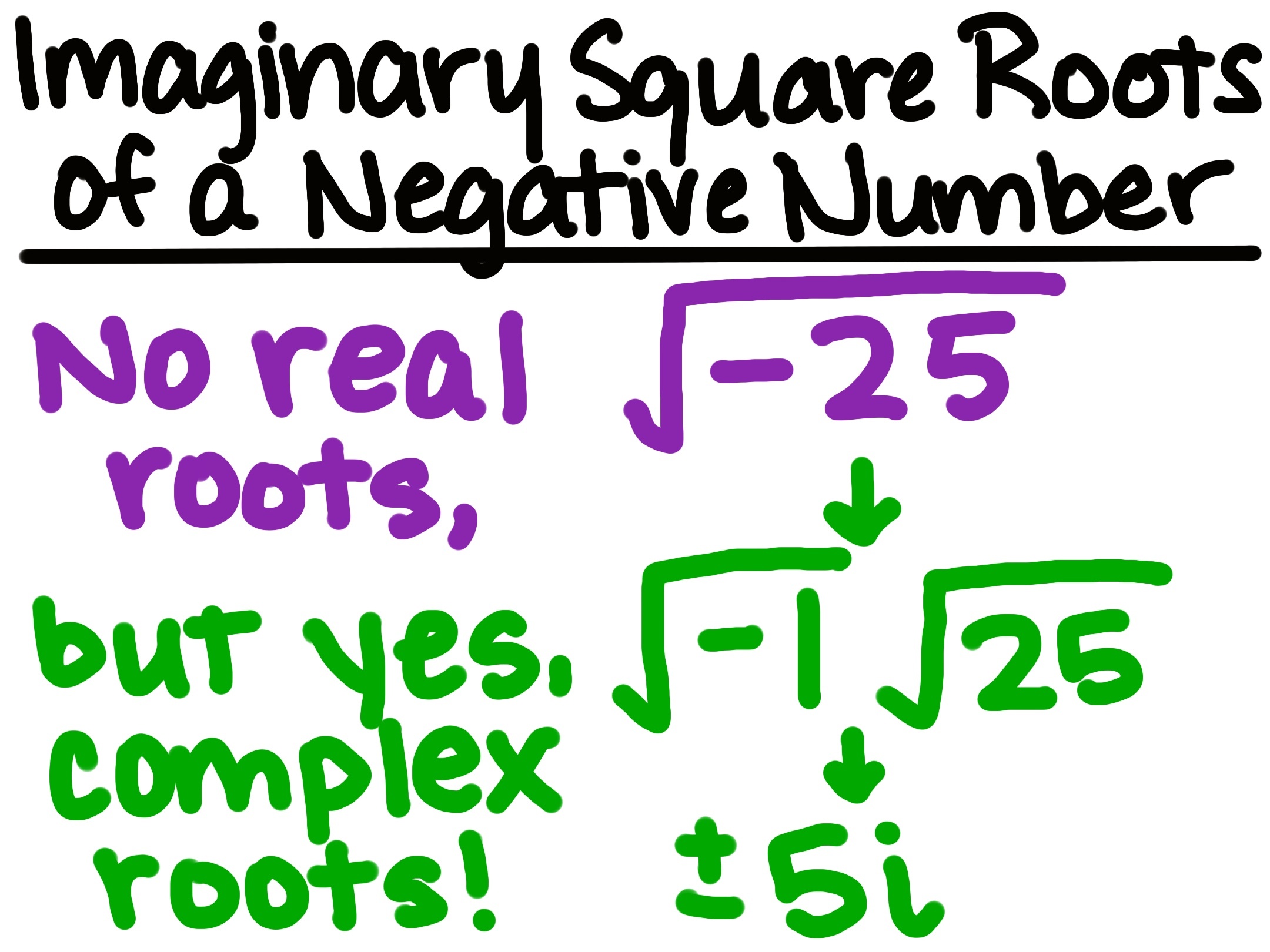
No real roots, but yes, complex roots!

Image source: by Anusha Rahman

Here's where something interesting happens: in regular math, there is no real number that can give a negative result when squared. However, mathematicians came up with a new type of number called imaginary numbers to solve this problem. The basic imaginary number is represented as ii, where ii is the square root of −1-1.

So, i2=−1i^2 = -1.

When we take the square root of a negative number, we can use ii to help us. Let's say that the square root of −25-25 is −25\sqrt{-25}. Since we know that 25=5\sqrt{25}=5, we can express −25\sqrt{-25} as 5i5i because:

−25=5⋅−1=5i\sqrt{-25}=5 \cdot \sqrt{-1}=5i

Imaginary numbers allow us to work with square roots of negative numbers, which opens up a whole new world in mathematics!

While imaginary numbers might seem strange at first, they are incredibly useful in higher-level math, physics, engineering, and even computer science! They help us solve equations and understand concepts that would be impossible with just real numbers.

Type a concept, like “slope” or “photosynthesis”.

↑ ↓ to choose · Enter to openSearch explanations and problems