Illustrated · 1 min

Two lines form two angles, one acute and one obtuse (unless they're both right angles). The internal angle bisector is (generally) the line that bisects the acute angle, whereas the one that bisects the obtuse angle is the external angle bisector. They are depicted in red below.

Also, technically they don't have to be acute/obtuse, but they just have to be the other of the two angles that you're looking at. For example if I'm looking at ∠ACB>90∘\angle ACB>90^\circ, then the external bisector is the bisector of the other angle formed by lines ACAC and BCBC.

Illustrated · 1 min

Exterior Angle Bisectors

If we bisect the angles of a triangle from the inside, we get our typical interior angle bisectors, which are concurrent at the incenter.

However, those aren't the only angles in a triangle. If we extend a triangle's sides, we get the exterior angles.

These are the angles on the outside of the triangle; it can easily be seen that they are the supplements of the interior angles.

Now, if we bisect the exterior angles, we get something interesting:

The orange dashed lines in this diagram are called the external angle bisectors of the triangle. The external angle bisectors are perpendicular to the internal angle bisectors (as they bisect supplementary angles).

The Excircle

Let's take a triangle △ABC\triangle ABC:

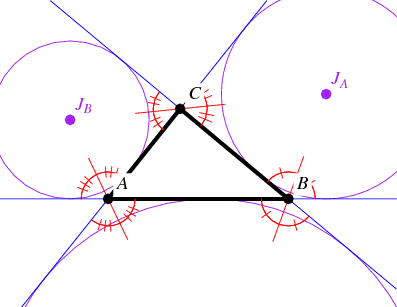
We draw a circle tangent to all three of its side, but outside of the triangle. This is called an excircle of the triangle. The center of this circle, XX, is called an excenter of the triangle.

Notice that since XX is equidistant from the three sides, we get that XX is the intersection of two external angle bisectors and an internal angle bisector.

That's it! You've learned what external angle bisectors, excircles, and excenters are.

Type a concept, like “slope” or “photosynthesis”.

↑ ↓ to choose · Enter to openSearch explanations and problems