
Interactive · 2 questions
+6 contributors





Split the equation into pieces
Before we go into solving absolute value as a piecewise function, let's first look at piecewise functions!
Piecewise functions are functions that have more than one piece to them. They follow different equations depending on what value of . For example, take a look at the following equation:
If you think about this function as a machine, you would have to sort your 's before you dropped them in. If is less than , you have to drop it in the bucket that goes to the equation . If it's greater than or equal to , you have to drop it in the bucket that goes to . A graph of this function looks like this:

Graph courtesy of Desmos
These equations don't form one straight, continuous line, but they're all part of the same function.
Absolute value functions work the same way on a graph. In fact, their graphs are always the shape of a V. Take a look at the graph below:

Graph courtesy of Desmos
This graph is for the function . Notice that there seem to be two lines. One has a slope that climbs up, another slides down. We can find the equations for these two lines by going through the steps to solve absolute value functions.
First, separate the two options out. We can say that is the same as
When the value of dips below , the direction of the line changes. We can formalize those by just putting them into one equation:
...and then simplifying the inequalities!
Then, you can find the graph by just plugging the values into the equation that they go to! These easy steps will allow you to interpret absolute functions as piecewise.
Try it!
Take a look at the following function:
What equation will it follow when is greater than or equal to ?
Right, when the segment of the equation that's within the absolute value brackets is equal to a number greater than or equal to , everything works normally.
What equation will it follow when is less than ?
When the value of is less than , the function will spit out the positive equivalent of that number. We can say that the equation it's actually following is:
Awesome! We know that the function follows if and if . Write out the piecewise function that means the same thing (don't forget to simplify the inequalities!).
Nice! Now try graphing those equations on a piece of paper, making sure to stop the lines when they get outside of their limit in the piecewise function.
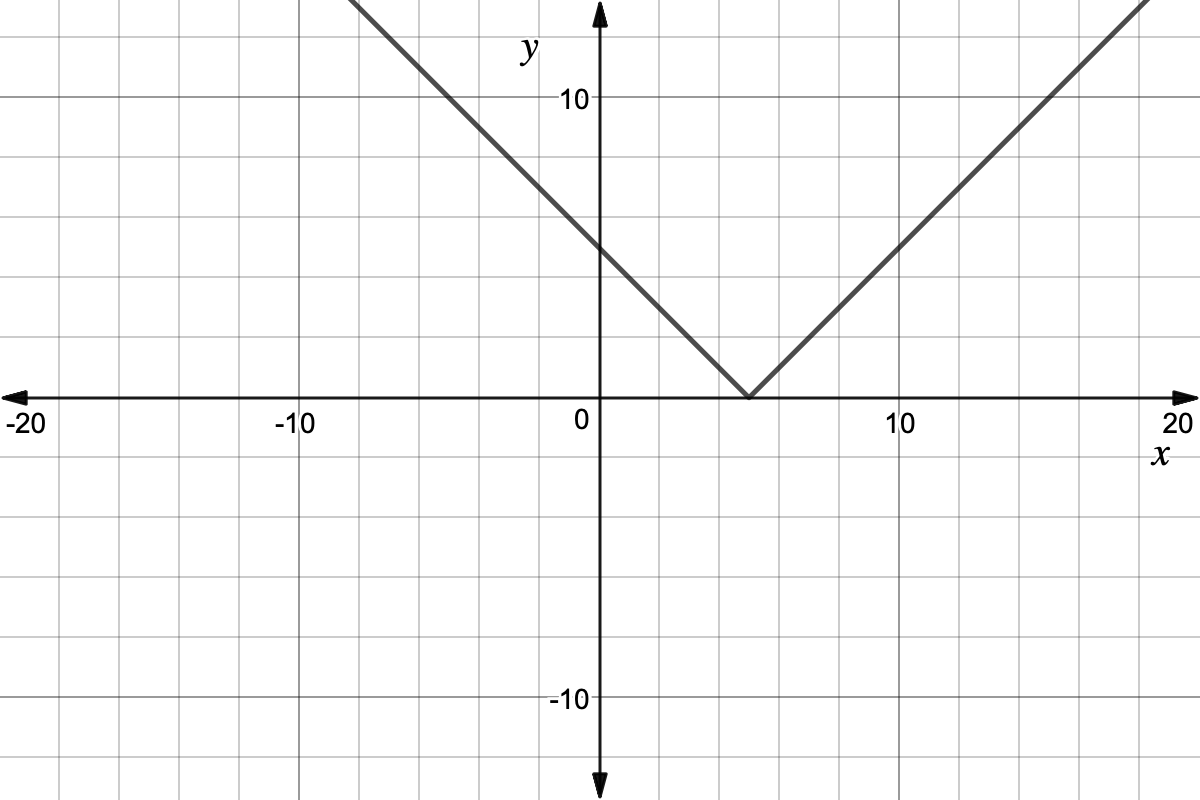
Graph courtesy of Desmos


