মূলদ রাশির যোগ ও বিয়োগ

Before this, knowমূূলদ রাশিমালাকে সরলীকরণের পদ্ধতিসমূহ

Interactive · 1 question

Adding and Subtracting Rational Expressions\textbf{Adding and Subtracting Rational Expressions}
Adding Rational Expressions: to simplify (2/(x+2))+(1/(x-5)), first find a common denominator, then convert each rational expression to an equivalent one with that denominator. Then add the new rational expressions, distribute/FOIL, and combine like terms. The simplified way of writing (2/(x+2))+(1/(x-5)) is (3x-8)/(x^2-3x-10).

Image source: by Caroline Kulczycky

Let's do another example, this time with subtracting rational expressions.

Fully simplify x+13−14x+59x.\dfrac{x+1}{3}-\dfrac{14x+5}{9x}.

Choose one answer

Video · + 3 min read

(Videos) Rational Expressions Arithmetic

by ThinkwellVids

In this video by ThinkwellVids, you learn how to add and subtract rational expressions.

Summary\large{\text{Summary}}

Adding and subtracting rational expressions can be a pain. The reason is, you need to make sure they have common denominators before you can add or subtract.

Let's look at an example and see how we do this. 1x+3+1x\frac{1}{x+3}+\frac1x We can't add these together yet because they have different denominators. To find a common denominator, you have to multiply both the top and bottom by the denominator of the other fraction.

So, since 1x+3\frac{1}{x+3} has a denominator of x+3x+3, we need to multiply 1x\frac1x by x+3x+3\frac{x+3}{x+3}. 1x+3+1x⋅x+3x+3\frac{1}{x+3}+\frac1x\cdot\color{#8925AE}{\frac{x+3}{x+3}} Similarly, since 1x\frac1x has a denominator of xx, we need to multiply 1x+3\frac{1}{x+3} by xx\frac{x}x. xx⋅1x+3+1x⋅x+3x+3\color{#8925AE}{\frac xx}\cdot\frac{1}{x+3}+\frac1x\cdot\color{#8925AE}{\frac{x+3}{x+3}}

Simplifying each fraction, we get: xx(x+3)+x+3x(x+3)\frac{x}{x(x+3)}+\frac{x+3}{x(x+3)} Now, we have two fractions with the same denominator and we can add. Remember, we only add the numerators. =x+x+3x(x+3)=\frac{x+x+3}{x(x+3)} Finally, we simplify as much as possible. =2x+3x2+3x\boxed{=\frac{2x+3}{x^2+3x}}

Interactive Example

In this video by ThinkwellVid, you can walk through an example.

Let's work through this problem together. 1x+z+1x−z\frac{1}{x+z}+\frac{1}{x-z}

Do these fractions have common denominators?

Choose one answer

Read · 1 min

Adding and Subtracting Rational Expressions with Uncommon Denominators

Now that we've covered the basics of simplifying rational expressions, we can move on. Let's learn how to add or subtract rational expressions with uncommon denominators.

We want to add 76+34\frac76+\frac34. Since they don't have common denominators we can't simply add them. Instead we multiply both fractions by the least common multiple of the denominators.

So in the problem above we have a denominator with 66 and one with 44. To figure out the common denominator we break the denominators down into their prime factorizations. 6=2⋅34=2⋅26=2\cdot3\\4=2\cdot2

Now we ask, "Is there a factor missing from the first that the second has?" and "Is there a factor missing from the second that the first has?" Well the 44 has two 2's and the 66 only has one. So the 66 is missing a factor of 2.2. The 44 has zero factors of 33 whereas the 66 has one factor of 3.3. So the 44 is missing a factor of 3.3.

We can then multiply the numerator and denominator of each fraction by the missing factor. So, 76+34=76 ⋅22 + 34 ⋅ 33=1412+912=2312\begin{align} \dfrac76+\dfrac34&=\frac76\color{#8925AE}{\ \cdot\frac22} \ + \ \frac34\color{#8925AE}{\ \cdot \ \frac33}\\ &=\frac{14}{12}+\frac9{12}\\ &=\frac{23}{12} \end{align}

As you can see, when we multiply to get the least common denominator, it gives both fractions the same bottom number. This makes it easier to add or subtract them. Just like with regular fractions, we need the bottoms to match before we can combine the tops.

Let's look at an example with rational expressions: 3x2+7x+10+4x2+5x+6\frac{3}{x^2+7x+10}+\frac{4}{x^2+5x+6}. So the first step is to factor the polynomials in the denominator. 3x2+7x+10+4x2+5x+6=3(x+5)(x+2)+4(x+2)(x+3)\begin{align} &\dfrac{3}{x^2+7x+10}+\dfrac{4}{x^2+5x+6}\\ &=\frac{3}{(x+5)(x+2)}+\frac{4}{(x+2)(x+3)} \end{align} So just like the problem above, we see that the first fraction is missing a factor of x+3x+3. The second fraction is missing a factor of x+5x+5. 3x2+7x+10+4x2+5x+6=3(x+5)(x+2)+4(x+2)(x+3)=3(x+5)(x+2)⋅x+3x+3+4(x+2)(x+3)⋅x+5x+5=3(x+3)(x+5)(x+3)(x+2)+4(x+5)(x+5)(x+3)(x+2)=3x+9(x+5)(x+3)(x+2)+4x+20(x+5)(x+3)(x+2)=7x+29(x+5)(x+3)(x+2)\begin{align} &\dfrac{3}{x^2+7x+10}+\dfrac{4}{x^2+5x+6}\\ &=\frac{3}{(x+5)(x+2)}+\frac{4}{(x+2)(x+3)}\\ &=\frac{3}{(x+5)(x+2)}\color{#8925AE}{\cdot\frac{x+3}{x+3}}\color{black}+\frac{4}{(x+2)(x+3)}\color{#8925AE}{\cdot\frac{x+5}{x+5}}\\ &=\frac{3(x+3)}{(x+5)(x+3)(x+2)}+\frac{4(x+5)}{(x+5)(x+3)(x+2)}\\ &=\frac{3x+9}{(x+5)(x+3)(x+2)}+\frac{4x+20}{(x+5)(x+3)(x+2)}\\ &=\frac{7x+29}{(x+5)(x+3)(x+2)} \end{align} The result cannot be factored anymore so it is our final answer. Sometimes, after adding or subtracting, you can reduce it further.

Looking Further

Let's continue to build on this idea. In the next lessons, you will learn how to:

Video

(Video) Adding and Subtracting Rational Expressions

by yaymath

Here's a video by yaymath showing you how to add and subtract rational expressions (or functions).

Summary\large{\text{Summary}}

To do this the denominators must be the same. In the video, he goes over examples showing you how to get like denominators and then how to add or subtract the terms.

Test Yourself: x−5x−6−2x−93x−18\frac{x-5}{x-6}-\frac{2x-9}{3x-18}

Choose one answer

Video

(Videos) Adding and Subtracting Rational Expressions with Common Denominators

by mathman1024

Here's a video by mathman1024 showing how to add and subtract rational expressions with common denominators.

Summary\large{\text{Summary}}

To add or subtract rational expressions you must have common denominators. ac+bc=a+bc\frac{a}c+\frac{b}c=\frac{a+b}c

He looks at the example xx+3+7x+3\frac{x}{x+3}+\frac{7}{x+3}. xx+3+7x+3=x+7x+3\dfrac{x}{x+3}+\dfrac{7}{x+3}=\frac{x+7}{x+3}

Try these next ones on your own!

  1. x+5x−2+3x+1x−2\frac{x+5}{x-2}+\frac{3x+1}{x-2}
  2. 4x−7−8x−7\frac{4}{x-7}-\frac{8}{x-7}
  3. 3x+1x2−4−7x2−4\frac{3x+1}{x^2-4}-\frac{7}{x^2-4}

In this video, mathman1024 looks at some problems where you have to remove a negative factor from the denominator before you can add or subtract.

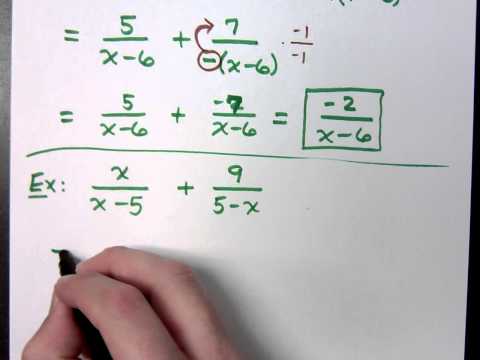
The first one he looks at is 5x−6+76−x\frac{5}{x-6}+\frac{7}{6-x}. Since these two rational expressions have different denominators we can't just simply add them. But we can factor out a negative one from the denominator of one. 5x−6+76−x=5x−6+7−x+6=5x−6+7−(x−6)=5x−6−7x−6=−2x−6\begin{align} &\dfrac{5}{x-6}+\dfrac{7}{6-x}\\ &=\dfrac{5}{x-6}+\dfrac{7}{\color{#8925AE}{-x+6}}\\ &=\dfrac{5}{x-6}+\dfrac{7}{\color{#8925AE}{-(x-6)}}\\ &=\dfrac{5}{x-6}\color{#8925AE}{-}\dfrac{7}{x-6}\\ &=\frac{-2}{x-6} \end{align}

Try this next one on your own!

  1. xx−5+95−x\frac{x}{x-5}+\frac{9}{5-x}

Type a concept, like “slope” or “photosynthesis”.

↑ ↓ to choose · Enter to openSearch explanations and problems