লগারিদম এবং প্রাকৃতিক লগ e

Before this, knowe, Euler's Number

Read · 1 min

Laws of Logs ft. e\color{purple}{\text{ft. e}}

Here's a summary of all the useful algebraic properties of logs that you can use, adjusted for the natural logarithm!

Basic facts and identities:

  1. ln⁡1=0\ln 1=0
  2. ln⁡e=1\ln e=1
  3. ln⁡eb=b\ln e^b=b
  4. eln⁡b=be^{\ln b}=b

Operations:

  1. ln⁡bc=ln⁡b+ln⁡c\ln bc=\ln b+\ln c
  2. ln⁡bc=ln⁡b−ln⁡c\ln\frac{b}{c}=\ln b-\ln c
  3. ln⁡bc=cln⁡b\ln b^c=c\ln b
  4. ln⁡c=1bln⁡c\ln c=\frac{1}{b}\ln c

Change of base:

  1. ln⁡b=log⁡cblog⁡ce\ln b=\frac{\log_{c}b}{\log_{c}e}

Many times, when we are dealing with natural logarithms, we look for values that are approximately equal to their actual values. Alternatively, you can use a graphing calculator to find the exact values.

Read · 1 min

The natural log is the special name for a logarithm with base e.e.

Namely, the natural log of kk is the solution to the equation ex=ke^x=k.

The natural log of kk is represented as either log⁡e(k)\log_{e}(k), or, more commonly, shortened to ln⁡(k)\ln(k).

Properties

From the definition of logarithms, we can derive some simple properties, such as eln⁡(x)=x\begin{align*} e^{\ln(x)} = x \end{align*} and ln⁡(ex)=x\begin{align*} \ln(e^{x}) = x \end{align*}

More properties

The natural log is called natural since it commonly shows up in mathematics.

For example, differentiating a logarithmic function with base bb, surprisingly, yields the natural log in its answer. ddxlog⁡b(x)=1x ln⁡(b)\frac{d}{dx}\log_{b}(x) = \frac{1}{x \: \ln(b)}

Another interesting property of natural logarithms relating to differentiation is that ddxln⁡(x)=1x\frac{d}{dx}\ln(x) = \frac{1}{x}, which can be drawn from the previous property.

Numerical value

There are many known ways of deriving the exact value for ee.

Some of them include:

∑k=0∞1k!\begin{align*} \sum_{k=0}^{\infty} \frac{1}{k!} \end{align*}

and lim⁡x→∞(1+1n)n\begin{align*} \lim_{x\to\infty} \Big(1+\frac{1}{n} \Big)^n \end{align*}

Video

(Video) Properties of Logarithms

by PatrickJMT

Here's a video by PatrickJMT giving you some properties of logarithms and explaining what the natural log is.

Summary\large{\text{Summary}}

He then goes over some problems. In the video he goes over the cancellation laws of logarithms. These are log⁡a(ax)=x\log_a(a^x)=x and aloga(x)=xa^{log_a(x)}=x. The natural log is when you have log⁡e(x)\log_e(x) and this can be rewritten as ln⁡(x)\ln(x).

Test Yourself: Solve for xx. e3x−5−2=0e^{3x-5}-2=0

Choose one answer

Interactive · 1 question

Common Logs and Natural Logs

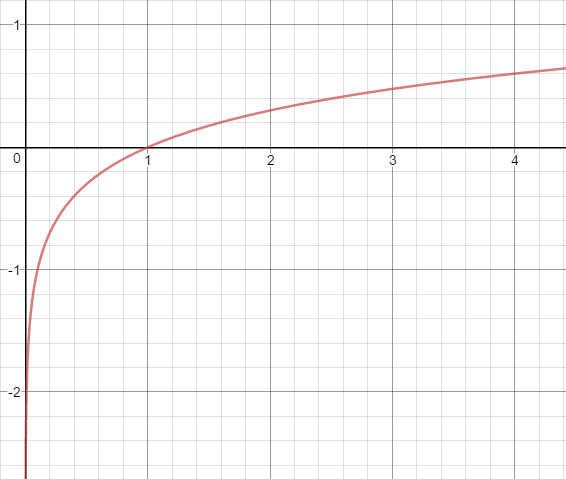
The natural log is just a log to the base ee. The graph of the log function is shown in Figure 11. The log function approaches infinity as xx approaches 00. And when x=1x=1 the log equals 00.

graph of log(x)

Made using Desmos

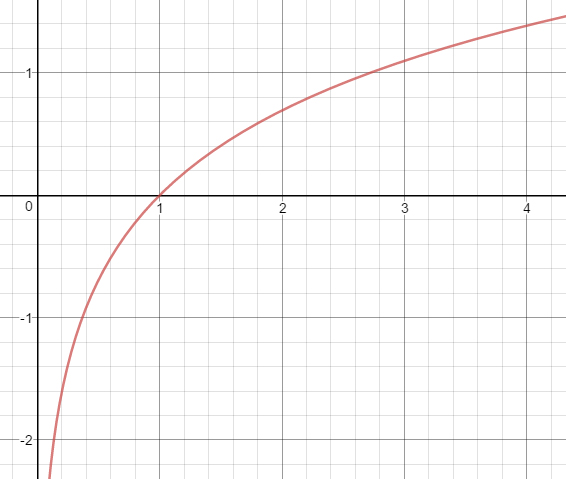
The graph of the natural log is shown in Figure 2. It is a similar shape as the log function but expanded more. The same properties still hold though. As xx approaches 0, the function approaches infinity, only it approaches slower than the log function. As always, when x=1x=1 the function equals 0.

graph of ln(x)

Made using Desmos

Test Yourself: Which function would reach y=100y=100 faster?

Choose one answer

Illustrated · 1 min

Natural Logarithms

Next in the series on logarithms and exponential functions, we will tackle natural logs. This is a common logarithm that you will see frequently. The mathematical constant e arises naturally in continuously compounded interest.

We previously learned about Euler's number, ee, and about logarithms. We can combine the two concepts to learn about natural logarithms.

Natural Logarithm
ln(x)=log_e (x)
e=2.71828

Image source: by Anusha Rahman

We can represent the natural logarithm with "ln". "Log base ee of xx" can be written as:

loge(x)=ln(x)log_e (x) = ln(x)

The natural logarithm answers the question: "To what power must ee be raised to in order to get a given number?"

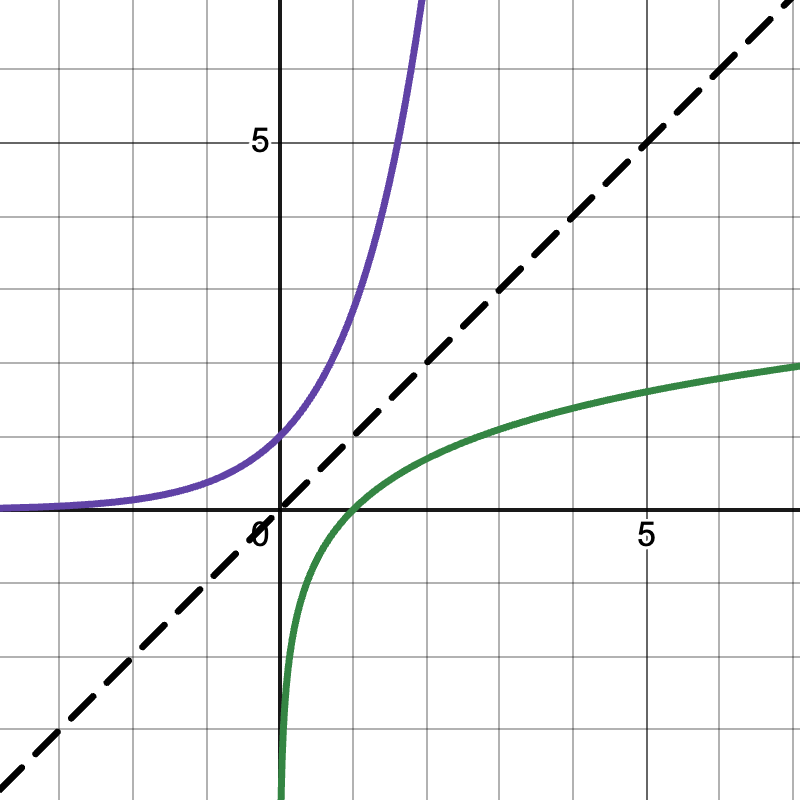
The natural logarithm is the inverse of the exponential function y=exy=e^x. Let's look at what this inverse relationship looks like on a graph!

Graph of natural logarithm and its inverse

Made using Desmos

Just as subtraction undoes addition, the natural logarithm undoes exponentiation with base ee. They are inverse functions!

ln⁡(ex)=x\ln(e^x) = x is the inverse of eln⁡(x)=xe^{\ln(x)} = x

There are some important restrictions on the domain and range of a natural log function. For the domain, the input must be positive (x>0x>0). That means that you cannot take the natural log of zero or a negative number.

For the range, the output can be any real number. That means that the range is (−∞,∞)(-\infty, \infty).

The graph of the natural logarithm has the following properties:

  • Passes through the point (1,0)(1,0)
  • Increases slowly as xx increases
  • Has a vertical asymptote at x=0x=0

Type a concept, like “slope” or “photosynthesis”.

↑ ↓ to choose · Enter to openSearch explanations and problems