Match the Variables
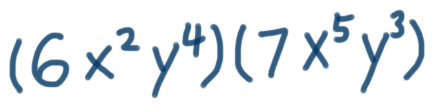
We usually think of monomials as just one sort of unit in algebra, since mono means one. However, they can be made up of different variables multiplied together!
Let's say we have two monomials that we're trying to multiply:
(4xy3z5)(9x3z2)
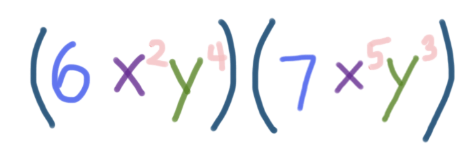
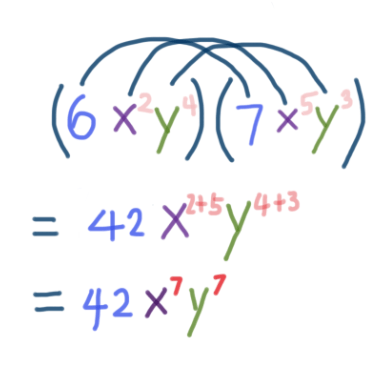
You want to focus on multiplying the like terms of these monomials. The constants multiply together, the x variables multiply together. The y variables multiply together. The z variables multiply together.
The constants, 4 and 9, aren't a mystery, so we can multiply them together like we would normally.
The variables are a mystery, so we have to represent how many times they're multiplied with themselves. For multiplying exponents, we add together the exponent parts.
Let's solve the example given above. First, let's split the problem into the multiplication of its like terms.
(4xy3z5)(9x3z2)=(4⋅9)×(x⋅x3)×(y3)×(z5⋅z2)
Then, multiply the like terms. Remember to add the exponent parts of the variables.
=36×x1+3×y3×z5+2=36x4y3z7
Let's try another problem.
Say we want to find the area of a rectangular garden, but we don't know the exact measurements. We do know that the length is equal to 6xyz and the width is equal 2xy.
The area of a rectangle is given by the formula: Area=length×width
Multiply the length and the width. When you do this, you multiply the coefficients and add the powers of the variables.
Area=length×width=(2xy)×(6xyz)=(2⋅6)×(x⋅x)×(y⋅y)×(z)=12×x1+1×y1×1×z=12x2y2z