
Interactive · 2 questions
+4 contributors



We know how to add and subtract polynomials with multiple unknowns, we know how to multiply two binomials together (FOIL), and we know how to multiply a monomial by a polynomial (basic distributive property).
But what are we supposed to do if the expressions that we're multiplying together have more than one variable (like and instead of just )?
Not to worry! We're actually going to use the same approaches as we always have:
- If we're multiplying two binomials together, we'll use FOIL.
- For all other kinds of polynomial multiplication, we're still going to apply the basic distributive property.
Before we continue, here's a quick refresher on FOIL, just to make sure you're clear: what does FOIL stand for?
Right—when we're dealing with a pair of binomials, the FOIL method reminds us which of those polynomials' terms should be multiplied together:
F: First two terms (in red below)
O: Outside two terms (in orange below)
I: Inside two terms (in yellow below)
L: Last two terms (in green below)
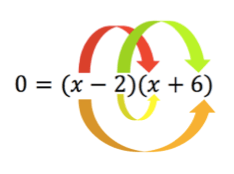
Image source: by Hannah Bonville
Let's look at some examples.
Example 1
We've got two binomials here, so let's use FOIL.
What's the result of FOILing these two binomials?
Choice A:
Choice B:
Choice C:
Notice how we still used FOIL despite having two binomials that contain multiple variables. Remember your rules for adding monomials - do not add the exponents!
So, when we had to multiply a term containing an variable and a term containing a variable together, we got a term with an (like ). Note that multiplying two terms together gives us the usual , and that multiplying two terms together still gives us a .
Example 2
We're going to apply the regular ol' distributive property here. This means that we need to distribute each term in the first set of parentheses to each term in the second set of parentheses. Think of it like dragging the terms through, multiplying them along the way.
All right, let's put this method into practice: give the example above a shot and then check your answer below!
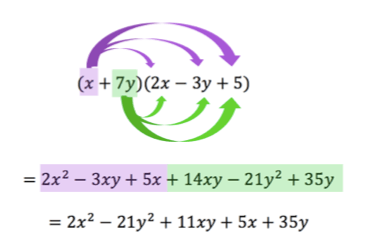
Image source: by Hannah Bonville
Example 3
Ugh. That looks horrible! But, when you take a deep breath, you'll notice that this expression is just two pairs of binomials being multiplied together.
So, let's use FOIL on both pairs of binomials and then add everything together.
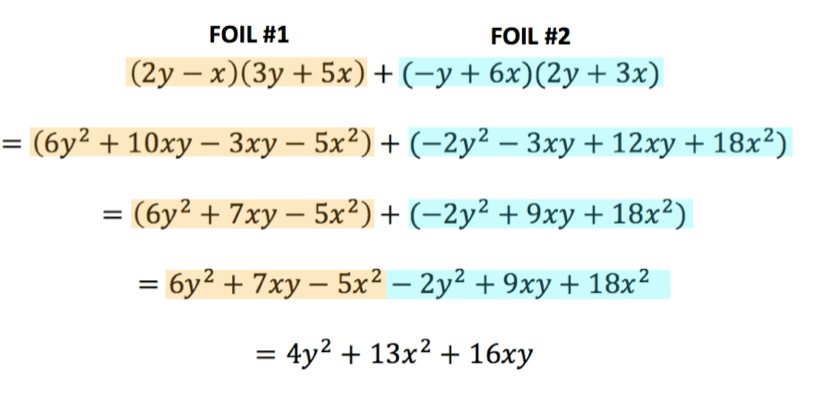
Image source: by Hannah Bonville


