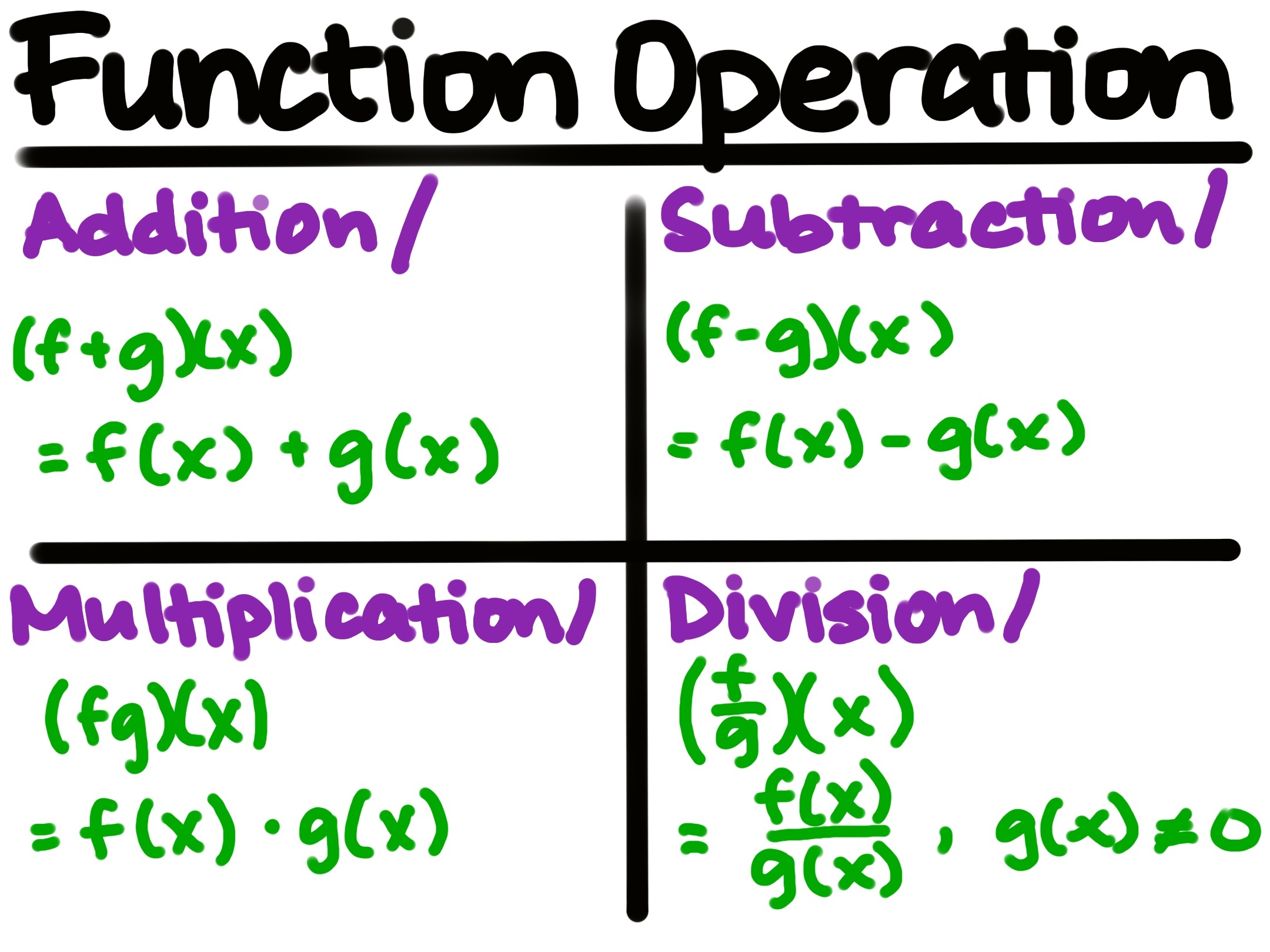
Multiplying two polynomials
This is similar to long multiplication. (I bet you can't wait until we get to long division!) For example, to multiply (x+3)⋅(2x+1):
[
\begin{array}{rrrr}
& & x & +3 \
\times & & 2x & +1 \
\hline & & x & +3 \
\hline & 2x^2 & +7x & +3
\end{array}
]
Essentially, we expand out (x+3)⋅(2x+1) as (x+3)⋅2x+(x+3)⋅1. Then we just multiply monomials: (x+3)⋅1=x+3, and (x+3)⋅2x=2x2+6x. Finally, we align the terms and add them up.
Also, notice the similarity between this product and 13⋅21=273. (In general, products of polynomials and of numbers don't look the same, because with numbers, you have to carry. But when you don't carry, because the digits are all small, you get the same answer.)
As with addition, eventually you pick up the trick of doing the math without writing out the long multiplication in full form.
This method works for any type of polynomial. For binomials (polynomials with two terms), there's a quicker method called FOIL. To take the product of (a+b)(c+d), where a,b,c,d can be any terms, you add ac (the product of the first terms), ad (the product of the outer terms), bc (the product of the inner terms), and bd (the product of the last terms).
Let's try this with the same problem: To find (x+3)⋅(2x+1), we take
(x+3)(2x+1)=(x⋅2x)+(x⋅1)+(3⋅2x)+(3⋅1)=2x2+x+6x+3=2x2+7x+3.