Interactive · 3 questions

Standing on the North Pole

In most places on Earth, your longitude and latitude are like xx and yy coordinates in the plane (as long as you don't go too far, of course, because then you start noticing that the world is not flat).

What if you're standing on the North Pole? A map of parallels and meridians would look like this (with you at the center):

a map of parallels and meridians

Knowing the latitude of a point close to you puts it on one of the circles, telling you how far away it is. Knowing the longitude of a point puts it on one of the lines, telling you which direction it's in. It's still true, of course, that latitude and longitude together specify a point uniquely; they just do it in a way we're not used to!

Polar coordinates

We can extend this to a mathematical notion of specifying a point on a plane, not by its xx and yy coordinates, but by its distance from the origin, rr, and its "direction", θ\theta.

What is θ\theta, exactly? It's an angle measure ranging from 00 to 2π2\pi radians (or from 0∘0^\circ to 360∘360^\circ, but degree measures are very rarely used for this) telling you how far counterclockwise you are from the positive xx-axis.

The rr and θ\theta coordinates of a point are called "polar coordinates".

Here are some examples:
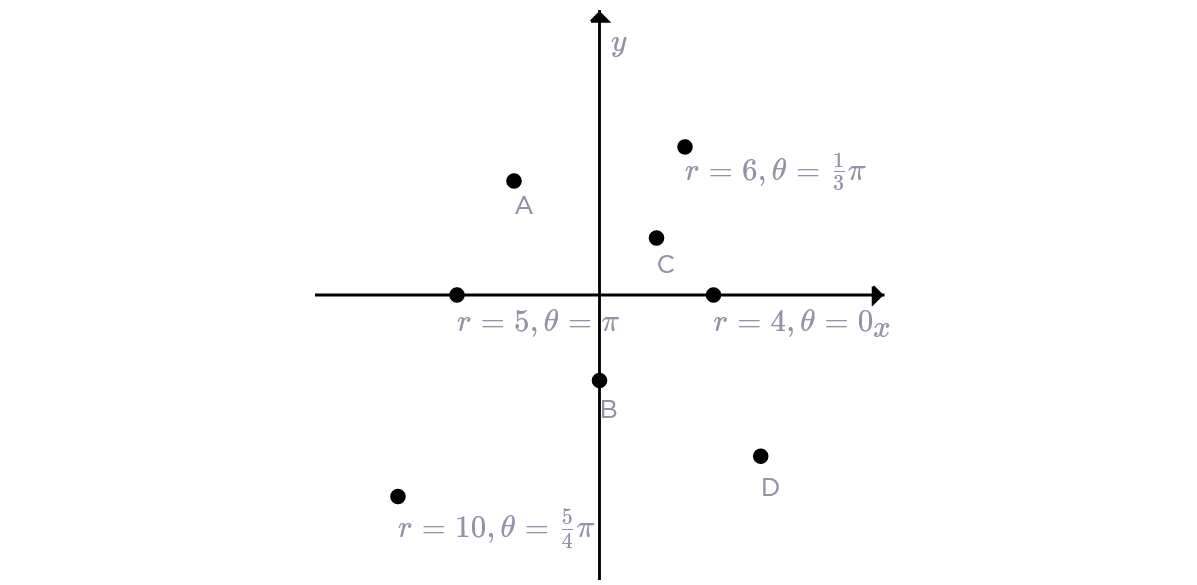
graph

Which of these lists puts AA, BB, CC, and DD in order of increasing rr?

Choose one answer

Read · 1 min

We are all familiar with the 2-D Cartesian coordinate system, in which the coordinates are the distances along the mutually perpendicular xx- and yy- axes.

However, sometimes it is more convenient to describe points in terms of the distance from the origin, which we will call rr, and the angle measured counterclockwise from the positive xx-axis, which we will call θ\theta.

For example, the point (1,1)(1,1) in Cartesian coordinates would become the point (2,π4)(\sqrt{2},\frac{\pi}{4}) in polar coordinates.

In general, we have the following conversion formulas, which are easy to derive: x=rcos⁡θx=r\cos\theta y=rsin⁡θy=r\sin\theta r2=x2+y2r^2=x^2+y^2 tan⁡θ=yx\tan\theta=\frac{y}{x}

Many shapes and equations, mainly those with radial symmetry (e.g. circles) or that have something to do with circles (e.g. cardioids), are easier to describe in polar coordinates. Be sure to keep this coordinate system in mind if there is some shape with either of these two properties mentioned above.

Be warned that, unlike Cartesian coordinates, every point in polar coordinates has infinitely many coordinate representations. A point may be (r,θ)(r,\theta), (r,θ+2π)(r,\theta+2\pi), and (−r,−θ)(-r,-\theta) simultaneously. To go around this problem, we typically restrict rr to be nonnegative and θ\theta to lie between 00 and 2π2\pi. However, some polar curves, such as r=θr=\theta, can only be completely accounted for if we remember that rr and θ\theta can occupy values outside the typical range.

Moreover, the angle θ\theta is ill-defined at the origin, since there is no preferred direction. Since r=0r=0 at this point, it is not very interesting anyway, but be sure to keep this fact in mind. For example, when finding the intersection points of two polar curves, check the origin case separately: the two curves may have r=0r=0 for different values of θ\theta, but they still intersect at the origin!

Type a concept, like “slope” or “photosynthesis”.

↑ ↓ to choose · Enter to openSearch explanations and problems