বর্গ সম্পূর্ণ করা: বাস্তব প্রয়োগ

Interactive · 3 questions

Completing the Square: Word Problem

In order to reinforce how to use completing the square, let's do a word problem involving this:

Al is an avid skateboarder, and is doing a crazy trick yet again. He has decided to do a sweet 720 off a ramp on a skyscraper and into a moving pillow truck. His current height (in meters) is modeled by the following equation:

y=−16x2+64x+9y = -16x^2 + 64x + 9

How high does Al get off the ramp before plummeting down into the pillow truck? Al starts at an xx-position of 0 meters.

Okay. A good way to start any problem like this is to draw a graph to get an idea what is going on.

Graph of Al's jump

Made with Desmos and edited in paint

As you can see in the graph, Al rockets off the top of the building, reaches the top of his jump before going back down. We want to find the vertex of this graph, as in the highest point on his jump.

What do we do to find the vertex?

Choose one answer

Interactive · 2 questions

Anytime you're given a written scenario that involves a U-shaped movement into the air (bungee jumping, skateboarding, throwing a ball, etc.), there's a decent chance you can use completing the square to find the maximum height of the movement.

Recall that, when graphed, quadratic equations are parabolas (U-shapes), and the maximum/minimum height of the U is called the vertex.

Let's walk through an example:

Marcus is bungee jumping off of a local bridge. He leaps up and outwards. His movement is shown as f(x) = -2x^2 + 20x + 151 where x is feet. What is the max height Marcus was above the ground?

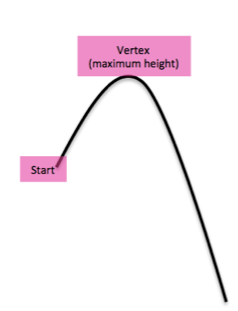
This describes U-shaped movement through the air - Marcus jumps up and outwards, and then falls downward. We can imagine it like this:

Graph that shows the general path of Marcus's jump

We need to find the vertex, or the maximum height that Marcus reached in the air. To do this, we're going to complete the square.

There are a bunch of great explanations of how and why we can use this approach to find the vertex of a parabola right.

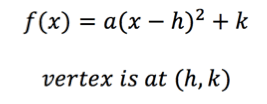
We need to first get our equation into vertex form. As a reminder, that looks like this:

f(x) = a(x-h)^2 + k
Vertex is at (h,k)
f(x)=−2x2+20x+151f(x)=−2(x2−10x)+151f(x)=−2(x2−10x)+(−2)(25)−(−2)(25)+151f(x)=−2(x2−10x+25)−(−2)(25)+151f(x)=−2(x2−10x+25)+50+151f(x)=−2(x−5)2+201\begin{align} f(x) &= -2x^2+20x+151\\ f(x) &= -2(x^2-10x) + 151\\ f(x) &= -2(x^2-10x) + (-2)(25) - (-2)(25) + 151\\ f(x) &= -2(x^2-10x+25) - (-2)(25) + 151\\ f(x) &= -2(x^2-10x+25) + 50 + 151\\ f(x) &= -2(x-5)^2+201 \end{align}

Again, if you need a refresher on other ways we can get from the top equation to the bottom one, check out this explanation.

Now that we've got the expression in vertex form, we can ask, what are the coordinates of the vertex?

Choose one answer

Video · + 1 min read

(Video) Optimization

by Math with Mr. Barnes

Math with Mr. Barnes shows a common quadratic function word problem: optimization of area problems. The hardest part of these problems is finding the quadratic function they are asking you to solve. The steps for doing this are as follows:

  1. Define your variables in the problem.

In the video, these are AA, the area, PP, the perimeter, ww, the width, and ll, the length.

  1. Write functions for area and perimeter.

With this step, it helps the most to use a diagram or picture. If the problem doesn't give you a picture, draw it yourself. You will be less likely to miss part of the problem. In the video we get the functions: A=l⋅wA=l\cdot wP=3w+l=96P=3w+l=96This means that both AA and PP are functions of ll and ww.

  1. Put the area function in terms of one variable.

Both area and perimeter use the same variables. We already know when PP is at its maximum, it is the amount of fencing that we have. The video shows how you can plug that in for PP and solve the equation for ll. Now it is easy to substitute ll into the function A=l⋅wA=l\cdot w to get our quadratic. A=(96−3w)⋅wA=(96-3w)\cdot wA=−3w2+96wA=-3w^2+96w

Now that we have the function in terms of one variable, the next step is to see what question we are trying to answer. Most of the time, with these optimization problems, we will be solving for the maximum area. This is a downward facing quadratic, so the vertex is at w=−b2aw=-\frac{b}{2a}. The video does a good job of plugging in the values to find ll and giving us an answer.

The steps we used here are good for area optimization, but will also work for most word problems if you need help deriving the quadratic function from the problem.

Interactive · 3 questions

The quality of Matha's cookies is usually a little bit suspect. If she puts in too much time, she overthinks it and tries to add too many "special" ingredients. Too little time, and she burns the cookies- like every time. Fariq, Martha's future husband and baking partner has been studying Martha's baking habits for 4 hours a day. He has actually created an equation that models how good Matha's cookies will be based on how much time she puts into it: y=−5x2+16x−83y = \frac{-5x^2 + 16x - 8}{3} Here, yy represents the quality of the cookies (measured in Fariq's own unit- Farz) and xx represents how many hours Martha has been baking for. Fariq, being a loving fiance and future husband decides it's worth risking his relationship to offer Martha (who does NOT take well to constructive criticism) some advice on how long she should spend baking.

How many minutes should Fariq tell Martha to bake for?

Hint: Watch those units!

Hint: Isolate the xx's, complete the square, then solve for yy!

Choose one answer

Type a concept, like “slope” or “photosynthesis”.

↑ ↓ to choose · Enter to openSearch explanations and problems