Video

(Video) Simplifying Radical Expressions

by mathman1024
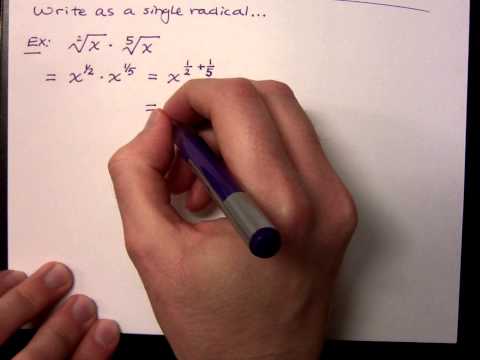
This video by mathman1024 works through converting fractional exponents into radicals.

Summary\large{\text{Summary}}

There are many rules about the combination or breakdown of exponents.

amn=an mam⋅an=am+naman=am−n(am)n=am⋅n\begin{align} &a^{\frac{m}{n}}=\sqrt[n]{a}^{\,m}\\ &a^m\cdot a^n=a^{m+n}\\ &\frac{a^m}{a^n}=a^{m-n}\\ &(a^m)^n=a^{m\cdot n} \end{align}

To review the laws of exponents, you can check out the lessons on: negative exponents, product rule, quotient rule, and power to a power.

The most relevant rule for this section is the first one with a fractional exponent. The denominator of the exponent is the degree of the radical. The numerator of the exponent is the power of the term inside of the radical.

We can combine this with the other rules to simplify radical and exponential expressions.

The first example is: x⋅x5\sqrt{x}\cdot\sqrt[5]{x}. x⋅x5=x12⋅x15=x12+15=x710=x10 7\begin{align} \sqrt{x}\cdot\sqrt[5]{x}&=x^{\frac12}\cdot x^{\frac15}\\ &=x^{\frac12+\frac15}\\ &=x^{\frac{7}{10}}\\ &=\sqrt[10]{x}^{\,7} \end{align}

The second example he does is: x34x23\dfrac{\sqrt[4]{x^3}}{\sqrt[3]{x^2}}.

x34x23=x34x23=x34−23=x112=x12\begin{align} \dfrac{\sqrt[4]{x^3}}{\sqrt[3]{x^2}}&=\frac{x^{\frac34}}{x^{\frac23}}\\ &=x^{\frac34-\frac23}\\ &=x^{\frac{1}{12}}\\ &=\sqrt[12]{x} \end{align}

These examples will be really helpful when solving word problems!

Find your level

The problems run from approachable to very hard, and each is rated by how often real students solve it, so you can pick your next step. These are real problems from the AMC 8, AMC 10, AMC 12 and AIME, the national math competitions for middle and high school students, each with a worked solution on LIVE by Po-Shen Loh.

Interactive · 2 questions

Fraction exponents are like an exponent and a radical

Fraction exponents tell you to take the power of a number, and then take a root. It's hard to explain in words, so here's a rule:

abc=abc=(ac)ba^{\frac{b}{c}} = \sqrt[c]{a^b} = (\sqrt[c]{a})^b

Basically, in a fraction exponent the numerator (top) is the power, and the denominator (bottom) is the root you need to take.

Rational Exponents: a^(b/c) = cth root of (a^b) = (cth root of a)^b. For example, 4^(3/2) = the square root of (4^3) = the square root of 64 = 8.

Image source: By Caroline Kulczycky

Let's look at a quick example using real numbers: 275327^{\frac53}

What's the power we're going to take the expression to?

Choose one answer

Interactive · 1 question

A rational exponent can always be turned into a radical. If bb to the nthn^{th} root of a number is real, and mm is a positive integer, then rational exponents and radicals are related like this: b1n=bn    and    bmn=bmn=(bn)mb^{\frac{1}{n}}=\sqrt[n]{b}\;\;\text{and}\;\;b^{\frac{m}{n}}=\sqrt[n]{b^m}=(\sqrt[n]{b})^m

The denominator of the fraction is the value of the root. For example, if the denominator is 33, you'll be taking the cube root. You may be dealing with positive or negative fractions, so be aware of that. Positive numbers are most common, as in the example above and below. Negative numbers means you'll need to follow the rules of exponent.

Let's try this with a number first.

What is 163216^{\frac32}?

Choose one answer

Type a concept, like “slope” or “photosynthesis”.

↑ ↓ to choose · Enter to openSearch explanations and problems


