Interactive · 3 questions
+3 contributors

So, what exactly is a "perfect square"?

A perfect square is the product of two identical terms multiplied together. Here are some examples:
Check off any perfect squares you see in the list below.
Notice how we said "two identical terms multiplied together" instead of "two identical numbers"? This is because terms with variables can also be considered perfect squares.
The same principle holds true: if it's two identical terms being multiplied together, the product is a perfect square.
So, these terms (highlighted in purple) can also be considered perfect squares:
What do perfect squares have to do with quadratic equations?
You can spot a perfect square by looking at the first and last terms, and , in a quadratic equation . If both of these terms are perfect squares, then we can sometimes use this information to quickly factor the left hand side our equation.
Consider the equation . Let's take a look at the left hand expression:
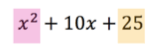
Both of these terms are perfect squares. In fact, the quadratic expression itself can be written as a perfect square: as two identical factors multiplied together. You can FOIL to check that .
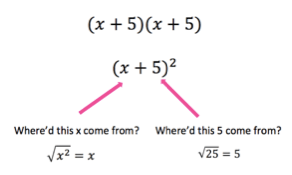
This tells us that the only zero, or solution, to , is .
Can we factor this quadratic expression using perfect squares?
(Remember to look at the first and last terms.)
Using the factorization from the previous question, find all solutions to the equation