একটি রেখার সাপেক্ষে প্রতিফলন কী?

Illustrated · 1 min

ট্রান্সফর্মেশন হল কোনো আকৃতিকে এমন ভাবে পরিবর্তণ করা যাতে তার পরিবর্তিত আকৃতির সাথে প্রকৃত আকৃতির সাথে কিছু বৈশিষ্টের মিল থাকে।

জ্যামিতির সকল ট্রান্সফর্মেশন কে কেবল ৪ টি ভাগে ভাগ করা যায়ঃ ট্রান্সলেশন, রোটেশন, রিফ্লেকশন এবং ডায়ালেশন বা হোমোথেটি। এই চারটি মৌলিক ট্রান্সফর্মেশন দিয়েই দুনিয়ার যাবতীয় সকল জ্যামিতিক পরিবর্তণকে সঙ্গায়িত করা যায়।

ট্রান্সলেশন

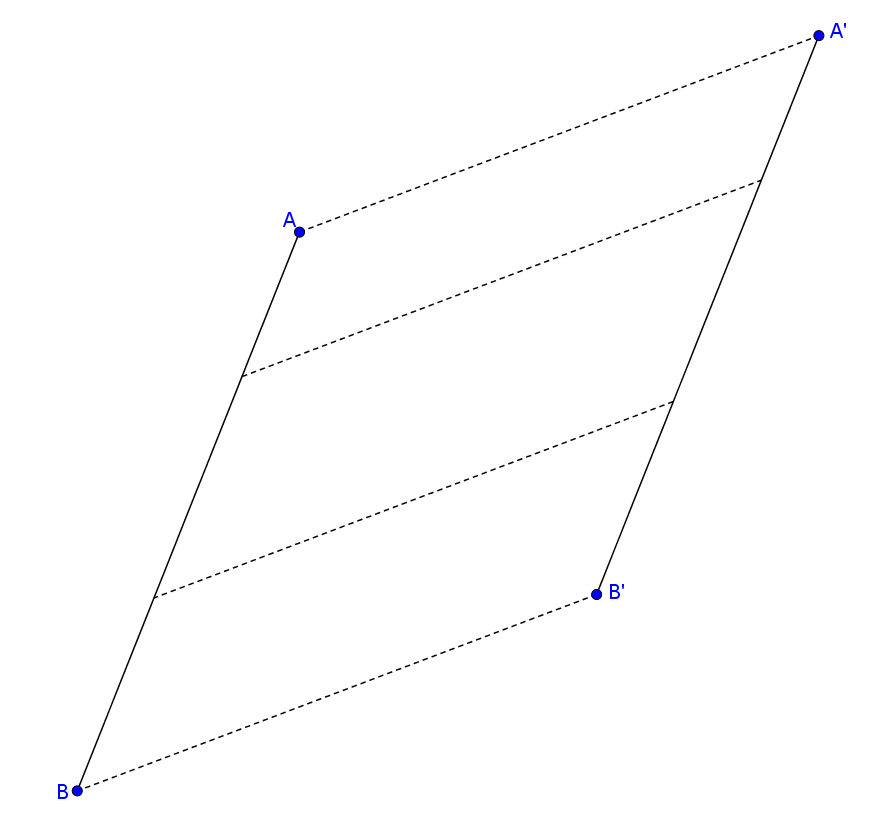
ট্রান্সলেশন এমন এক প্রকার ট্রান্সফর্মেশন যা কোনো আকৃতিকে ঠেলে সরিয়ে নতুন স্থানে নিয়ে যায়। এ পরিবর্তণের সময় ওই আকৃতির প্রতিটি বিন্দু সমান দূরত্ব অতিক্রম করে। যেমন নিচের চিত্রে ABAB রেখাংশকে ট্রান্সলেট করে A′B′A'B' রেখাংশ তে নিয়ে যাওয়া হয়েছে

ট্রান্সলেশন

রোটেশন

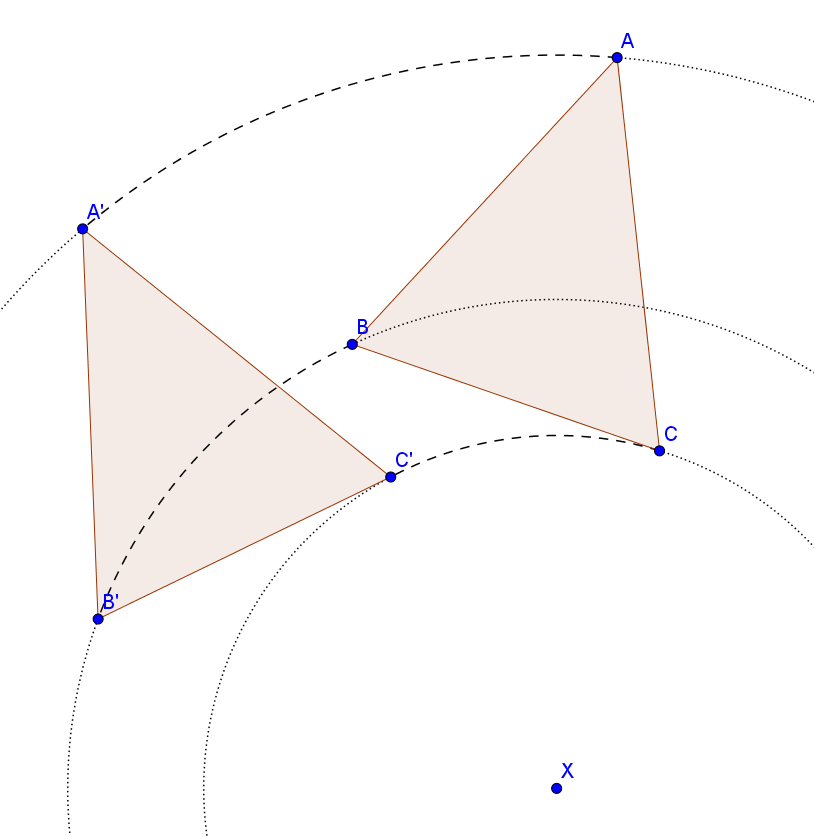
কোনো আকৃতিকে কোনো বিন্দু এর সাপেক্ষে বৃত্তাকার পথে ঘুরানোকে রোটেশন বলে। যেমন নিচের চিত্রে △ABC\triangle ABC কে XX বিন্দুর সাপেক্ষে রোটেট করে △A′B′C′\triangle A'B'C' এ নিয়ে যাওয়া হয়েছে।

রোটেশন

রিফ্লেকশন

রিফ্লেকশন ট্রান্সফর্মেশন কোনো বিন্দু, রেখা বা বৃত্তের সাপেক্ষে হয়ে থাকে।

    **রেখা** :

যে ধরণের রিফ্লেকশন এর সাথে আমরা সবচেয়ে বেশি পরিচিত, তা হল রেখার সাপেক্ষে। তার কারণ আমরা সবাই প্রতিদিন কমবেশি আয়নায় নিজেকে দেখি। আয়নায় আমরা যা প্রতিফলন দেখি সেই একি প্রতিফলন বা রেফ্লেকশন এর কথা আমরা বলছি। তার মানে রেখার সাপেক্ষে রিফ্লেকশন কোনো আকৃতির অবিকল একটি প্রতিরূপ তৈরি করে শুধু প্রতিরূপ রেখার যে পাশে মূল আকৃতি থাকে তার বিপরীত পাশে থাকে। নিচের চিত্রে এর উদাহরণ দেয়া হলঃ
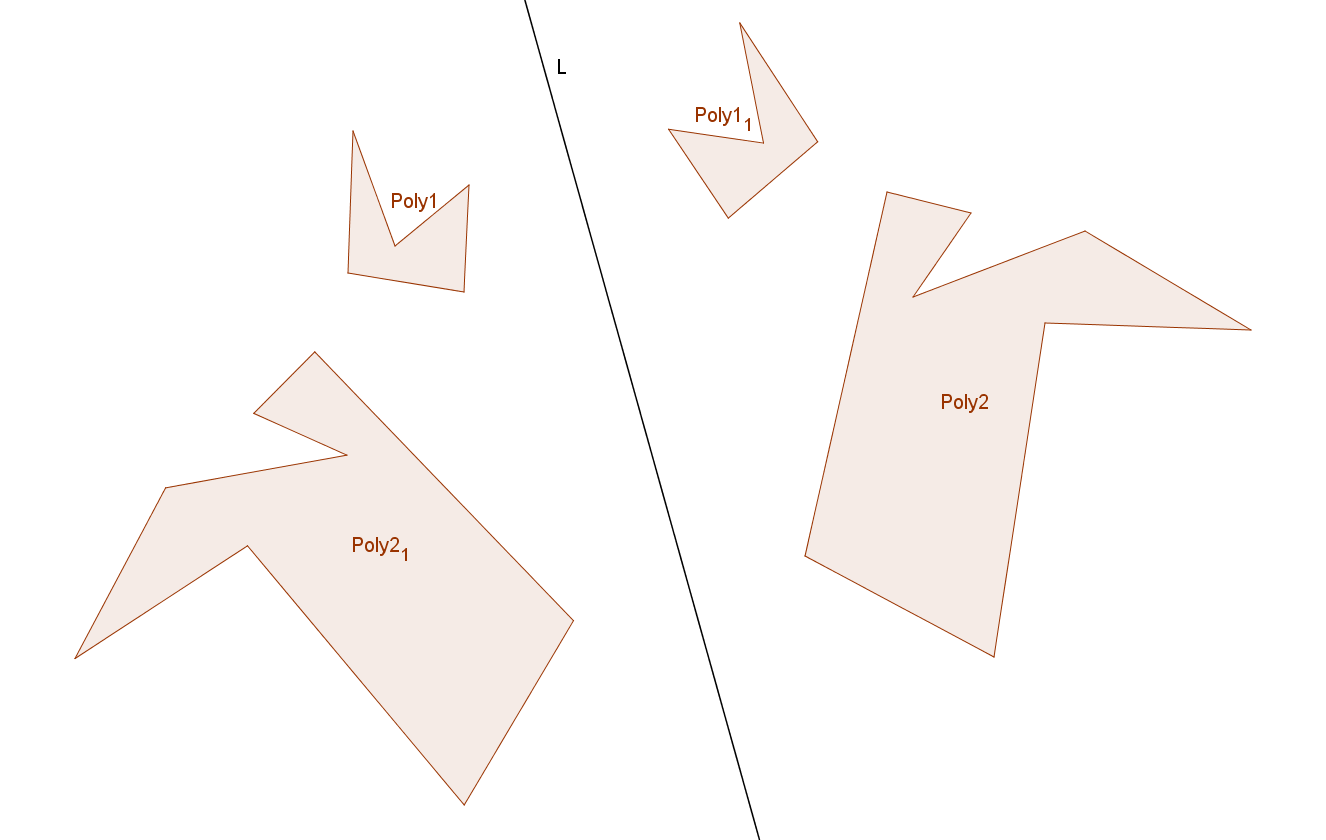
এখানে LL রেখার সাপেক্ষে Poly1,Poly2Poly1, Poly2 কে রিফ্লেক্ট করে Poly11,Poly21Poly1_1, Poly2_1 এ নিয়ে যাওয়া হয়েছে

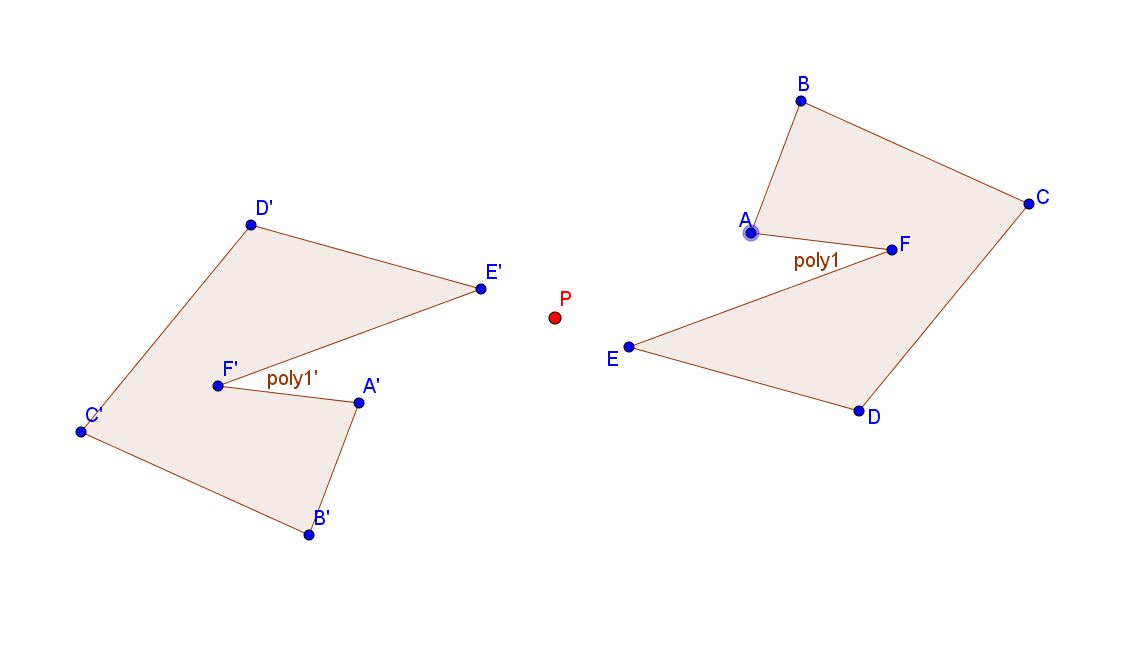
বিন্দু : বিন্দুর সাপেক্ষে রিফ্লেকশন ও রেখার সাপেক্ষে রিফ্লেকশন এর মত, কেবল এক্ষেত্রে প্রতিবিম্বের প্রতিটি বিন্দুর সাপেক্ষ বিন্দুর থেকে দুরত্ব প্রকৃত আকৃতির অনুরূপ বিন্দুর সাপেক্ষ বিন্দু থেকে দুরত্ব সমান। যেমন নিচের চিত্রে, ABCDEFABCDEF কে PP বিন্দুর সাপেক্ষে রিফ্লেক্ট করে A′B′C′D′E′F′A'B'C'D'E'F' তে নিয়ে যাওয়া হয়েছে।

এখানে PP বিন্দুর সাপেক্ষে poly1poly1 কে রিফ্লেক্ট করে poly1′poly1' এ নিয়ে যাওয়া হয়েছে

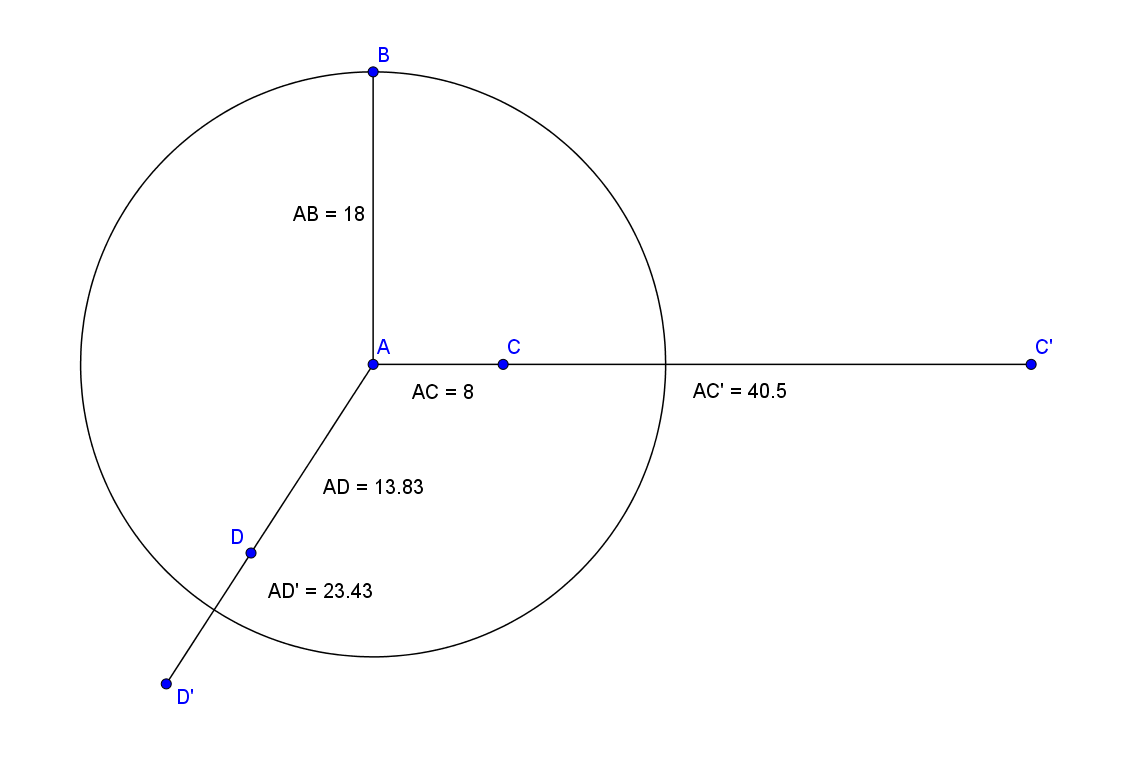
বৃত্ত : নিচের চিত্র দেখ, এখানে AA কেন্দ্র ও ABAB ব্যাসার্ধ বিশিষ্ট্য বৃত্তের সাপেক্ষে CC ও DD বিন্দুর রিফ্লেকশন হল C′C' ও D′D'।

ABAB; AC,AC′AC, AC', এবং AD,AD′AD, AD' এর মধ্যে কোনো সম্পর্ক দেখতে পাচ্ছ কী?

ঠিক, AB2=AC∗AC′=AD∗AD′AB^2 = AC*AC' = AD*AD'. তাহলে হয়ত অনুমান করতে পারছ, বৃত্তের সাপেক্ষে রিফ্লেকশন কি। বৃত্তের কেন্দ্র OO, ব্যাসার্ধ rr হলে এই বৃত্তের সাপেক্ষে XX বিন্দুর রিফ্লেকশন X′X' হবে যদি OX∗OX′=r2OX*OX' = r^2 হয়। এই ধরণের রিফ্লেকশনের অসাধারণ কিছু বৈশিষ্টের জন্য একে আদর করে বিশেষ নামে ডাকা হয়: Inversion.

এ ব্যাপারে আরো পড়তে পারবে এখান থেকে: 1 2

হোমোথেটি বা ডায়ালেশন

কোনো আকৃতিকে প্রথমে ট্রান্সলেট করে (অথবা না করে) তারপর বিবর্ধিত করাকে বলে হোমোথেটি। নিচের চিত্র দেখলে বিষয়টি বুঝতে পারবেঃ
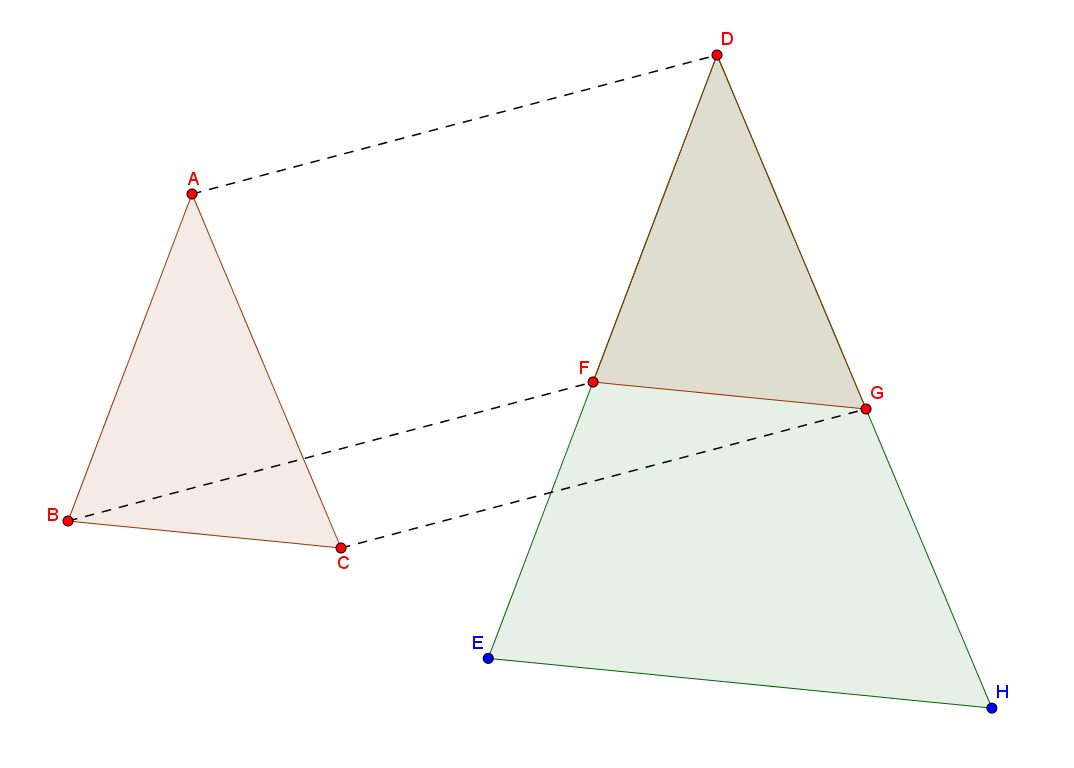
এখানে △ABC\triangle ABC কে প্রথমে ট্রান্সলেট করে △DFG\triangle DFG নেয়া হয়েছে, তারপর DD বিন্দুকে কেন্দ্র করে △DFG\triangle DFG কে বিবর্ধিত করে △DEH\triangle DEH তে নিয়ে যাওয়া হয়েছ। এখানে △ABC\triangle ABC থেকে △DFG\triangle DFG, △DFG\triangle DFG থেকে △DEH\triangle DEH, △ABC\triangle ABC থেকে △DEH\triangle DEH, প্রতিটি হোমোথেটি ট্রান্সফর্মেশন এর উদাহরণ।

Preparing for a math contest?

Working through past problems on one idea at a time is one of the most effective ways to prepare. These are real problems from the AMC 8, AMC 12 and AIME, the national math competitions for middle and high school students, each with a worked solution on LIVE by Po-Shen Loh.

Read · 1 min

A reflection is colloquially known as a flip because it does the same thing a mirror does −- flips an object over a line or point or plane into an image.

For example, if a point AA is reflected over a line ℓ\ell to a point A′A', we have that the distance between AA and ℓ\ell is the same as the distance between A′A' and ℓ\ell. The same holds for sets of points such as lines and planes.

Read · 1 min

Intuitively, we think that reflections are isometries. After all, when we look in the mirror, it seems as though the reflection is our size. So how do we prove this?

Suppose that the segment ABAB is reflected about a flat nn-dimensional (don't worry, the value of nn doesn't really matter) surface SS to the segment A′B′A'B'. We would like to prove that AB=A′B′AB=A'B', regardless of the surface.

Suppose that AA′AA' meets SS at XAX_A and that BB′BB' meets SS at XBX_B.

From the definition of reflection, we have the following statements: AXA=A′XAAX_A=A'X_A BXB=B′XBBX_B=B'X_B AA′⊥SAA'\perp S BB′⊥SBB'\perp S

Of course, XAXBX_AX_B is congruent to itself.

Now look at the quadrilaterals AXAXBBAX_AX_BB and A′XAXBB′A'X_AX_BB'.

Clearly, these two quadrilaterals are congruent, since the remaining parts of the quadrilateral may be completely determined from the existing information.

Thus, since ABAB and A′B′A'B' are corresponding segments in the two quadrilaterals, we have AB=A′B′AB=A'B'.

Thus, a reflection preserves distances, so it is an isometry.

Video

(Video) Reflection

by Planet Nutshell

Remember this?

Who is that girl I see \\ Staring straight back at me? \\ When will my reflection show \\ Who I am inside? \\

Yep, it's from the song Reflection, featured in the movie Mulan. The use of reflection here is much more poetic--Mulan sees herself in the reflection, yet she is not seeing herself.

Reflection works slightly differently in geometry. It can be thought of as "folding or "flipping" an object over the line of reflection." (source) \\

Here is a video that goes deeper into reflection.

The video explains reflection and some properties of reflection. Try this problem to test your understanding of reflection.

Imagine a triangle on a coordinate plane. Reflect the triangle according to the x-axis, reflect the triangle a second time according to the y-axis. Are the locations of the two reflected triangles the same?

Choose one answer

Video · + 1 min read

(Video) How Do I Reflect a Figure

by MashUp Math

Here is a video talking about the properties of reflections.

Here is a brief summary of the video:

A reflection is a mirror image. It is NOT a change in size or shape.\\ The line of reflection, or line of symmetry, can be any line you choose, but the x and y axis are some common lines of reflection.

Notation\\ requationr_{equation} is used to denote the line of symmetry. Replace "equation" with any line--y=x, y=0, x=1, etc.

The distance of a point to the line of symmetry is the same as the distance of its reflection to the line.

Watch the following clip to learn about reflection of a line segment and a figure.

The above clip shows some examples of reflecting line segments and geometric figures. Try doing them yourself to get better at it!

Try the problem below to test your understanding.

Points MM and NN are reflected according to the y-axis. Now we have two new points M′M' and N′N'. Is the distance between MM and NN the same as the distance between M′M' and N′N'?

Choose one answer

Type a concept, like “slope” or “photosynthesis”.

↑ ↓ to choose · Enter to openSearch explanations and problems