
Interactive · 7 questions
Consider 2 resistors in series, as shown in Figure 1. Imagine that there is a current flowing through the wire.
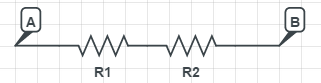
Figure 1: Admire this lovely circuit
Since there is only 1 wire, and no breaks in it, which of the following quantities must be the same at any point along the wire?
The current at any point along the wire must be the same. Thus, we can call it . Suppose the current is flowing to the right, i.e. from to . Let point be between the resistors and .
What is the potential difference between points and ?
Now, what is the potential difference between points and ?
So what is the potential difference between and ?
The potential difference between and is just . Now, if we were to take two more points, and make the potential difference , and run the same current between them, we would want a resistor with resistance between and . That way, .
The notion of putting one resistor in place of two or more resistors in series is called equivalent resistance. It helps a lot in problems where you have a ton of resistors and you have to figure out the potential difference between them. In this case, if you have resistors, through , connected in series, then the equivalent resistor that you can put in the place of all those resistors would just be one with resistance .
Let's do one quick example before we close:
Example: Suppose that, in Figure 1, and . The voltage difference between and is . What is the voltage difference across ?
What is the equivalent resistance of the resistors?
What is the current in the wire?
So, what is the voltage difference across ?
That's it!