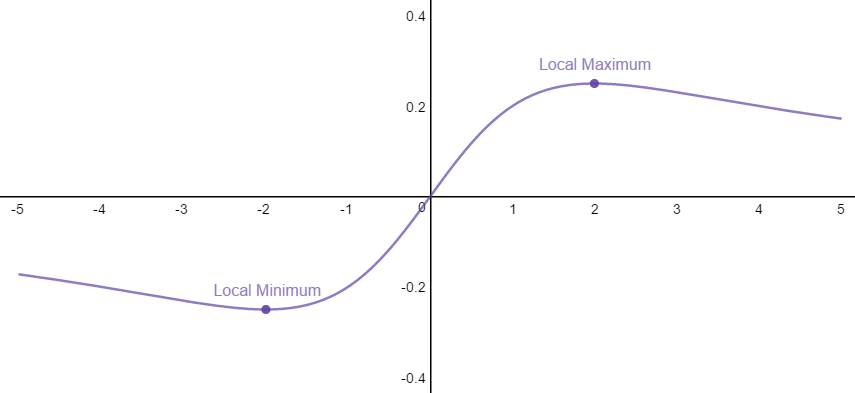
The critical points of a function are the points of the function where the derivative is equal to zero, or does not exist. The critical points are very useful if we want to graph a function by hand, and we don't have a calculator with us. Critical points are Local Maximum, Local minimum, absolute maximum, absolute minimum, and saddle point (for multi-variable functions). When we have a maximum or minimum, the tangent line is zero. (Remember the tangent line is the rate of change at a specific point.)
A local maximum is the highest point on a graph around that point, but not necessarily the highest point on the graph. A local minimum is the lowest point on a graph around that point, but not necessarily the lowest point on the graph. A local extrema is a local maximum or minimum. A saddle point is a point where it is a local maximum in one direction, but a local maximum in the other direction. To find the saddle points and local extrema, we must first take the second derivatives. A second derivative is the derivative of a derivative.
We then plug all of the second derivatives into a formula and then we can determine the local extrema and any saddle points.
The formula we use is D=fxxfyy+[fxy]2.
First, we must take the second derivatives fxx, fyy, fxy, and fyx. Note: fxy and fyx should always be the same.
In order to take the second derivative, we must first take the first derivatives:
If f(x,y)=3x4+4y2, then fx(x,y)=12x3 and fy(x,y)=8y.
Now that we have the two first derivatives, we can now take the four second derivatives:
fxx(x,y)=36x2
fyy(x,y)=8
fxy(x,y)=0
fyx(x,y)=0
Now, we plug these four into the formula: D=36x2(8)−0(0) which simplifies to D=288x2.
Next, we can find a point to plug into the equation and find out if the point is a critical point or not.
If we plug in the point (0,0), we get D=0, so it is a saddle point.
If we plug in a point and get a positive answer for D, then we look back at the second derivative with respect to x. If fxx(x,y) is positive, then the point is a local minimum. If fxx(x,y) is negative, then the point is a local maximum. If D is negative, we can't determine any critical points from this method.