ট্রান্সফর্মেশন : আইডেনটিটি ও কম্পোজিশন

Before this, knowঘূর্ণন

Interactive · 1 question

Recall that we learned about 3 kinds of transformation: Reflection, Rotation, translation. Take a minute to review them if you want.

Sometimes we apply more than one kind of transformation to a figure. Compare the following examples:

Imagine a skateboard sliding down the flat pavement, as shown in the doodle below. The skateboard didn't rotate or reflect, its location change is a result of translation. Only translation is involved in this transformation.
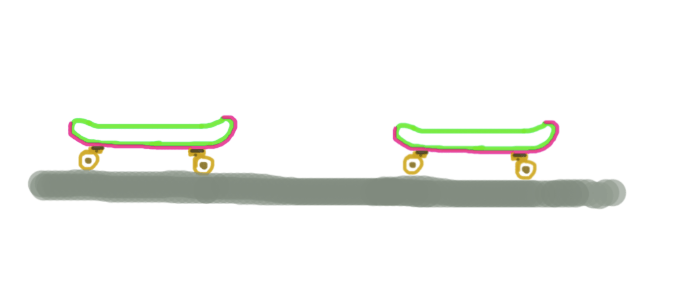
Consider the locations of the skateboard at two different times, one earlier and the other later.

Now, let's take a closer look at the wheels of the skateboard.
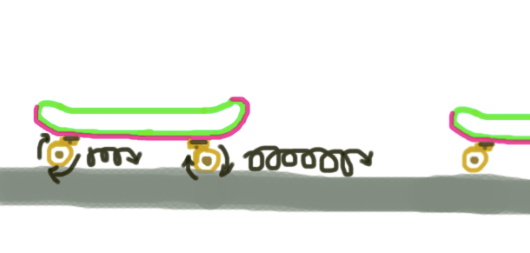
Notice that the wheels rotate in the process.

The movement of the wheels involve two transformation: translation and rotation. The wheels undergo a sequence of transformations.

Try the question below to test your understanding.

A triangle in the coordinate plane has gone through the following sequence of transformation: \\

  1. Rotate the triangle around its center by −90∘-90^{\circ} \\
  2. Reflect the triangle over the x-axis \\
  3. Translate the triangle 5 units to the right.

What qualities of the triangle are preserved after the sequence of transformations? Choose all the right answer(s).

Choose all correct answers

Put ideas together

Contest problems often need this idea together with one or two others. That is where understanding goes deeper than memory. These are real problems from the AMC 8, AMC 12 and AIME, the national math competitions for middle and high school students, each with a worked solution on LIVE by Po-Shen Loh.

Read · 1 min

The identity is the transformation that does nothing. It maps every element in the domain to itself. Unsurprisingly, it is often denoted I:x↦xI:x\mapsto x.

The composition of two transformations is the transformation equivalent to doing one transformation first, and then the other. Keep in mind that composition is generally order-sensitive.

For example, the composition f∘gf\circ g is the composition formed by applying gg first and then ff. Notice that the order is reversed. To remember this, one may remember f∘gf\circ g as f(g(x))f(g(x)) and notice that the name of the function applied first shows up farthest to the right.

The identity function is not so interesting by itself, but it has many important properties related to composition.

The identity function, unlike most functions, is not order sensitive: I∘f=f∘I=fI\circ f=f\circ I=f.

The inverse of a function, f−1f^{-1}, is the function gg such that I=g∘fI=g\circ f. The inverse function is also not order-sensitive, so f−1∘f=f∘f−1=If^{-1}\circ f=f\circ f^{-1}=I. Note that the domain of ff is the range of f−1f^{-1}, and that the range of ff is the domain of f−1f^{-1}.

Here are two other important properties of function composition, both of which are not difficult to prove: (f∘g)∘h=f∘(g∘h)(associativity)(f\circ g)\circ h=f\circ (g\circ h) (associativity) (f∘g)−1=g−1∘f−1(f\circ g)^{-1}=g^{-1}\circ f^{-1}

Type a concept, like “slope” or “photosynthesis”.

↑ ↓ to choose · Enter to openSearch explanations and problems