Read · 1 min
+6 contributors



Solving Inequalities: Multiplication by a Negative Number:
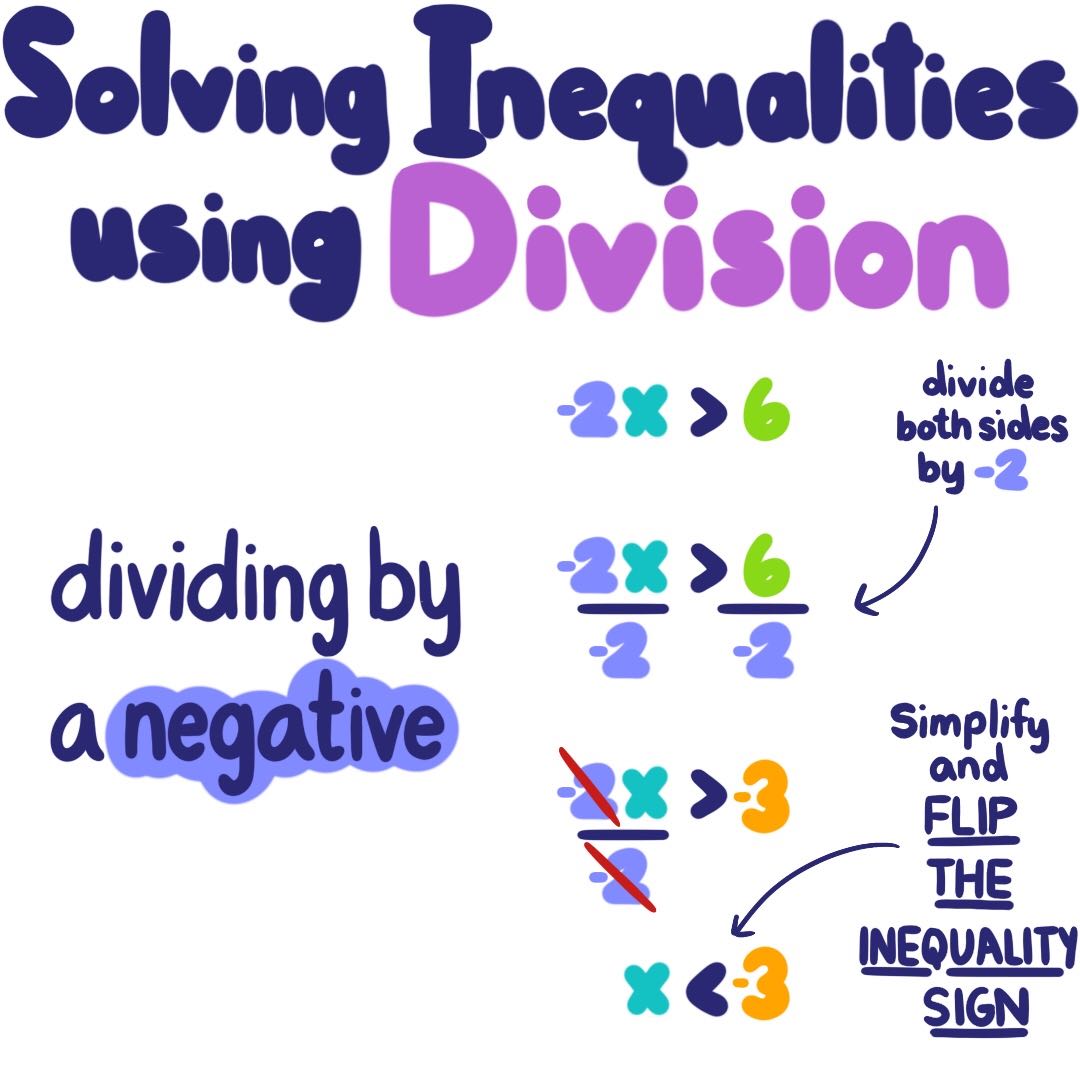
Sometimes, it is necessary to multiply an inequality by a negative number in order to solve the inequality. Compared to multiplying inequalities by positive numbers, there's one extra step. It's called flipping the inequality sign. Let's see what exactly this looks like.
Take the following example:
The is on the left-hand side. We'll try to move everything else to the other side.
We can use our inverse property of addition (subtracting from both sides). We can reduce this to:
We could add to both sides in order to solve this: $$\begin{align} -x &\leq -12\ -x + 12 &\leq - 12 + 12\
- x + 12 &\leq 0 \
\ -x + 12 &\leq 0\ -x + 12 + x &\leq 0 + x\ 12 &\leq x\
\ x &\geq 12 \end{align}$$
But there's a faster way. Much like with equations, we can just multiply both sides by .
In words, the variable is greater than or equal to .
Careful!
Notice how the sign of the inequality flipped when we multiplied by negative one. Much like when you divide by a negative number, the sign of the inequality must flip! Here's why:
Imagine comparing the numbers and . Clearly . But what about ? The result is ?!?! Obviously this is wrong! When you multiply both sides by a negative value you make the side that is greater have a "bigger" negative number, which actually means it is now less than the other side! This is why you must flip the sign whenever you multiply by a negative number.
You can also consider this with a number line. On a number line, is to the right of . However, is to the left of .
As an additional note—much like with division, do not multiply both sides of an inequality by a variable unless you know the sign of the variable!
Okay, now click over to the problems tab and give this technique a try!