দ্বিঘাত সমীকরণের সমাধান: গ্রাফ

Before this, knowIntro to Quadratic Functions

Illustrated · 1 min

Solving quadratics by graphing is a great complement other approaches, like factoring. You can use it to verify that your solutions are correct.

Regardless of the approach you take, "solving quadratic equations" means solving for possible values of xx.

Recall that the graph of a quadratic equation is a parabola (U shapes). The solutions to the equation (i.e., the possible values of xx) can be found by locating the xx-intercepts of the parabola. (Note that we are looking at xx-intercepts here, not yy-intercepts.)

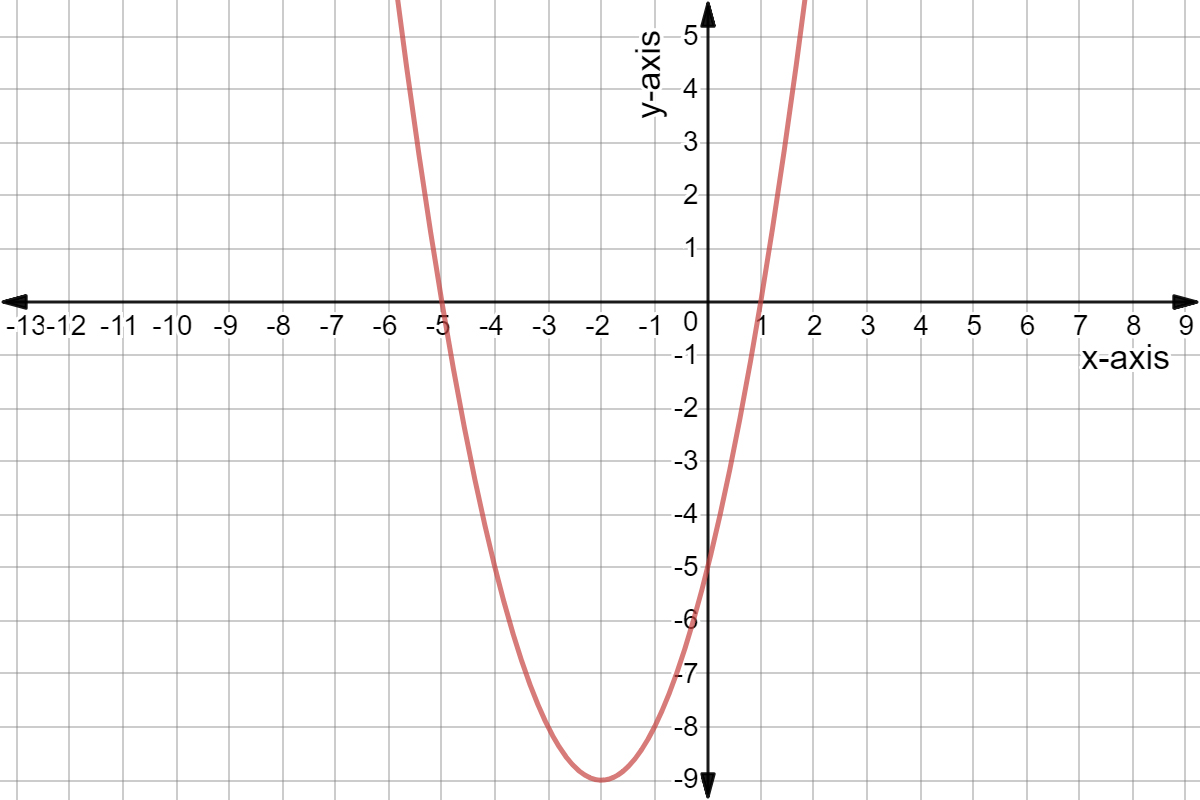
Let's take a look at y=x2+4x−5:y = x^2 + 4x - 5:

Quadratic graph of y = x^2 + 4x - 5.

Image source: Desmos

We need to locate the parabola's xx-intercepts. These are our solutions.

The xx-intercepts are located where the parabola crosses the xx-axis.

In our graph, the parabola crosses the xx-axis at x=−5x=-5 and x=1x=1.

So, the solution to the quadratic equation is: x=−5,1\boxed{x=-5, 1}

Illustrated · 1 min

Solving Quadratic Equations by Graphing

All quadratic equations have at most two solutions — these solutions can be real or imaginary. Some quadratic equations have two real solutions, some have two imaginary solutions, and some have one real solution, often called a double root or a repeated root. (It is never the case that a quadratic equation can have one real solution and one imaginary solution.)

There are multiple methods to find the solutions to a quadratic equation, including factoring, using the quadratic formula, completing the square, and graphing.

Solutions = xx-Intercepts

Say you have access to a graphing calculator, and you want to quickly find the solutions to a quadratic equation. Luckily, when you graph a quadratic equation, it's easy to see what its real solutions are! All you have to do is look at the xx-intercepts...those are the solutions! (A reminder: the xx-intercepts are the spots on the graph where the parabola intersects with the xx-axis.)

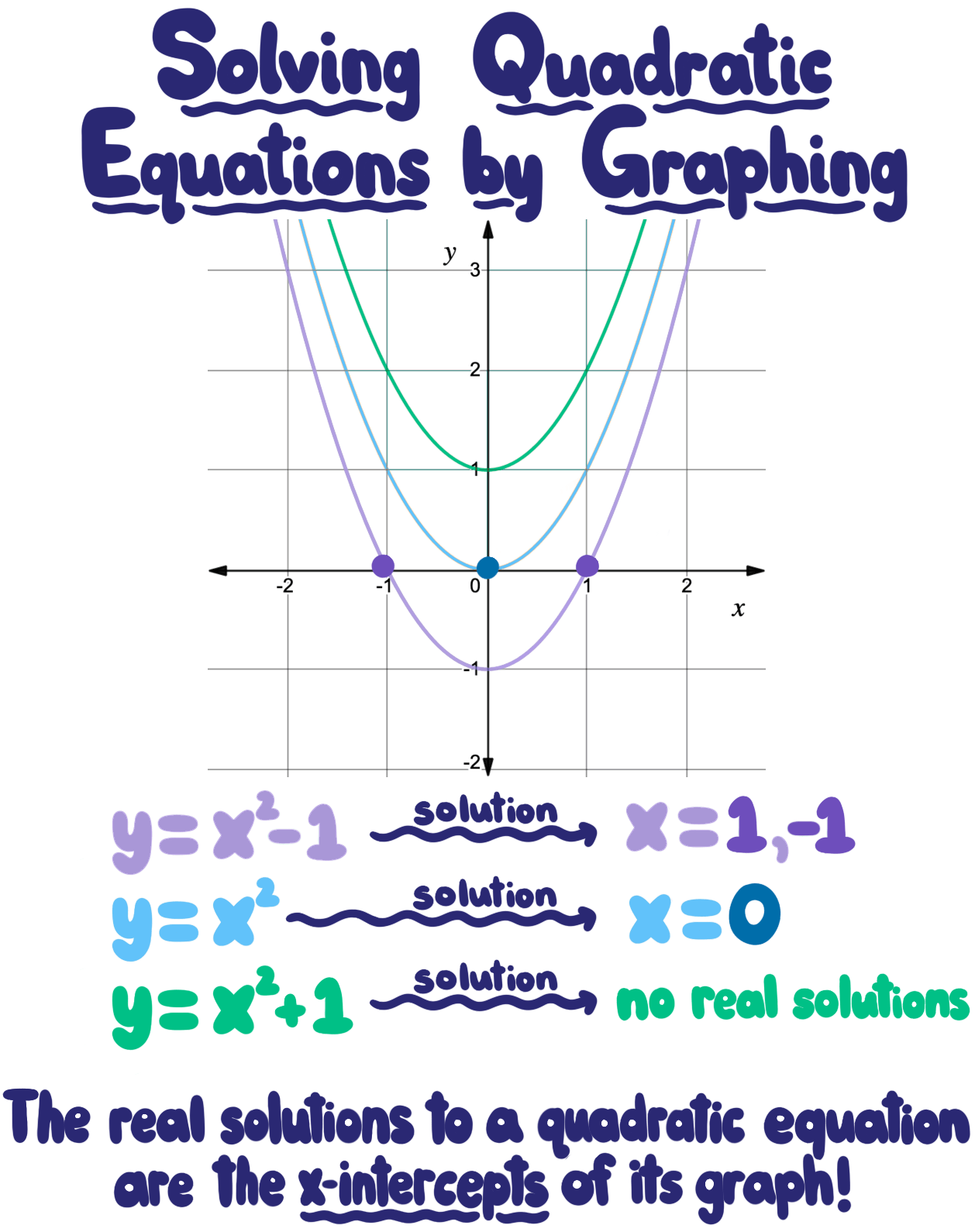
One xx-intercept means the quadratic equation has one real solution, and that solution is the value of that x-intercept.

Two xx-intercepts means that the quadratic equation has two real solutions, and those solutions are the values of those xx-intercepts.

No xx-intercepts means that the quadratic equation has no real solutions...it must have two imaginary solutions!

Solving Quadratic Equations by Graphing. The real solutions to a quadratic equation are the x-intercepts of its graph! For example, the solutions to y=x^2-1 are x=1 and x=-1, the solution to y=x^2 is x=0, and y=x^2+1 has no real solutions.

Image source: By Caroline Kulczycky

Example

Let's do an example! Say you are given the quadratic equation y=x2−x−6,y=x^2-x-6, and you want to know its solutions. It's a bit difficult to simply look at this equation and immediately see the solutions, so let's graph it!

Graph of x^2-x-6. The x-intercepts are -2 and 3.

Image source: Desmos

Here, we can see that there are two xx-intercepts: x=−2x=-2 and x=3.x=3. Those are the solutions to y=x2−x−6!y=x^2-x-6!

You can use the graphing technique to solve linear equations, cubic equations, and even systems of equations (like linear-quadratic systems)!


Video · + 2 min read

(Video) Solving Quadratic Equations by Graphing

by Textbook Tactics

This video by Textbook Tactics shows you how to solve a quadratic by graphing.

Summary

We normally see quadratics written as: y=ax2+bx+cy= ax^2 + bx + c When we want to solve them we set them equal to 00. ax2+bx+c=0ax^2+bx+c = 0 This means that the solutions to the quadratic are any point where: y=0y = 0

We can graph the parabola and find the the points where it crosses the xx-axis. These points are called the xx-intercepts, which you may remember from linear graphs.

Example

The first example problem is

y=x2−2x−3y= x^2-2x-3

We need to graph this equation, so lets start with finding the vertex. The xx coordinate is found with x=−b2ax= \frac{-b}{2a}. The xx-value also gives us our axis of symmetry. Let's plug in our values.

x=−b2ax=−(−2)2(1)x=22x=1\begin{align} x&= \frac{-b}{2a}\\ x&=\frac{-{\color{#8925AE}{(-2)}}}{2{\color{#8925AE}{(1)}}}\\ x&=\frac{2}{2}\\ x&=\boxed{1} \end{align}

The xx-coordinate of the vertex is 11. The axis of symmetry is x=1x=1. Let's plug 11 into the equation to find the yy-coordinate of the vertex.

y=x2−2x−3y=(1)2−2(1)−3y=1−2−3y=−4\begin{align} y&=x^2-2x-3\\ y&= {\color{#8925AE}{(1)}}^2-2{\color{#8925AE}{(1)}}-3\\ y&= 1 - 2 - 3\\ y&=\boxed{-4} \end{align}

The vertex is at (1,−4)(1,-4). Let's put these on the graph.

(1,-4) on a graph with x=1 as the axis of symmetry.

Image source: Desmos

We need to find another point to graph this. Let's find the yy-intercept by setting x=0x=0.

y=x2−2x−3y=(0)2−2(0)−3y=−3\begin{align} y&= x^2-2x-3\\ y&=({\color{#8925AE}{0}})^2-2({\color{#8925AE}{0}})-3\\ y&=-3 \end{align}

The yy-intercept is (0,−3)(0,-3). This is one unit to the left of the vertex, so we know that the point one unit to the right of the vertex also has a yy-value of −3-3. That point will be (2,−3)(2,-3). Let's plot these.

The points (0,-3), (1,4), and $(2,-3)$.

Image source: Desmos

We can keep extending the plot of this graph by plugging in more xx-values. Let's plug in x=3x=3 and x=−1x=-1, since they are 22 unites to the right and left of the vertex, respectively.

y=x2−2x−3y=(3)2−2(3)−3y=9−6−3y=0y=x2−2x−3y=(−1)2−2(−1)−3y=1+2−3y=0\begin{align}y&=x^2-2x-3\\ y&=({\color{#8925AE}{3}})^2-2({\color{#8925AE}{3}})-3\\ y&= 9 -6 -3\\ y&=0\\ \\ y&=x^2-2x-3\\ y&=({\color{#8925AE}{-1}})^2-2({\color{#8925AE}{-1}})-3\\ y&= 1 +2 -3\\ y&=0\\ \end{align}

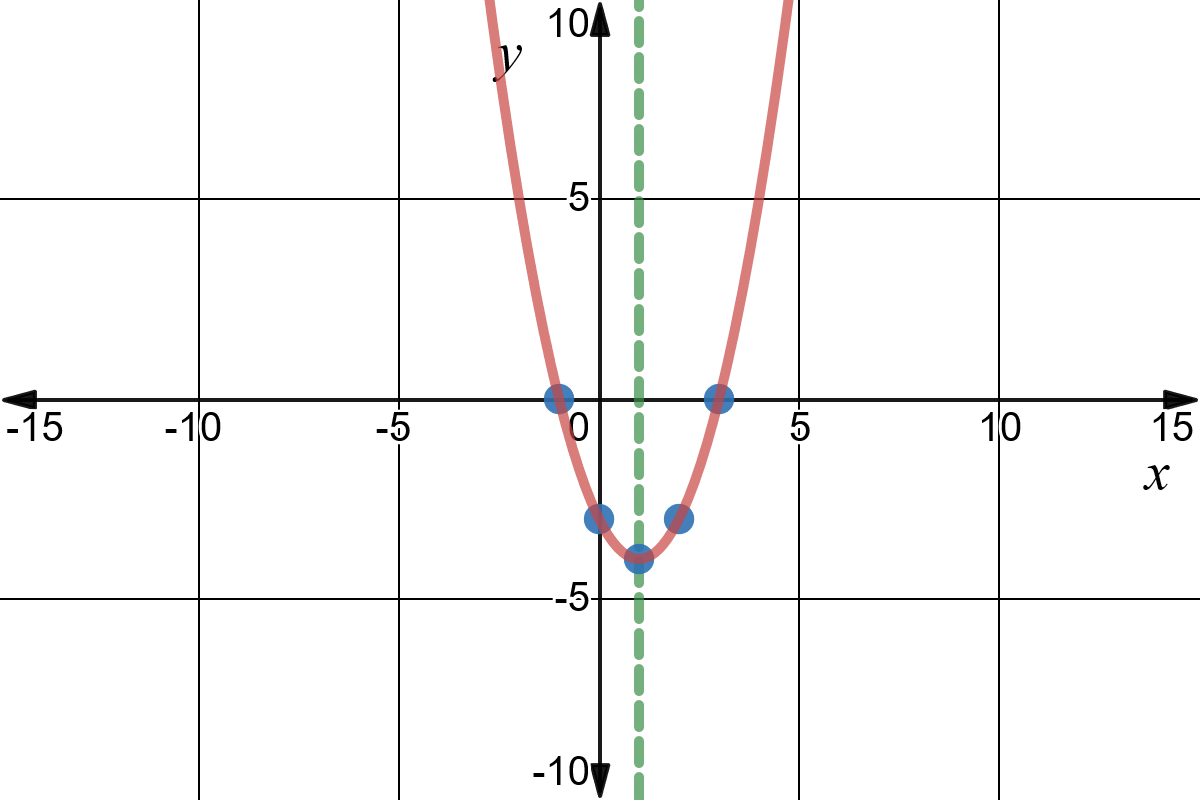
We can add the points (3,0)(3,0) and (−1,0)(-1,0) to our graph, along with the parabola that goes through all of these points.

The parabola crosses the x-axis at x=3 and x=-1.

Image source: Desmos

The last two points are where the parabola crosses the xx-axis. That means the solutions to y=x2−3x−3y=x^2-3x-3 are −1-1 and 33.

Remember, not all quadratics have 22 solutions. A quadratic with 11 solution will touch the xx-axis in exactly one point. A quadratic with no real solutions will never cross the xx-axis. The video linked above has more examples including quadratics with 11 and no solutions.

Type a concept, like “slope” or “photosynthesis”.

↑ ↓ to choose · Enter to openSearch explanations and problems