Interactive · 1 question
+1 contributors

Quite simply, the surface of a pyramid or a cone is the area of its base plus its lateral surface area.
For a general cone, there is no way to simplify, and this article would end right about now.
However, when people say "pyramid" or "cone" in standard usage, there are a couple of implicit restrictions that will allow us to have better formulas, and these cases are the subject of this discussion.
What do you think may be the most useful piece of information for a cone or pyramid?
If the slant height is uniform, we have an extremely powerful tool to calculate the surface area of a pyramid or cone.
Let us take the first case: a right circular cone. Suppose that the radius is and that the height is .
Call this slant height . However, using the Pythagorean theorem, it is easy to see that , and that this is true regardless of which slant you take. Thus, the slant height is uniform.
However, this is important to note: since the slant height is uniform, every point on the edge of the base is equidistant from the apex. Thus, unraveling the lateral surface gives us a sector of a circle, with radius and arc length , which is the circumference of the base.
Thus, we may calculate the lateral surface area:
The base is just a circle, so the base area is simply . Thus, the total surface area is as follows:
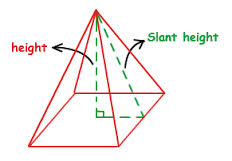
Now, let us take a pyramid with uniform slant height. Now, the slant will obviously not be the same everywhere. What we mean by slant height instead is the perpendicular distance from the apex to each edge of the base.
For the slant height to be uniform, the base must be a regular polygon, and the pyramid must be right.
Let be the number of edges of the base, be the slant height, and be the side length of each side of the base.
Now, the base area is the area of an -gon with side length , which is as follows: Now, for the lateral surface area, notice that it is composed of congruent triangles.
Each triangle has base and height . Thus, the lateral surface area is: Note that this equals one half the product of the slant height and the perimeter. This actually also applies to the case of the right circular cone, since the perimeter of the base is .
By the way, if is the apothem of the polygonal base and is the height of the pyramid, then .
Thus, we have the total surface area:
A similar idea may be employed even if the polygon is not regular; perhaps in a simple quadrilateral, such as a rectangle, or a triangle, or maybe even a hexagon. But beyond a few very simple cases, the surface area becomes outrageous, and one must abandon all attempts at a general formula.