গনিত থেকে কথা

Before this, knowকথা থেকে গনিত: বিয়োগকথা থেকে গনিত: ভাগ

Interactive · 4 questions

Translating Math into Words

We spend a lot of time talking about how to solve word problems by translating the words into mathematical expressions: addition, subtraction, multiplication, or division.

The useful thing about translation is that it can go both ways. Just like we can translate words into mathematical expressions, we can translate mathematical expressions back into words.

That's what we'll focus on here—going from math to words.

Translate

Image source: By Gerd Altmann CC0 via pixabay.com

One of the most helpful things to start with is the translation of the operation in a mathematical expression.

Here are some possible translations:

Operation // Translation

+ // Sum of _ and _, total of _ and _, more than, plus, increased by

- // minus, _ decreased by _, fewer, less, difference between

* // multiply _ by _, _ times _, percent of, product of _ by _

/ // divide _ by _, quotient of, per, _ divided by _
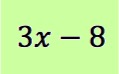
3x-8

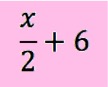
Which of the following accurately translates the expression above?

Choose one answer

Read · 1 min

Sometimes, math problems can be pretty scary to look at. There might be numbers and symbols and parentheses everywhere which make equations/expressions practically unreadable.

One useful trick to try and understand math equations is to try to convert them to words. We can even do this for algebraic expressions.

Let's try a small example to start: 7y+97y+9

We can say this in a few different ways:

  1. 99 more than 7y7y
  2. 7y7y more than 99
  3. The sum of 7y7y and 99

All these statements are saying the same thing, so feel free to figure out what way makes the most sense to you!

Now, let's see if we can try something a little more complicated like follows: 3y−8=2⋅(y−2)3y-8 = 2 \cdot (y-2)

For something like this, it might be better to almost think of a small story. We want the variable to represent an object. We might say something like "I started with yy dogs and 22 were taken away, then the number of dogs I had was doubled! After that, it was the same amount of dogs as if I had first tripled the number of dogs I had then taken 88 away."

In this type of situation, the algebraic equations are represented in stories.

For this specific problem, we want to figure out how many dogs I originally had. I'll leave it to you to solve the equation and answer the question we started with. Here's a hint, though: use the distributive property on the right-hand side.

Try to get creative with the ways you convert equations to words and see what phrases you're most comfortable interpreting math as. Then read the problem once more for good measure. This will help ensure you don't miss any important details. Good luck!

Video · + 1 min read

(Video) Translating Math to Word Statements

by MuchoMath

Here's a video by MuchoMath that teaches you how to turns mathematical equations into words.

Summary:\large{\text{Summary:}}

The first example he looks at is: 3+83+8

When translating math into words, we want to look at the operation being used. Here, it's addition. One way to write addition is "the sum of". The sum of \text{The sum of } Next, we write the numbers being used in the expression. These will be 33 and 88. The sum of three and eight.\text{The sum of three and eight.}

Let's look at an equation now. −2+8=6-2+8=6 Again, our operation is addition. The sum of\text{The sum of} Our numbers next to the operation are −2-2 and 88. The sum of negative two and eight\text{The sum of negative two and eight} We can use the word "is" to refer to an equal sign. The sum of negative two and eight is\text{The sum of negative two and eight is} Finally, our last number is 66. The sum of negative two and eight is six.\text{The sum of negative two and eight is six.}

Type a concept, like “slope” or “photosynthesis”.

↑ ↓ to choose · Enter to openSearch explanations and problems